When retailers, IP owners, and B2B buyers develop custom merchandise, an eye-catching visual design drives the initial sale. However, product durability is what protects your brand reputation, prevents costly return rates, and secures recurring wholesale reorders.
A product prototype can look immaculate on a showroom table but fail under real-world conditions:
-
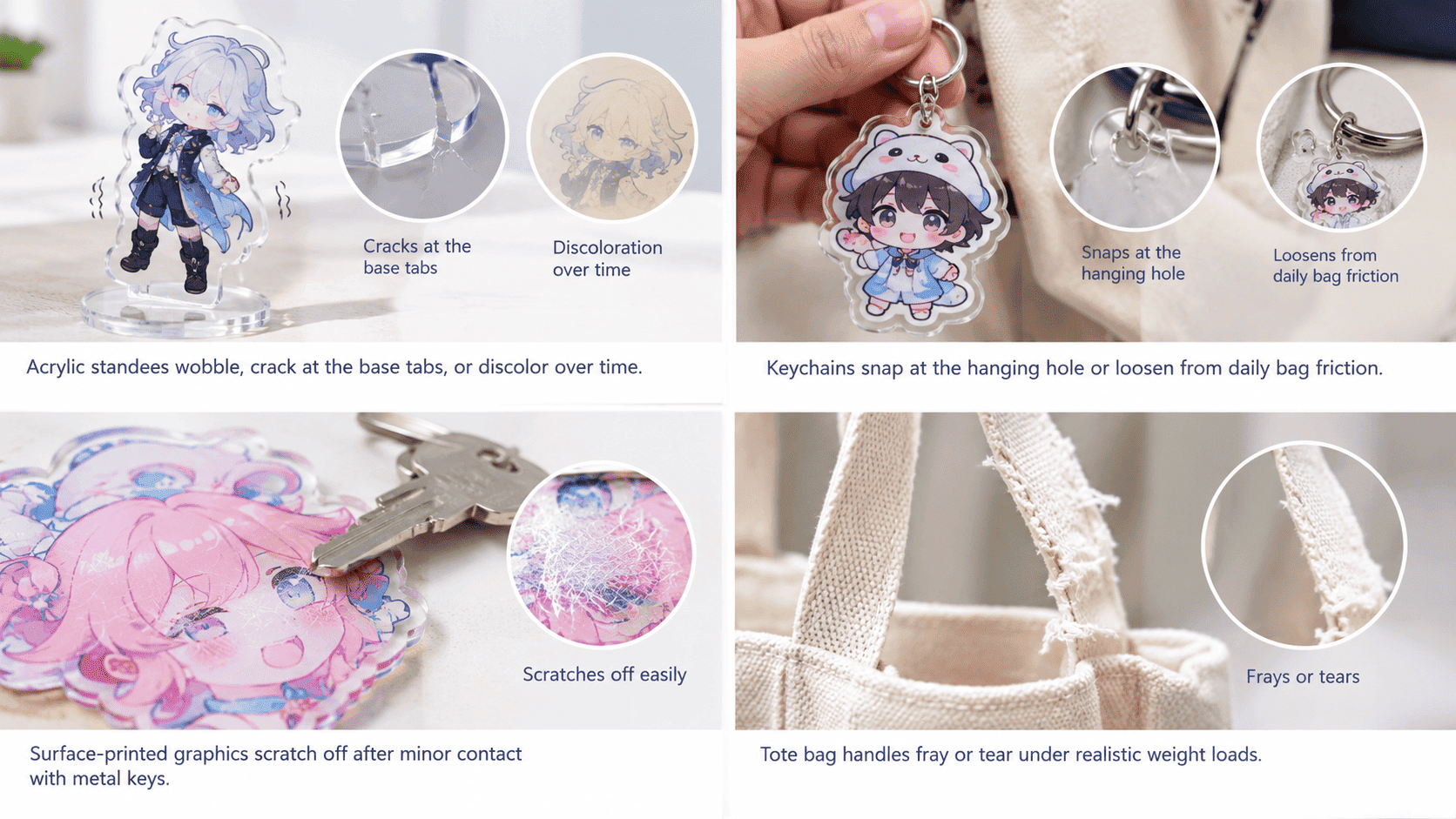
Acrylic standees wobble, crack at the base tabs, or discolor over time.
-
Keychains snap at the hanging hole or loosen from daily bag friction.
-
Surface-printed graphics scratch off after minor contact with metal keys.
-
Tote bag handles fray or tear under realistic weight loads.
In bulk manufacturing, these issues rarely stem from “bad luck”—they are directly tied to decisions made during the design and engineering phase. Material grades, structural geometry, printing layer architecture, assembly tolerances, and export packaging all dictate how long a product lasts.
If you are planning a bulk production run, durability must be engineered before you sign off on mass production. This guide breaks down actionable design strategies to help you collaborate effectively with your custom merchandise manufacturer and eliminate preventable failure points.
1. Start With the Real-World Use Case
Before selecting raw materials or setting production specs, clearly outline how your end consumers will handle the merchandise. A premium desk collectible requires different engineering tolerances compared to an everyday accessory subjected to continuous friction and movement.
Ask these key questions before approving dielines:
-
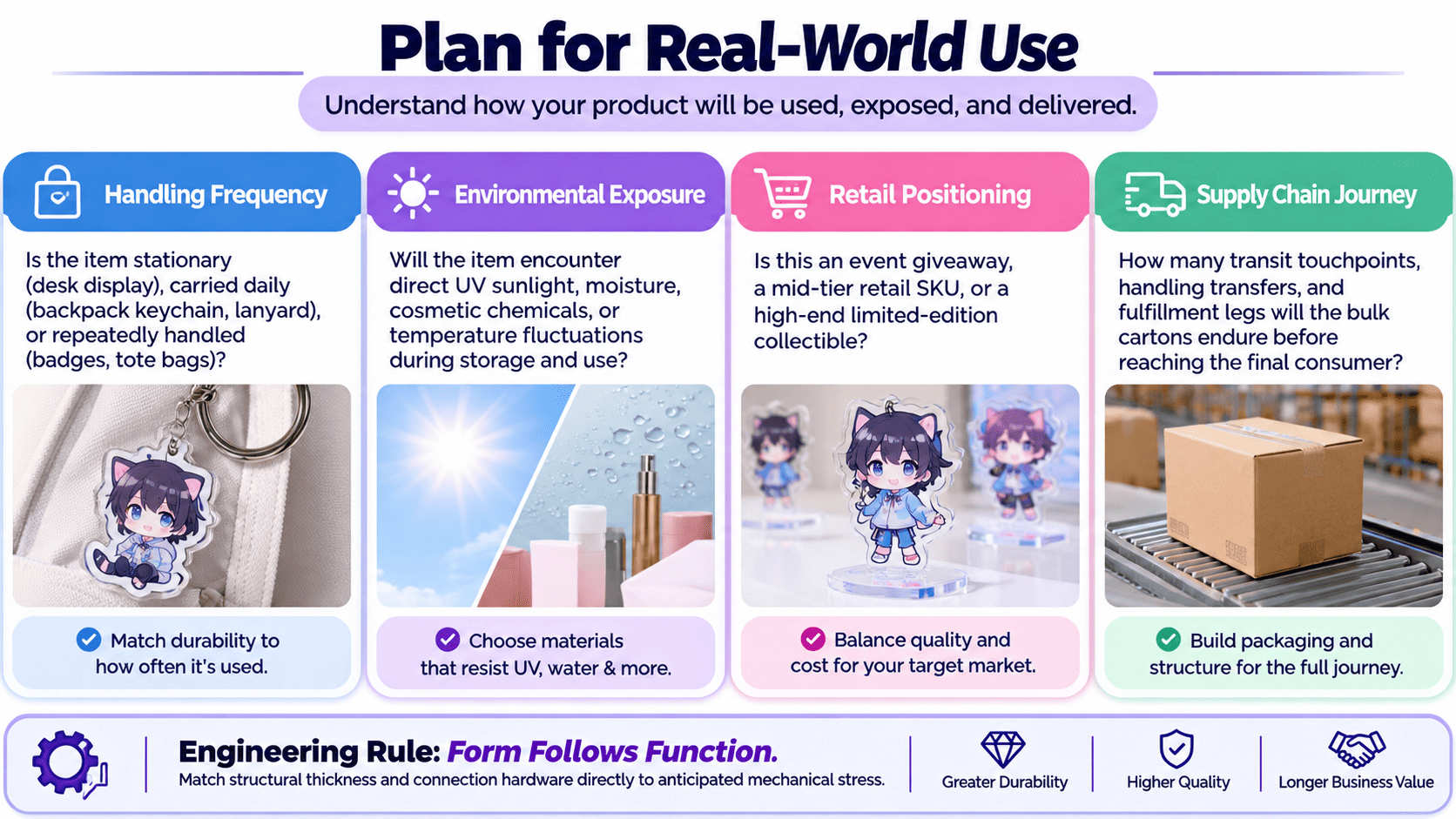
Handling Frequency: Is the item stationary (desk display), carried daily (backpack keychain, lanyard), or repeatedly handled (badges, tote bags)?
-
Environmental Exposure: Will the item encounter direct UV sunlight, moisture, cosmetic chemicals, or temperature fluctuations during storage and use?
-
Retail Positioning: Is this an event giveaway, a mid-tier retail SKU, or a high-end limited-edition collectible?
-
Supply Chain Journey: How many transit touchpoints, handling transfers, and fulfillment legs will the bulk cartons endure before reaching the final consumer?
Engineering Rule: Form follows function. Do not specify material dimensions based on aesthetics alone. Match structural thickness and connection hardware directly to anticipated mechanical stress.
2. Choose Materials That Match Product Stress Profiles
Material quality is the foundation of durable custom merchandise. Rather than blindly requesting the thickest material available—which often adds unnecessary shipping weight without resolving structural weak points—select raw material grades tailored to the item’s stress profile.
Acrylic Merchandise
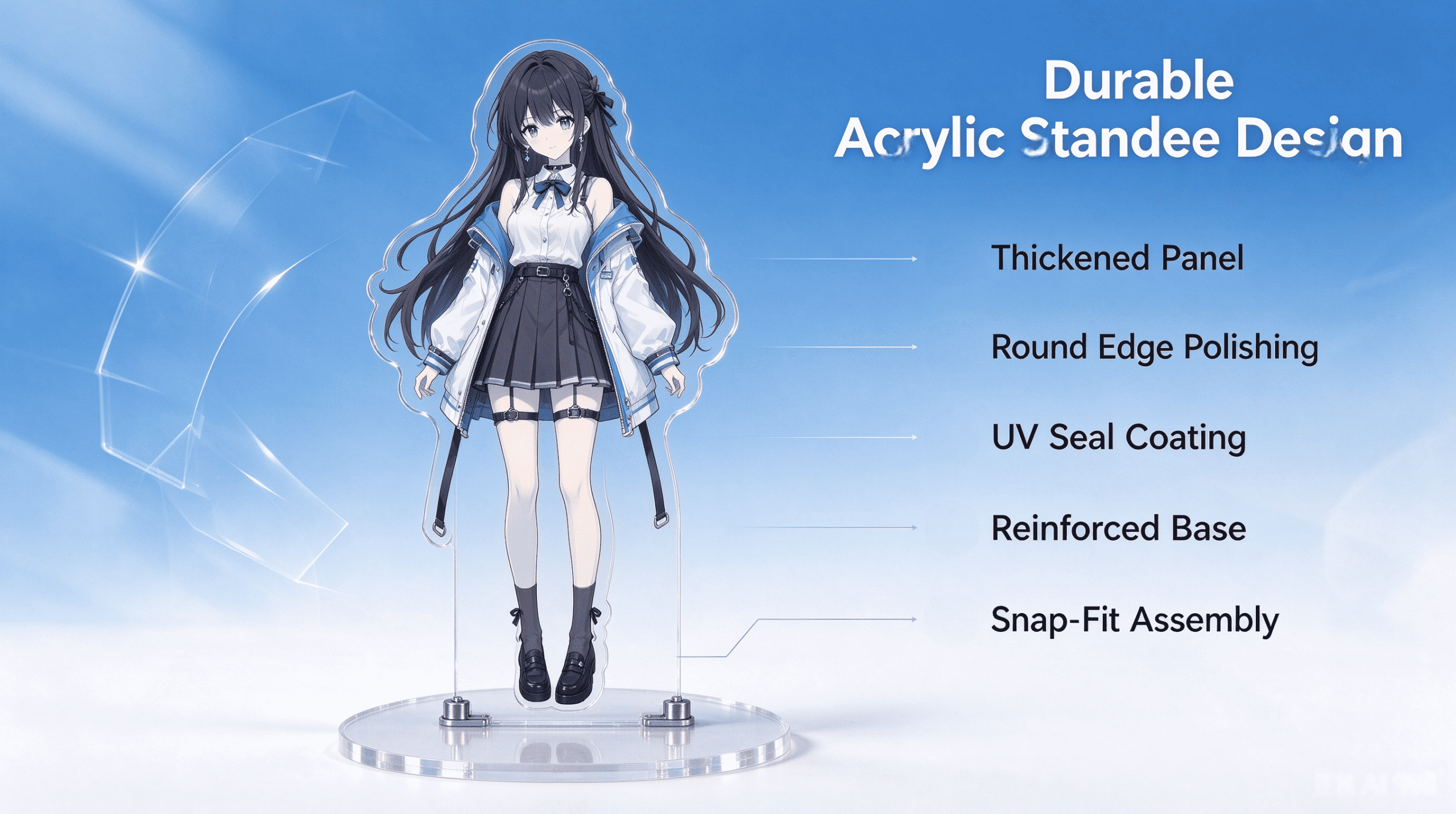
For acrylic standees and charms, virgin optical-grade cast acrylic (100% MMA) is essential. Lower-grade extruded or recycled acrylics tend to yellow under sunlight, release harsh chemical odors, and develop brittle internal stress that fractures easily.
-
To see how raw material choices impact your final unit economics, read our guide on What Affects the Price of Custom Acrylic Standees?
Fabric Merchandise (Tote Bags, Ita Bags & Pouches)
Fabric longevity depends on fabric weight (e.g., 10oz–16oz canvas), reinforced cross-stitching at strap anchor points, and seam binding. A heavy canvas shell offers little value if the handle webbing tears along single-stitched seams.
Metal & Enamel Pins, Badges, and Hard Enamel Accessories
For pins and badges, durability lies in the metal base (zinc alloy vs. stamped iron), electroplating adhesion, and the fastening mechanism. Spun or welded butterfly/rubber clutches must hold firmly under lateral force to prevent loss.
Pro Tip for Sourcing: Request material specification data sheets from your wholesale merchandise supplier during sampling to verify virgin material grades before approving mass production.
<!-- IMAGE 1 PLACEHOLDER -->
-
Recommended Placement: Between Section 2 and Section 3
-
Visual Concept: Close-up technical shot comparing acrylic standee base tabs, thickness gauge, smooth diamond-polished edges, and interlocking base slots.
-
Image Alt Text:
Durable custom acrylic standee material and structural design
3. Design Strong Structures and Mitigate Stress Concentrations
Even premium materials fail if structural design concentrates mechanical stress onto fragile points.
Pay close attention to these common structural vulnerabilities:
-
Sharp Internal Notches: Inside corners with sharp 90-degree angles create high stress concentrations. Adding a subtle radius (fillet) to interior cuts disperses mechanical impact significantly.
-
Hole-to-Edge Margins on Keychains: A common design mistake on custom acrylic keychains is placing the attachment hole too close to the outer perimeter. Maintain a solid margin (at least 2.5mm–3.5mm of acrylic wall thickness) to prevent the ring from shearing through the edge.
-
Tab & Slot Assembly Tolerances: An acrylic standee tab must fit into the base slot securely without requiring excessive force. A slot that is too loose causes the figure to lean; a slot that is too tight induces micro-cracks along the acrylic edges during assembly.
-
For step-by-step guidance on setting dieline tolerances, check out Custom Acrylic Standee Manufacturing: From Artwork to Bulk Order.
-
4. Optimize Printing Processes and Protective Layers
Surface durability is just as critical as structural integrity. Graphics that peel, chip, or scratch degrade perceived product quality rapidly.
+-------------------------------------------------------------+
|               Top Acrylic Panel (Clear Protective)          |
+-------------------------------------------------------------+
|    Print Layer 1 (Front Artwork)                            |
|    Print Layer 2 (Opaque White Ink Backing)                 |
|    Print Layer 3 (Reverse Artwork / Backside)               |
+-------------------------------------------------------------+
|               Bottom Acrylic Panel (Laminated Seal)         |
+-------------------------------------------------------------+
* Figure: Double-Sided "Sandwich" Lamination Architecture protecting printed layers.
When specifying printing for custom merchandise:
-
Double-Sided Sandwich Lamination: Instead of single-layer printing with the ink exposed directly on the back surface, opt for sandwich lamination (printing encapsulated between two bonded acrylic sheets). This prevents graphics from scratching against metal keys or rough surfaces.
-
White Ink Density: High-opacity white ink backing ensures colors remain vibrant under varying lighting while reinforcing layer adhesion.
-
Learn more about this technique in our article: Why White Ink Matters for Custom Acrylic Standees.
-
-
Edge Finishing: Micro-fractures from unpolished laser cuts can propagate over time. Diamond edge polishing removes cut ridges, yielding crystal-clear aesthetics and superior impact resistance.
5. Engineer Reliable Assembly and Hardware Connections
Multi-part products—such as multi-tiered standees, charm clusters, and lanyards—often fail where individual components connect.
Audit your hardware and assembly connections:
-
Jump Rings & Clasps: Opt for heavy-duty split rings or reinforced lobster clasps over weak, thin C-rings that easily pull open under moderate tension.
-
Swivel Mechanisms: Ensure keychains and lanyard hooks rotate freely 360 degrees to prevent torque buildup that can twist and snap attachment tabs.
-
Self-Assembly Tolerances: If the end consumer must assemble the product, keep the assembly intuitive and test friction fits across multiple environmental humidity levels.
6. Prototype Rigorously Before Approving Bulk Production
Never transition directly from a 2D PDF mockup to bulk manufacturing. A physical golden sample allows you to evaluate mechanical properties under simulated daily use.
| Product Category | Core Vulnerability | Actionable Durability Check |
| Acrylic Standees | Tab snapping / Wobbling | 10x insertion/removal test, tilt stability check, drop check from 1m onto hard surface |
| Acrylic Keychains | Hole fracture / Scratching | Ring tensile pull test (5–10kg), simulated coin/key abrasion scratch test |
| Enamel Badges | Pin separation | Solder bond shear test, 50x clasp engagement/release cycle |
| Fabric Bags & Lanyards | Seam blowouts | Seam elongation pull test, handle load test at 1.5x intended weight rating |
-
For a complete pre-production inspection checklist, see our guide on Custom Acrylic Standee Quality Control: What B2B Buyers Should Check.
-
Before submitting your dielines, review How to Prepare Artwork for Custom Acrylic Standees.
<!-- IMAGE 2 PLACEHOLDER -->
-
Recommended Placement: Directly below Section 6 table
-
Visual Concept: Professional factory quality control setup showing dimensional calipers checking acrylic tab tolerances alongside surface scratch testing.
-
Image Alt Text:
Quality control inspection for custom acrylic merchandise
7. Protect the Product Through Transit-Ready Packaging
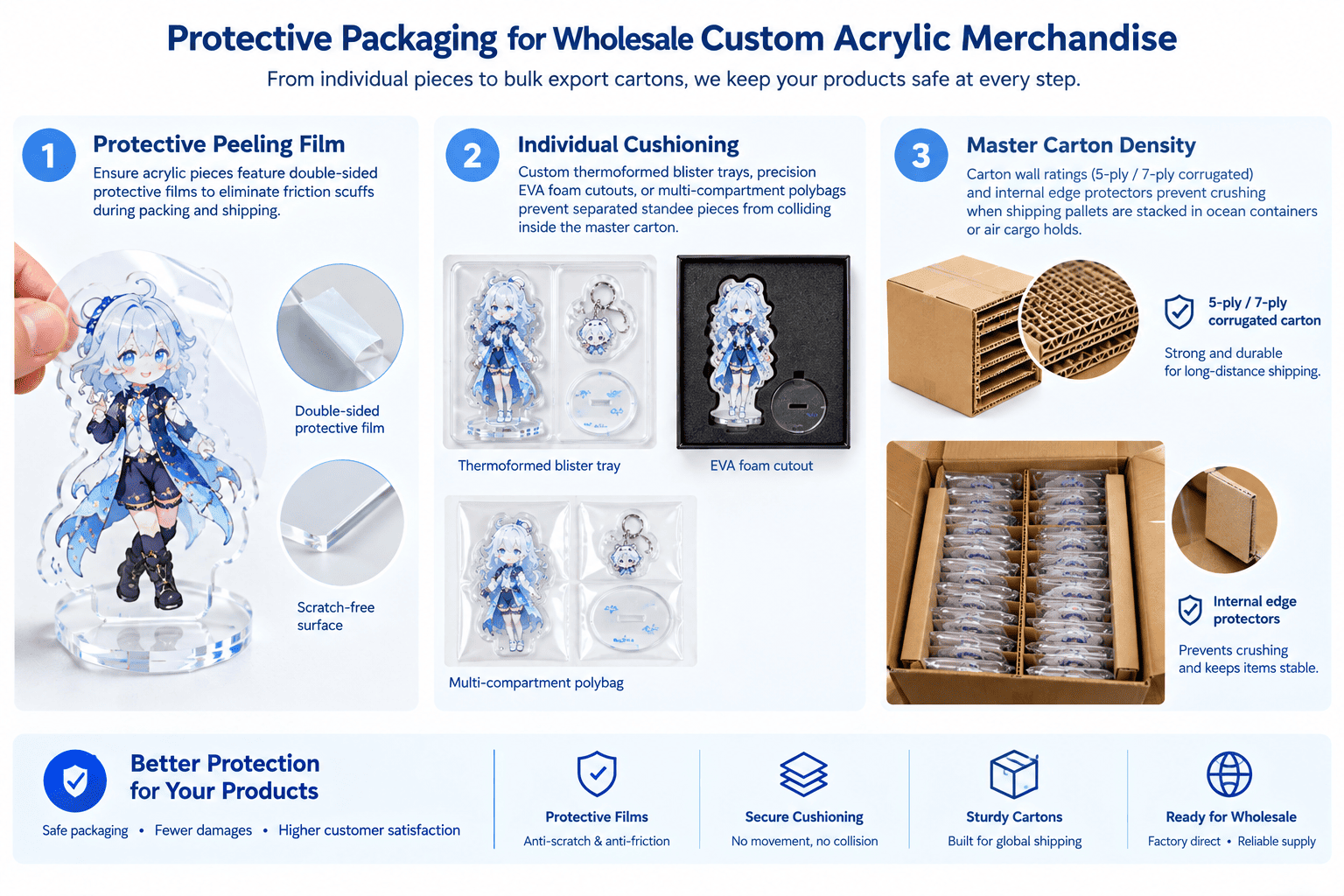
A product can pass every factory stress test and still arrive damaged if secondary packaging fails to cushion it during international freight.
-
Protective Peeling Film: Ensure acrylic pieces feature double-sided protective films to eliminate friction scuffs during packing and shipping.
-
Individual Cushioning: Custom thermoformed blister trays, precision EVA foam cutouts, or multi-compartment polybags prevent separated standee pieces from colliding inside the master carton.
-
Master Carton Density: Carton wall ratings (5-ply / 7-ply corrugated) and internal edge protectors prevent crushing when shipping pallets are stacked in ocean containers or air cargo holds.
<!-- IMAGE 3 PLACEHOLDER -->
-
Recommended Placement: Section 7
-
Visual Concept: Retail-ready packaging with custom backing cards, protective films, and partitioned master export carton arrangement.
-
Image Alt Text:
Protective packaging for wholesale custom acrylic merchandise
8. Lock In Requirements With a Product Specification Sheet
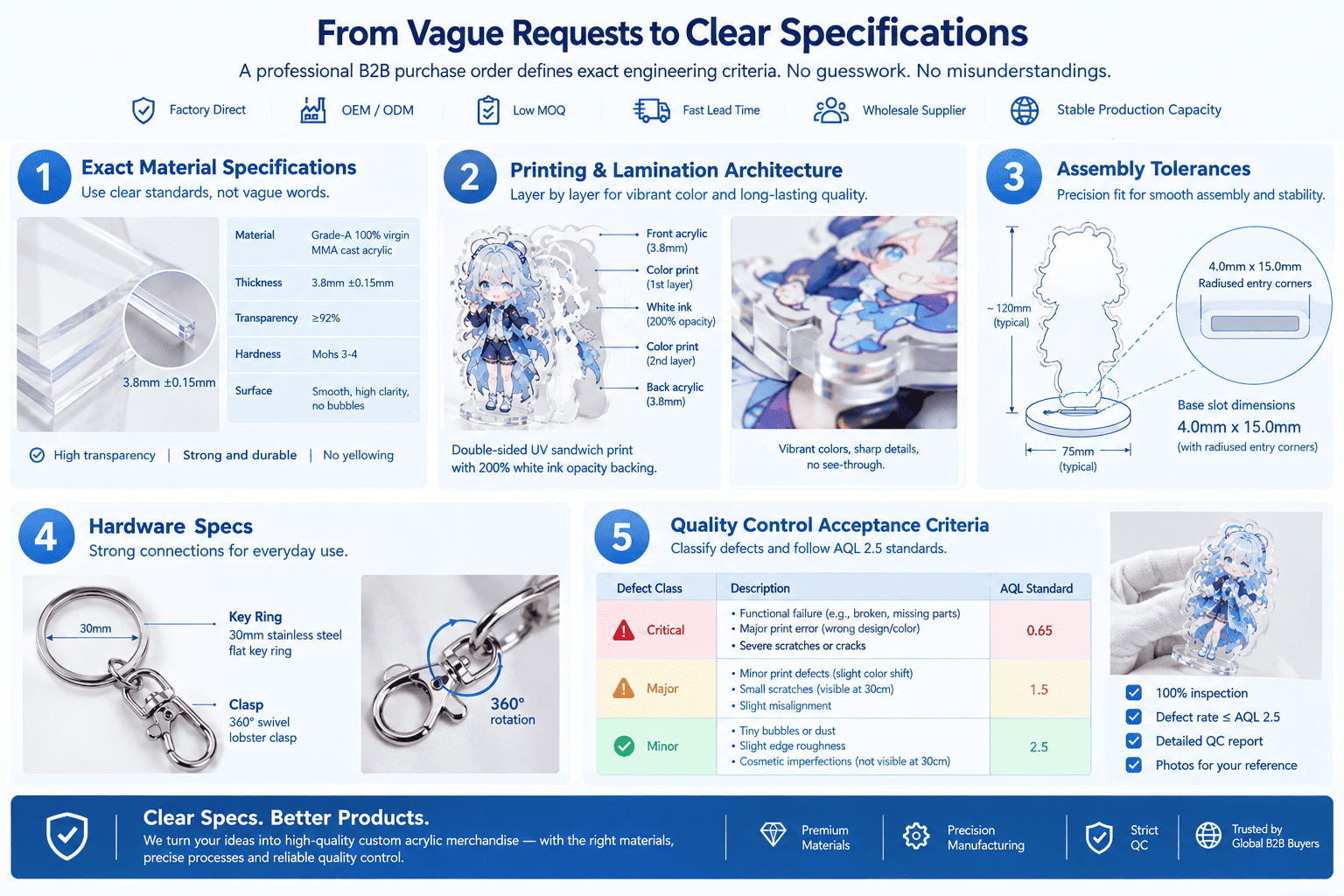
Vague instructions like “ensure high quality” or “make it strong” are open to subjective interpretation. A professional B2B purchase order must define objective engineering criteria:
-
Exact Material Specifications: (e.g., Grade-A 100% virgin MMA cast acrylic, 3.8mm ±0.15mm thickness).
-
Printing & Lamination Architecture: (e.g., Double-sided UV sandwich print with 200% white ink opacity backing).
-
Assembly Tolerances: (e.g., Base slot dimensions 4.0mm x 15.0mm with radiused entry corners).
-
Hardware Specs: (e.g., 30mm stainless steel flat key ring + 360-degree swivel lobster clasp).
-
Quality Control Acceptance Criteria: Defect classification (Critical, Major, Minor) following standard AQL 2.5 guidelines.
9. Balance Durability Against Unit Economics and Margins
Durable design does not mean adding cost indefinitely. The goal is to maximize product life at your target wholesale price point.
Work with your factory to evaluate cost-to-performance trade-offs:
-
Upgrading to diamond edge polishing adds a negligible fraction to unit cost while eliminating micro-cracking risks.
-
Using sandwich lamination adds modest print passes but prevents 100% of surface graphics rub-off complaints.
-
Over-engineering panel thickness from 3mm to 6mm might double material weight and inflate air shipping costs without adding meaningful functional durability.
10. Partner With a Factory-Direct Supplier That Engineers Early
The most effective way to eliminate product defects is partnering with a factory that proactively audits your dielines before cutting plates.
A qualified OEM/ODM partner evaluates your vector files for stress points, recommends practical material formulations, and manufactures physical prototypes that validate structural integrity.
-
Sourcing in Asia? Read our in-depth evaluation framework: How to Choose an Anime Merchandise Manufacturer in China.
Durability Checklist Before Approving Your Bulk Run
-
[ ] Intended mechanical use and environment clearly established.
-
[ ] Virgin-grade materials specified (avoiding recycled blends).
-
[ ] Minimum 2.5mm–3.5mm wall margin maintained around all hanging holes.
-
[ ] Inner corner radius applied to eliminate sharp 90° stress risers.
-
[ ] Sandwich lamination selected for high-contact printed surfaces.
-
[ ] Pre-production prototype stress-tested (pull, drop, and assembly checks).
-
[ ] Packaging engineered to prevent friction and shipping damage.
-
[ ] Complete product specification sheet signed off by both parties.
Engineer Reliable Custom Merchandise With BOCE GIFTS {#contact-boce}
At BOCE GIFTS, we partner with global retailers, game publishers, and brand licensors to manufacture premium custom anime merchandise and corporate promotional gifts. As a factory-direct supplier in China, our engineering team audits your artwork files, selects optimal material grades, and executes strict pre-shipment quality control.
Whether you are designing acrylic standees, keychains, enamel pins, or retail gift collections, our team is ready to evaluate your specifications.
Planning your next wholesale order?
Send your artwork files, estimated quantities, and target specifications to our engineering team to get a detailed production review and wholesale quote.