
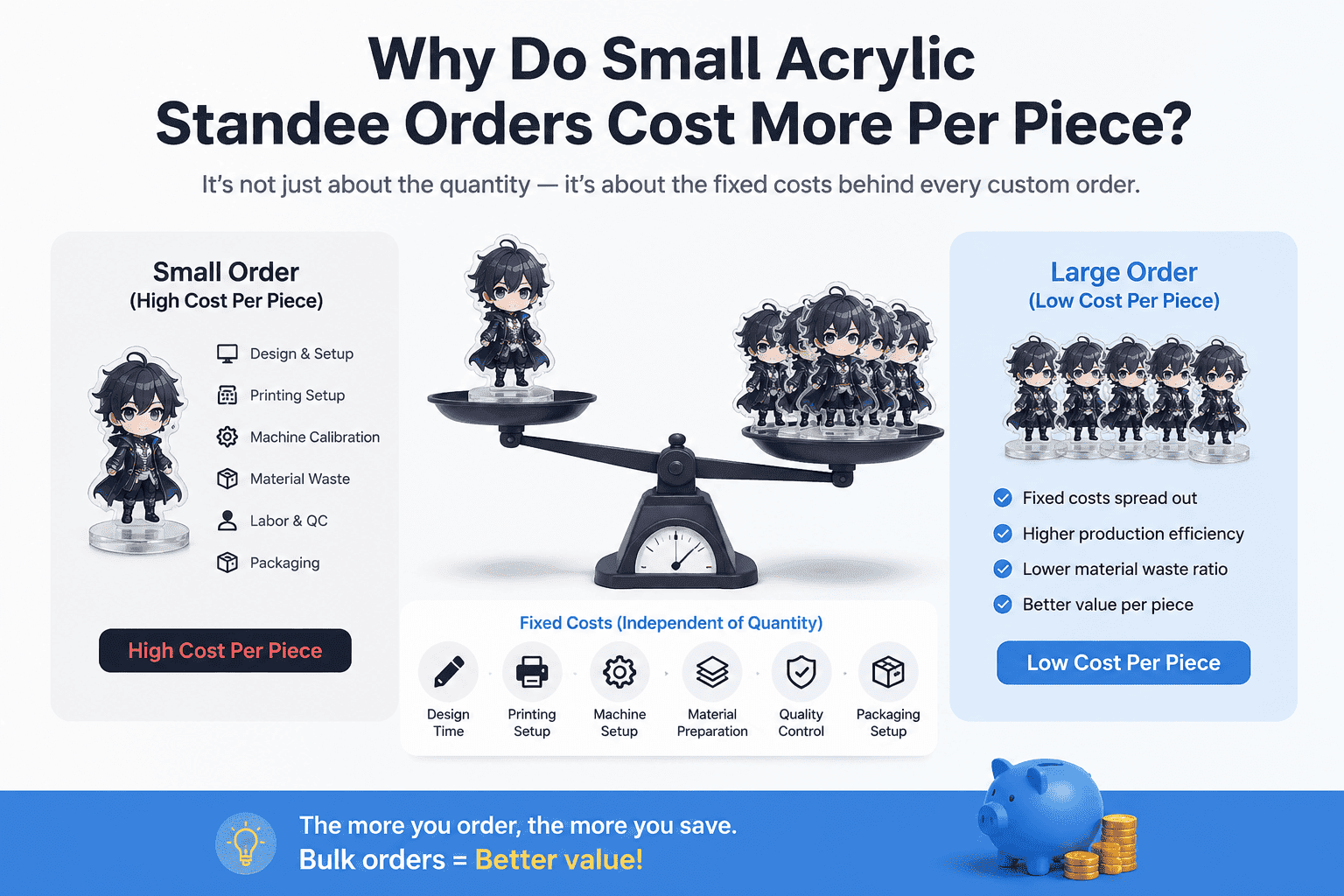
One of the most common questions buyers ask is:
“If one acrylic standee is small, why is the unit price so much higher when I order only 50 pieces instead of 1,000?”
Many buyers assume that the price difference comes only from the quantity of acrylic material used. In reality, raw material is only one part of the equation. The biggest difference lies in manufacturing efficiency.
Acrylic Sheet Utilization Makes a Big Difference
Professional acrylic standee manufacturers do not purchase acrylic sheets in the exact size of each standee. Instead, factories typically purchase standardized acrylic sheets in fixed dimensions, such as 1000 × 1000 mm, 1220 × 2440 mm, or other industry-standard sizes.
When producing only a few standees, those designs occupy only a small portion of the sheet, leaving a large amount of unused material.
For example:
- An order of 20 custom acrylic standees may use only 15–20% of a sheet.
- The remaining acrylic cannot always be reused because every customer’s artwork, cutting paths, and product dimensions are different.
Although experienced factories try to combine multiple customer orders on one sheet through nesting optimization, this is not always possible due to differences in production schedules, artwork approval, and material specifications.
As a result, small orders usually generate more material waste, increasing the cost per piece.
By contrast, an order for 5,000 identical acrylic standees can fully utilize dozens or even hundreds of acrylic sheets with very little waste. The higher material utilization significantly reduces the average production cost.
Machine Setup Costs Are Almost the Same for Every Order
Another important factor is production setup.
Every new order requires technicians to prepare the production line before manufacturing begins.
Typical setup work includes:
- Checking artwork files
- Adjusting print layouts
- Configuring UV printing parameters
- Loading acrylic sheets
- Calibrating laser cutting equipment
- Testing color accuracy
- Inspecting the first production sample
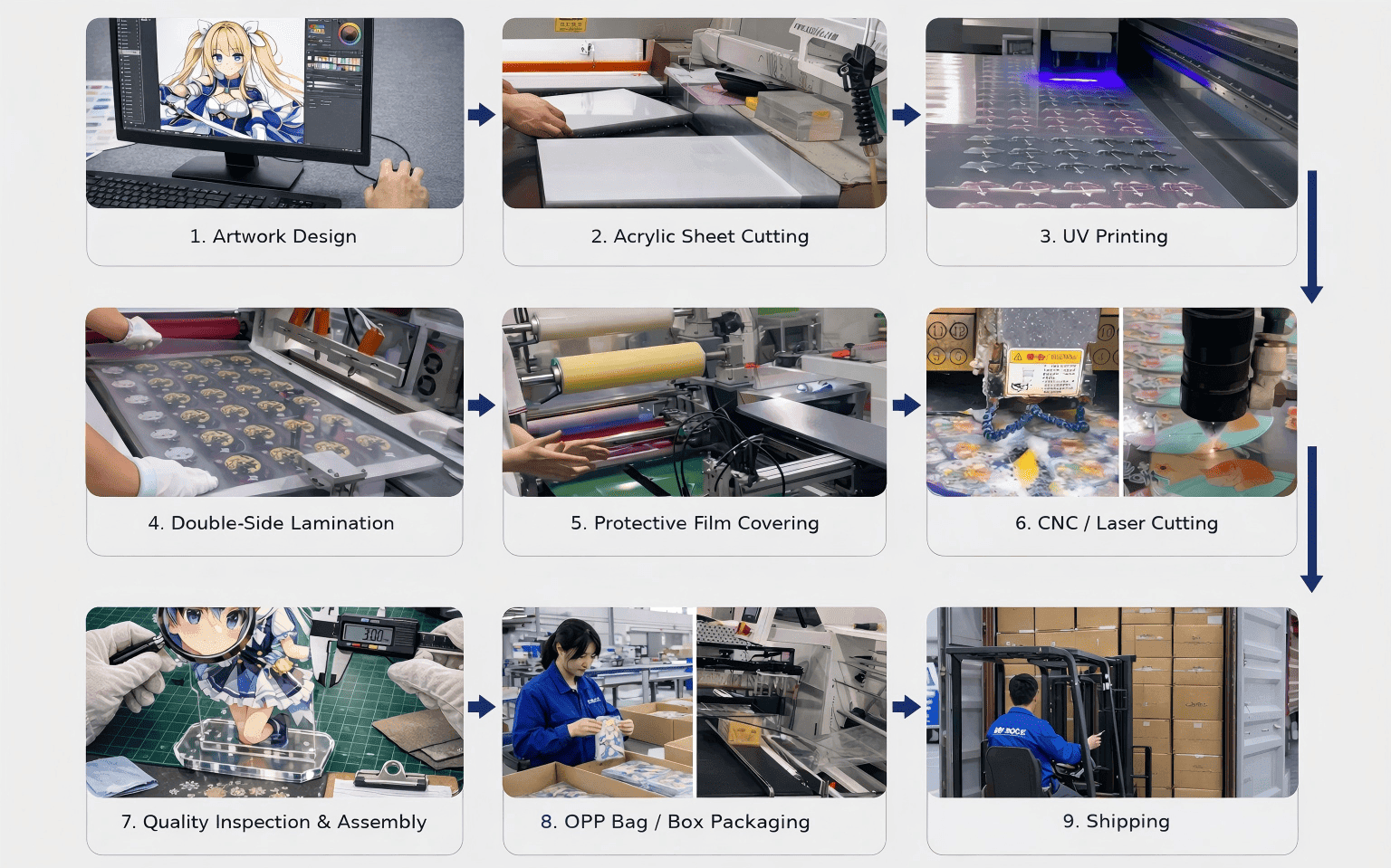
Whether the customer orders 50 pieces or 5,000 pieces, these preparation steps are almost identical.
In other words, the factory spends nearly the same amount of engineering time before production actually starts.
When that setup cost is divided across only 50 products, the cost per unit is relatively high.
When divided across 5,000 products, the setup cost becomes almost negligible.
Think of It Like Baking or Candle Making
A simple way to understand this is to compare manufacturing with making candles.
Imagine you want to produce scented candles.
Before pouring the wax, you must:
- Heat the wax to the correct temperature
- Add fragrance oil
- Stir until the mixture reaches the ideal pouring temperature
- Prepare the molds
These preparation steps take nearly the same amount of time whether you make one candle or twenty-four candles.
Now imagine a customer orders:
- Five candles with one fragrance
- Five candles with a second fragrance
- Five candles with a third fragrance
Each fragrance requires the equipment to be cleaned before the next batch can begin.
Industrial production works the same way.
Every new acrylic standee design requires new artwork loading, machine adjustments, printing calibration, and cutting file verification. Frequent product changes reduce production efficiency and increase manufacturing costs.
Larger Orders Improve Production Efficiency
Large-volume production allows factories to keep machines running continuously.
Instead of stopping production to prepare new files every few minutes, operators can:
- Print the same artwork continuously
- Cut identical products repeatedly
- Package products in standardized workflows
This reduces:
- machine idle time
- labor cost
- material waste
- production errors
As a result, bulk acrylic standees generally have a much lower manufacturing cost per unit.
MOQ Is About Manufacturing Efficiency, Not Just Sales
Some buyers believe that factories set minimum order quantities simply to encourage larger purchases.
In reality, MOQ is largely based on production efficiency.
Every manufacturing job has fixed costs that must be covered before production begins.
These include:
- Artwork processing
- Machine setup
- Equipment calibration
- Quality inspection
- Packaging preparation
- Production scheduling
The same principle applies in many industries.
For example, a print shop may charge $3.50 for a single printed sheet, but 10 sheets for only $10, because the setup process remains almost the same regardless of quantity.
Similarly, producing one custom acrylic standee is not significantly easier than producing hundreds. The difference is that larger orders spread those fixed costs across more products, reducing the unit price.
For this reason, experienced B2B buyers often consolidate multiple designs into a single production run or increase order quantities to achieve better material utilization and lower per-unit costs.
B2B Procurement Tip
Instead of asking “What’s your lowest MOQ?”, procurement managers often achieve greater savings by asking:
- Can multiple designs be combined into one production run?
- Can different SKUs share the same acrylic sheet?
- Is there a more efficient packaging option?
- Can orders be consolidated to improve material utilization?
These discussions often create greater cost savings than simply negotiating a lower unit price.