1. Why Quality Disputes Happen in Anime Merchandise Orders
Quality disputes can arise even when you work with an experienced anime merchandise supplier. When a multi-pallet consignment arrives at your fulfillment center, discovering that your keychains have micro-fractures or that an entire run of standees shows noticeable color banding immediately puts your retail drops, convention dates, and cash flow at risk.
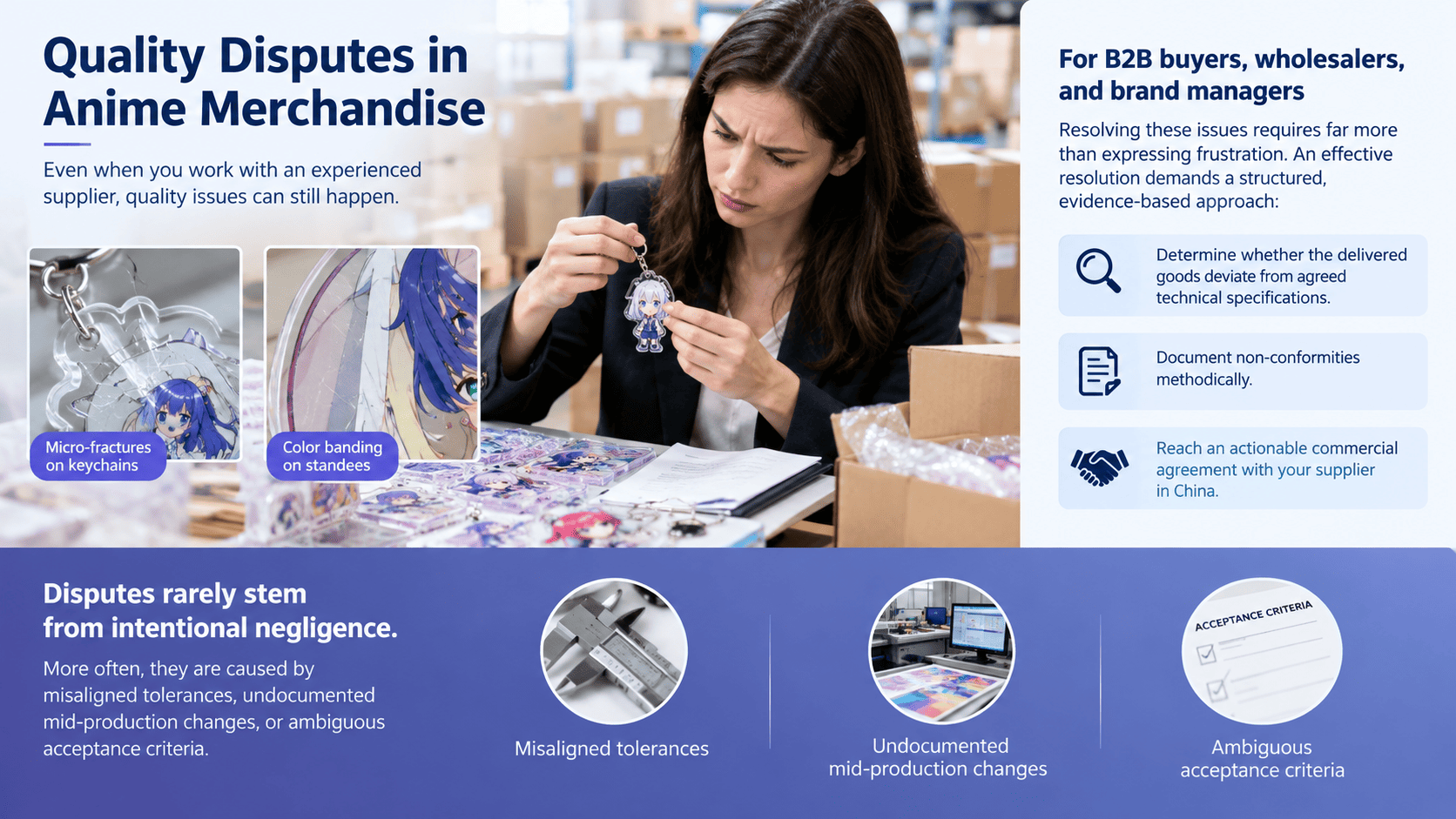
For B2B buyers, wholesalers, and brand managers, resolving these issues requires far more than expressing frustration. An effective resolution demands a structured, evidence-based approach: determining whether the delivered goods deviate from agreed technical specifications, documenting non-conformities methodically, and reaching an actionable commercial agreement with your supplier in China.
Disputes rarely stem from intentional negligence. More often, they are caused by misaligned tolerances, undocumented mid-production changes, or ambiguous acceptance criteria.
Common Breakdown Points in Custom Anime Manufacturing:
├── Pre-Production: Uncalibrated digital proofs vs. physical CMYK curves
├── Materials: Inconsistent sheet thickness or uninspected sub-tier hardware
├── Production: UV flatbed head misalignments, laser burrs, or incomplete ink curing
├── Post-Processing: Protective film applied over uncured ink, manual assembly misfits
└── Logistics: Substandard inner box integrity leading to transit compression
2. Define What Counts as a Quality Defect
Before lodging an official complaint, buyers must distinguish between a genuine defect and an acceptable manufacturing tolerance. Commercial manufacturing—especially across custom acrylic, enamel pins, zinc alloys, and specialty paper—is subject to natural process variations unless strict mathematical tolerances were contractually established beforehand.
Quality discrepancies generally fall into four distinct categories:
| Issue Category | Description | Primary Verification Source |
| Contractual Non-Compliance | Measurable parameters that breach written agreements (e.g., acrylic thickness is 2.4 mm instead of the specified 3.0 mm; base slot is cut to 3.2 mm, causing wobble). | Purchase Order (PO), Technical Spec Sheet, Engineering CAD files. |
| Visible Production Defects | Physical and aesthetic flaws that impair commercial viability (e.g., pinholes, ink flaking, adhesive residue, severe surface scratches, print offset >0.5 mm). | High-res photos/videos, AQL inspection records, defect count logs. |
| Process Tolerances | Subtle variations inherent to custom manufacturing (e.g., slight delta-E color variance under differing color temperatures, negligible laser-entry points). | Master approved physical samples, agreed industry AQL limits. |
| Transit / Handling Damage | Damage occurring after factory gate dispatch (e.g., crushed master cartons, moisture exposure, corner dings). | Container loading records, bill of lading, outer carton drop/crush photos. |
Key Rule: Separate verifiable non-conformities from subjective aesthetic dissatisfaction. If a specific tolerance (such as Pantone matching variance or sheet thickness limits) was never documented or sampled prior to mass manufacturing, enforcing total vendor liability becomes difficult.
3. Collect Evidence Before Contacting Your Supplier
Approaching a manufacturer with vague statements like “The print looks wrong” or “The whole batch is ruined” instantly slows down the dispute process. Professional factories operate on engineering data and measurable facts.
Before sending your initial claim notification, compile an Evidence Package:
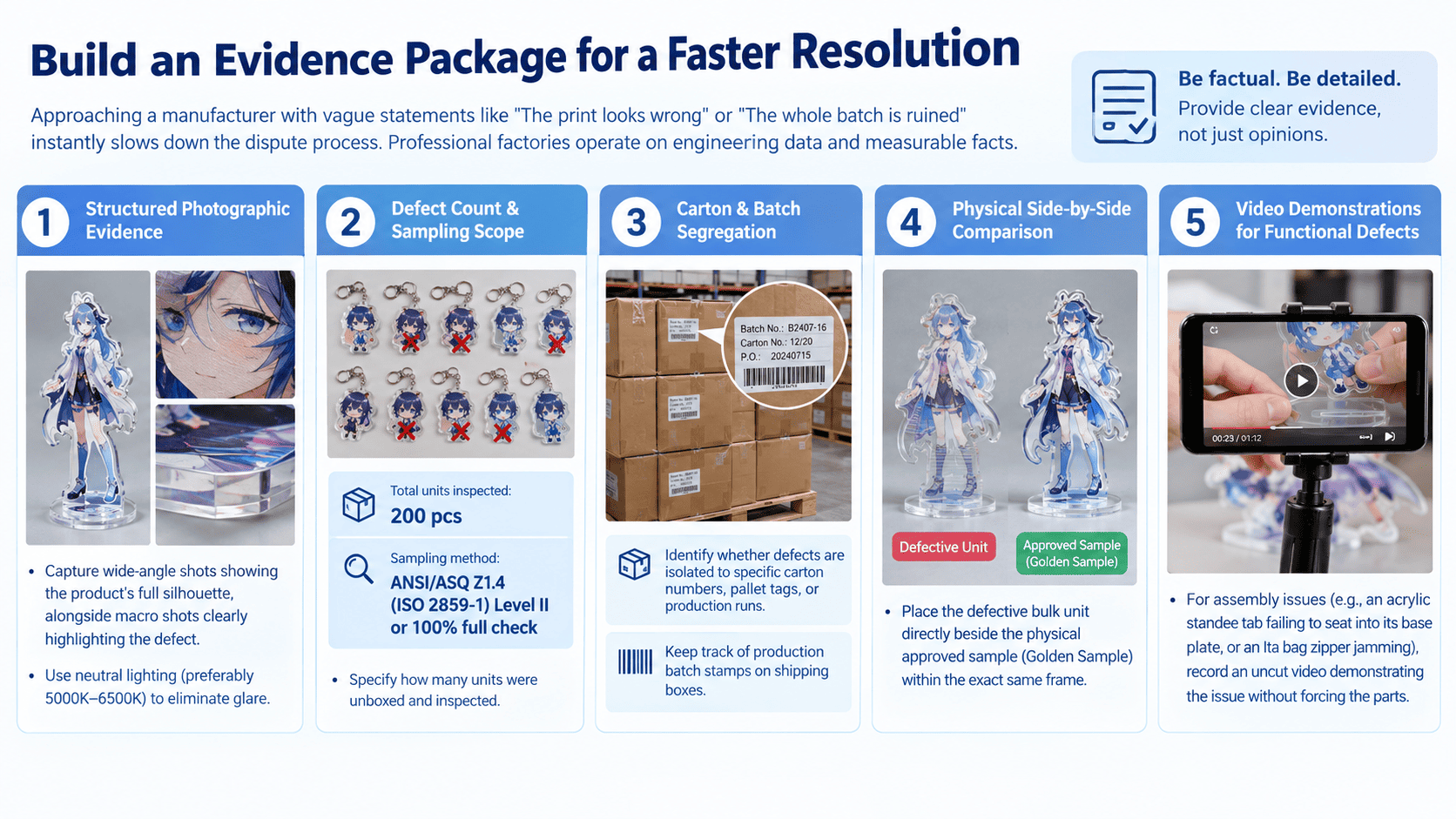
-
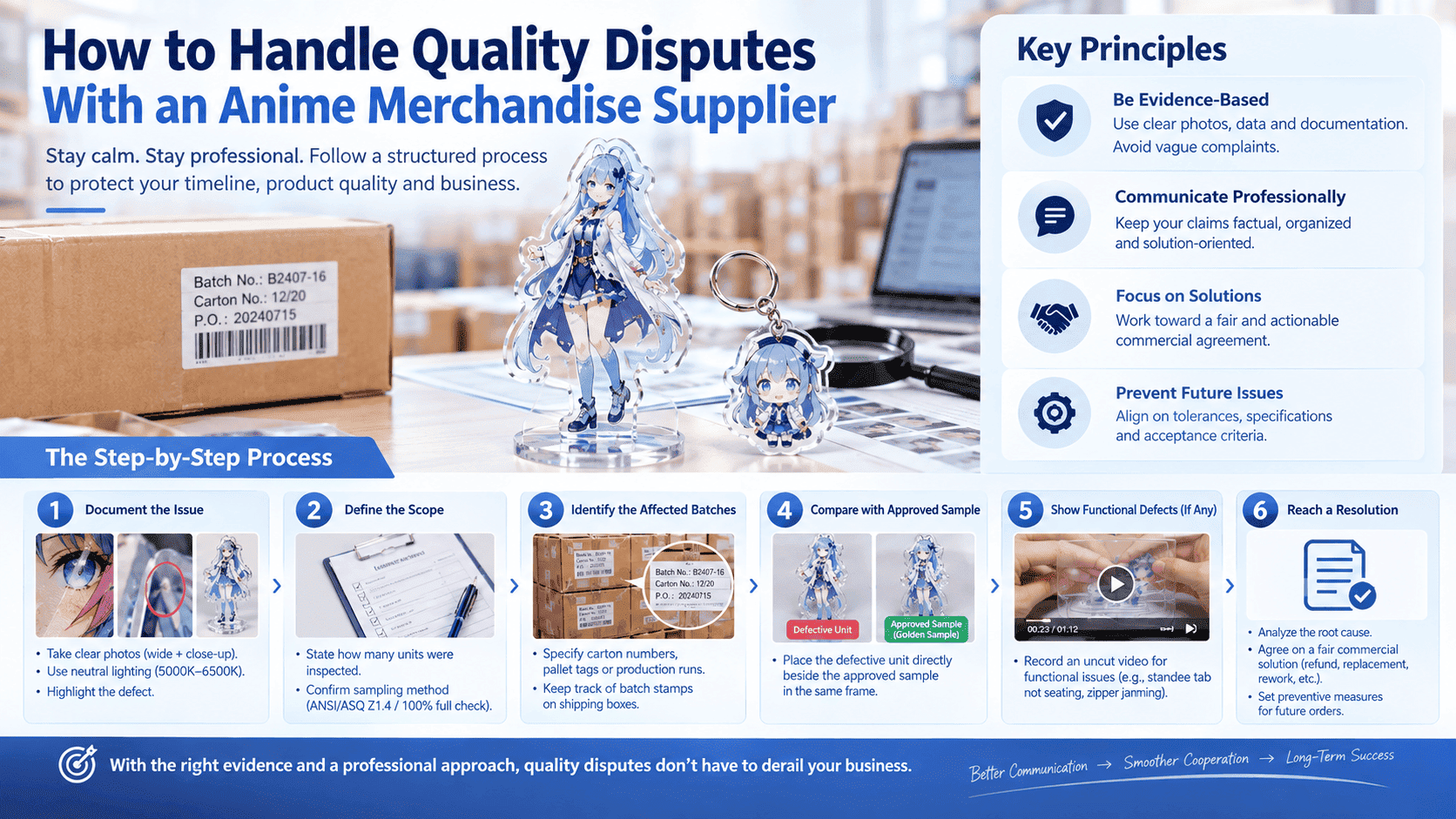
Structured Photographic Evidence: Capture wide-angle shots displaying the product’s full silhouette, alongside macro shots clearly highlighting the defect. Ensure lighting is neutral (preferably 5000K–6500K color-balanced lighting) to eliminate glare.
-
Defect Count & Sampling Scope: Specify how many units were unboxed and inspected. State whether the defect was discovered via standard ANSI/ASQ Z1.4 (ISO 2859-1) Level II random sampling, or through a 100% full check.
-
Carton & Batch Segregation: Identify whether defects are isolated to specific carton numbers, pallet tags, or production runs. Keep track of production batch stamps on shipping boxes.
-
Physical Side-by-Side Comparison: Place the defective bulk unit directly beside the physical approved sample (Golden Sample) within the exact same frame.
-
Video Demonstrations for Functional Defects: For assembly issues (e.g., an acrylic standee tab failing to seat into its base plate, or an Ita bag zipper jamming), record an uncut video demonstrating the issue without forcing the parts.
4. Compare the Bulk Order With the Approved Sample
The physical approved sample—signed, dated, and sealed prior to mass production—is your most critical point of leverage. Digital mockups on backlit computer monitors cannot act as an objective baseline for color density or physical assembly.
Run your inspection against a standardized technical checklist:
[Master Inspection Comparison: Bulk Run vs. Approved Golden Sample]

1. Dimensional & Structural Audit
   □ Profile Height & Width (Vernier caliper: ±0.2 mm standard)
   □ Substrate Thickness (Micrometer check across 5 points)
   □ Insertion Fit (Standee tab engagement: firm slide, zero lateral wobble)

2. Surface & Substrate Integrity
   □ Material Clarity (Cast acrylic transparency vs. recycled sheet cloudiness)
   □ Edge Finish (Clean laser-polished or diamond-beveled edges vs. serrated burns)
   □ Protective Masking (Easy-peel kraft paper or static PET without adhesive residue)

3. Printing & Decoration Fidelity
   □ Registration Alignment (White ink backing fully contained beneath color layers)
   □ Color Target Matching (CMYK density against signed physical sample)
   □ Layer Adhesion (Cross-hatch tape test: ASTM D3359 zero peeling standard)

4. Packaging & Barcoding
   □ Individual Sleeve Seal (OPP/adhesive flap strength)
   □ Label Data (Correct EAN/UPC barcode scale, scannability, character naming)
If you notice discrepancies, note whether they affect the entire run or represent random variance.
(For a deeper breakdown of setting these physical baselines before ordering, see our guide on [How to Approve a Pre-Production Sample Before a Bulk Order].)
5. Contact Your Supplier Professionally and Promptly
Initiating a dispute should follow a cooperative, fact-finding tone rather than an aggressive escalation. Experienced manufacturing directors respond far more constructively to organized, precise data than to emotional ultimatums.
Reach out via formal email to your primary project lead and sales director within your contractually stipulated claims window (typically 14 to 30 days post-delivery).
Commercial Claim Email Template
Plaintext
Subject: Quality Review & Non-Conformance Report: PO #[PO_Number] – [Product Name]

Dear [Supplier Contact Name],

We have completed receiving and incoming quality inspection for order #[PO_Number] ([Product Description]), delivered on [Delivery Date].

During our incoming quality control check, our team identified specific non-conformities that deviate from our approved golden sample (signed on [Sample Date]) and the agreed technical specifications sheet.

Summary of Findings:
- Total Units Received: [Total Units]
- Units Inspected: [Inspected Units] ([Inspection Method: e.g., 100% check / AQL Level II])
- Critical Defective Units Identified: [Quantity] ([% of Total])
- Primary Defect Type: [e.g., Base plate slot cut 0.4mm undersized; units cannot be assembled]
- Affected Batch/Carton IDs: [e.g., Cartons 14 through 28]

We have compiled a formal Non-Conformance Report (attached), which includes comparative high-resolution photographs against the approved pre-production sample, dimensional caliper measurements, and a short video demonstration of the assembly failure.

Could your engineering and production team please review these findings and provide an initial response by [Date, typically 3-4 business days], covering:
1. The likely root cause within the cutting/printing process.
2. Confirmation of whether this issue affected other production lines during that run.
3. Your proposed corrective solution for the affected [Quantity] units to help us meet our pending retail launch.

We value our ongoing manufacturing partnership and look forward to resolving this matter promptly and pragmatically.

Best regards,

[Your Name]
[Your Title]
[Company / Brand Name]
[Link/Attachment: Non_Conformance_Report_PO[Number].pdf]
6. Determine the Root Cause Before Negotiating Compensation
A successful resolution requires identifying where the breakdown occurred along the supply chain. Determining the root cause dictates who bears the financial burden and what technical changes must be implemented.
                  ┌─────────────────────────────────────────┐
                  │       Root Cause Identification         │
                  └────────────────────┬────────────────────┘
                                       │
      ┌──────────────────┬─────────────┴───────┬──────────────────┐
      ▼                  ▼                     ▼                  ▼
[Specification]    [Manufacturing]       [Packaging]        [Logistics]
 • Outdated PDF     • Dull cutting bits   • Thin master      • Pallet drops
 • Unclear bleed    • UV lamp failure       carton walls     • Moisture
 • Buyer file bug   • Wrong raw sheet     • Missing corner     seepage
                                            protectors
      │                  │                     │                  │
   Buyer's            Supplier's            Supplier's         Forwarder /
Responsibility      Responsibility        Responsibility        Insurance
-
Artwork / Spec Ambiguity: If the buyer supplied a revised vector file via chat software but failed to update the signed PO or confirm the updated spec sheet, responsibility is often shared.
-
Manufacturing Execution: If the factory ran the job with incorrect machine calibrations, unapproved raw materials, or skipped inline QC stages, the liability rests fully with the anime merchandise manufacturer.
-
Packaging Engineering: If items cracked because the factory packed 500 unpadded acrylic plates into an unsupported single-wall outer carton, the factory is responsible for inadequate packaging engineering.
-
Logistics & Rough Handling: If the master cartons show exterior puncture marks, crush damage, or wet spots from sea container condensation, the claim should be redirected toward the freight forwarder or cargo insurance policy.
7. Choose the Right Resolution for the Type of Defect
Demanding an immediate 100% refund or complete batch destruction is rarely practical and often counterproductive. A seasoned procurement specialist matches the remedy to the severity of the defect, commercial deadlines, and the salvageability of the goods.
Severity Ladder & Commercial Remedies:

[Critical Flaws: 100% Unsellable] ──► Full Remake (Air-freighted) OR Full Refund / Balance Cancellation
[Major Flaws: Rework Possible]   ──► On-site Factory Rework OR Factory-Funded Local Third-Party Rework
[Aesthetic Flaws: Discountable]   ──► Partial Refund (15%-40%) to offset secondary B-grade clearance sales
[Isolated Flaws: Minor Quantity] ──► Credit Note against upcoming Repeat Order balance
1. Factory Rework
-
When to Use: The products can be safely corrected without structural damage (e.g., swapping incorrect split rings, replacing missing backing cards, peeling and reapplying clean protective films).
-
Key Terms: Establish who pays for round-trip freight if units must return to the facility, or negotiate a labor allowance for your own warehouse staff to perform the sorting locally.
2. Fast-Track Replacement (Remake)
-
When to Use: Products are functionally or aesthetically unsellable (e.g., fractured acrylic, wrong character artwork, severe white ink peeling).
-
Key Terms: The manufacturer produces replacement units prioritizing line capacity, and covers expedited air freight to prevent the buyer from missing major retail deadlines.
3. Commercial Discount / Partial Refund
-
When to Use: Products deviate slightly from specifications but remain commercially viable (e.g., minor backing-card paperweight variance, slight saturation difference).
-
Key Terms: The buyer retains and retails the goods as secondary or promotional items; the factory issues a cash refund or credit note corresponding to the margin loss.
4. Credit Applied to Repeat Orders
-
When to Use: The defect affects a small percentage of units, and the buyer maintains an active, ongoing relationship with the manufacturer.
-
Key Terms: The exact dollar value of defective units is credited directly against the deposit or final payment of the next bulk order.
8. What If Your Supplier Rejects Your Quality Claim?
If a supplier initially rejects a claim—citing “standard factory tolerance” or claiming the goods left the facility in good order—escalate the issue systematically using objective criteria:
-
Re-anchor to the Golden Sample: Place the factory’s signed physical confirmation counter-sample back on the table. Ask their QC team to explain the measurable variance between the approved sample and the bulk production.
-
Request Inline Production & QC Logs: Ask for the signed Quality Inspection Sheets, moisture meter readings, or raw material batch certs from the date of manufacture. Unwillingness or inability to produce these logs strengthens your position.
-
Commission a Joint or Third-Party Inspection: If the dispute involves a significant financial sum, hire an accredited neutral inspection agency (e.g., SGS, Bureau Veritas, QIMA) to conduct a formal audit on the disputed lot. Agree in advance that the party proven wrong by the audit covers the inspection fee.
-
Enforce Contractual Terms: Reference your purchase agreement’s governing law, dispute resolution clauses, and agreed warranty periods. Professional Chinese contract manufacturers operate within clear business legal frameworks and prioritize preserving long-term commercial accounts over one-off disputes.
(For strategic risk hedging before signing POs, review our article on [How to Build a Reliable Backup Plan for Your Anime Merchandise Supply Chain].)
9. Prevent the Same Quality Problem in Your Next Bulk Order
Resolving a single dispute fixes an immediate order; standardizing your quality control procedures prevents disputes from reoccurring on future repeat orders.
Closed-Loop Prevention System (CAPA):
[Dispute Resolved]
        │
        ▼
[Issue Corrective & Preventive Action (CAPA) Report]
        │
        ▼
[Update Master Tech Pack & CAD Drawings]
        │
        ▼
[Revise Tolerances & Defect Acceptance Thresholds]
        │
        ▼
[Implement Mid-Production Checkpoint on Next PO]
-
Issue a CAPA (Corrective and Preventive Action) Request: Ask the factory’s production manager to document why the failure happened, what machine/process was adjusted, and how their inline inspectors will catch it next time.
-
Revise the Product Specification Sheet: If a defect occurred due to an ambiguous detail (e.g., base slot tension), translate that lesson into a clear dimensional tolerance (e.g.,
Slot width: 3.05 mm +0.05/-0.00 mm) in the master document. -
Schedule In-Process (DUPRO) Inspections: On subsequent bulk runs, do not wait until the final packing stage. Mandate an inspection after the first 10%–20% of the order has cleared printing and cutting. Catching an error early allows the factory to correct machine parameters before the entire raw material batch is consumed.
10. Example: Resolving a Quality Dispute Over Custom Acrylic Standees
To see how these principles apply in practice, consider this typical B2B manufacturing scenario:
The Problem
A merchandise retailer orders 10,000 custom multi-piece acrylic standees for an upcoming convention. Upon unboxing the first five master cartons, the warehouse team finds that while the character printing is sharp, the acrylic tabs are extremely tight: roughly 35% of the pieces snap or chip when forced into the base slots.
The Investigation
-
The buyer checks the baseline specifications: The PO states an acrylic thickness of 3.0 mm and a base slot width of 3.1 mm (a +0.1 mm clearance fit).
-
A micrometer check reveals the factory sourced an uncalibrated acrylic sheet lot that measures 3.25 mm to 3.35 mm thick.
-
The factory’s laser cutting program was running on standard 3.1 mm cut paths, creating an interference fit that led to acrylic cracking.
-
The buyer packages 15 defective units, records a video showing the failure to assemble under normal pressure, logs measurements from 200 random samples across 10 cartons, and shares the evidence with the supplier.
The Resolution
-
The factory acknowledges that the incoming raw sheet material was outside standard thickness tolerances and bypassed initial thickness screening.
-
Because the event is three weeks away, a complete remake of 10,000 units would miss the delivery window.
-
The Solution: The factory agrees to immediately laser-cut 10,000 new, dedicated base plates with an expanded 3.4 mm slot profile, covering the material, cutting costs, and 4-day express air freight.
-
The original character figures remain fully intact and assemble smoothly into the new bases. The retailer receives the replacement bases in time for the show, avoiding lost sales.
The Prevention
Both parties update the master spec sheet: the factory adds a mandatory digital micrometer check for all raw acrylic sheets prior to UV printing, and institutes a mandatory pre-assembly test of 50 units before releasing any bulk run to packaging.
Work With a Manufacturer That Takes Quality Control Seriously
Quality control should protect your business, not become a point of contention. When you work with a manufacturing partner that maintains clear technical documentation, verified material specifications, and rigorous inline inspections, disputes are far less likely to happen in the first place.
At BOCE GIFTS, we support anime brands, retailers, wholesalers, and independent creators with factory-direct custom merchandise manufacturing across China.
From custom acrylic standees, double-sided keychains, and enamel badges to Ita bags, photocard holders, and comprehensive convention drops, our engineering team works directly with your technical files to align color profiles, material tolerances, and packaging requirements before a single sheet of material is cut.
-
Factory-Direct Transparency: Direct communication with the production floor—no middlemen or obscured communications.
-
Rigorous Sampling: High-precision pre-production sampling, digital color proofing, and strict retention of physical golden samples.
-
Flexible Scaling: Support for low-MOQ catalog testing, scheduled bulk wholesale runs, and streamlined repeat-order management.
Planning your next anime merchandise collection?
Share your artwork, dimensions, packaging needs, and target tolerances with our team to discuss an efficient, reliable production plan.
Internal Linking & Content Architecture (For BOCE Site Integration)
-
Pre-Production Phase: Link Section 4 to
[How to Approve a Pre-Production Sample Before a Bulk Order]using the anchor “approved pre-production sample”. -
Quality Checklists: Link Section 3 and Section 4 to
[Custom Acrylic Standee Quality Control: What B2B Buyers Should Check]using the anchor “incoming quality control check”. -
Supplier Selection: Link Section 8 to
[How to Choose an Anime Merchandise Manufacturer in China]using the anchor “professional Chinese contract manufacturers”. -
Risk & Change Management: Link Section 6 and Section 9 to
[How to Manage Product Changes During Mass Production]and[How to Build a Reliable Backup Plan for Your Anime Merchandise Supply Chain]. -
Category Landing Pages: Naturally hyper-link Custom Acrylic Standees and Acrylic Keychains in the conclusion to BOCE’s core factory manufacturing service pages.