1. Why Your Anime Merchandise Business Needs a Supply Chain Backup Plan
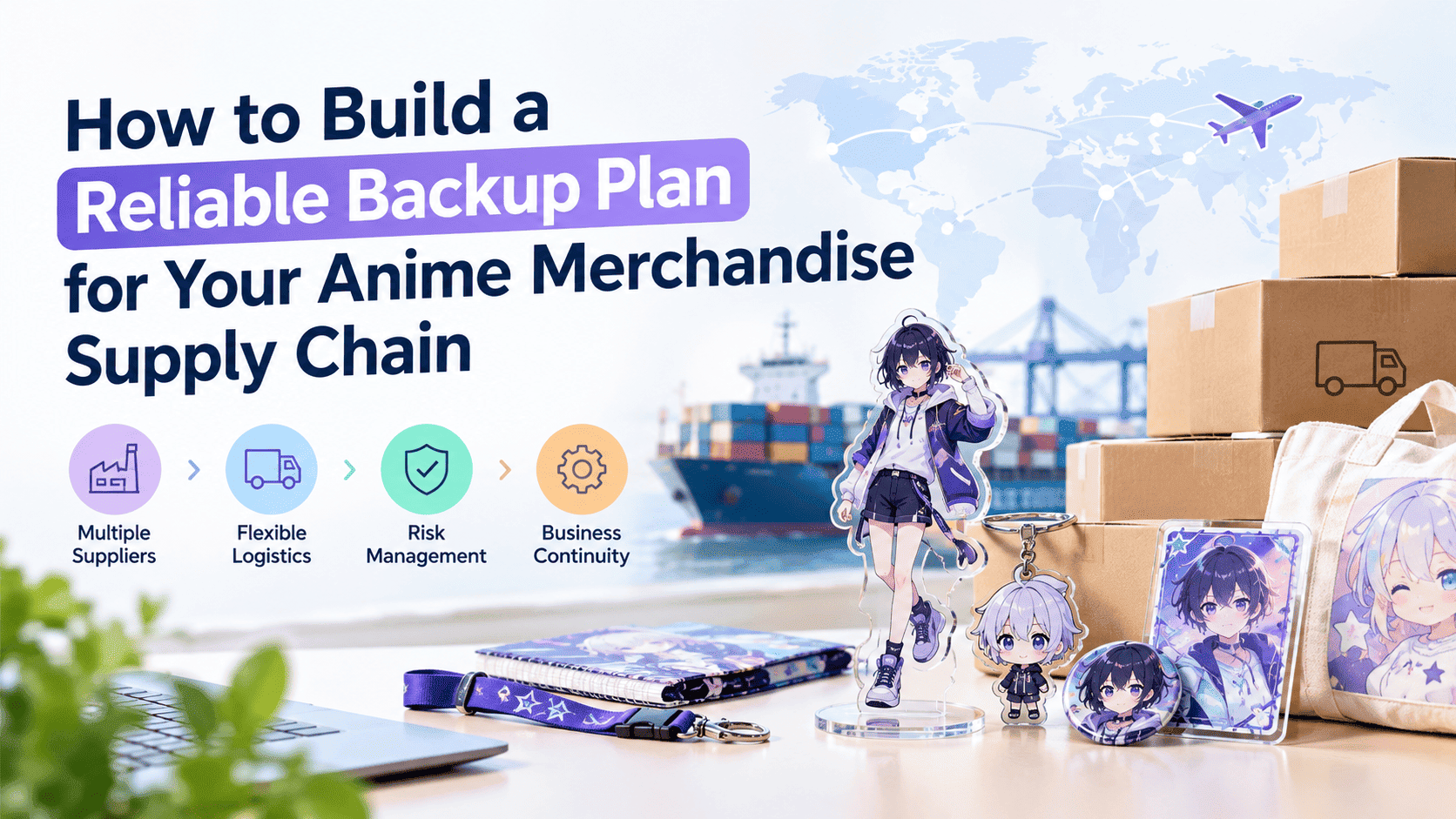
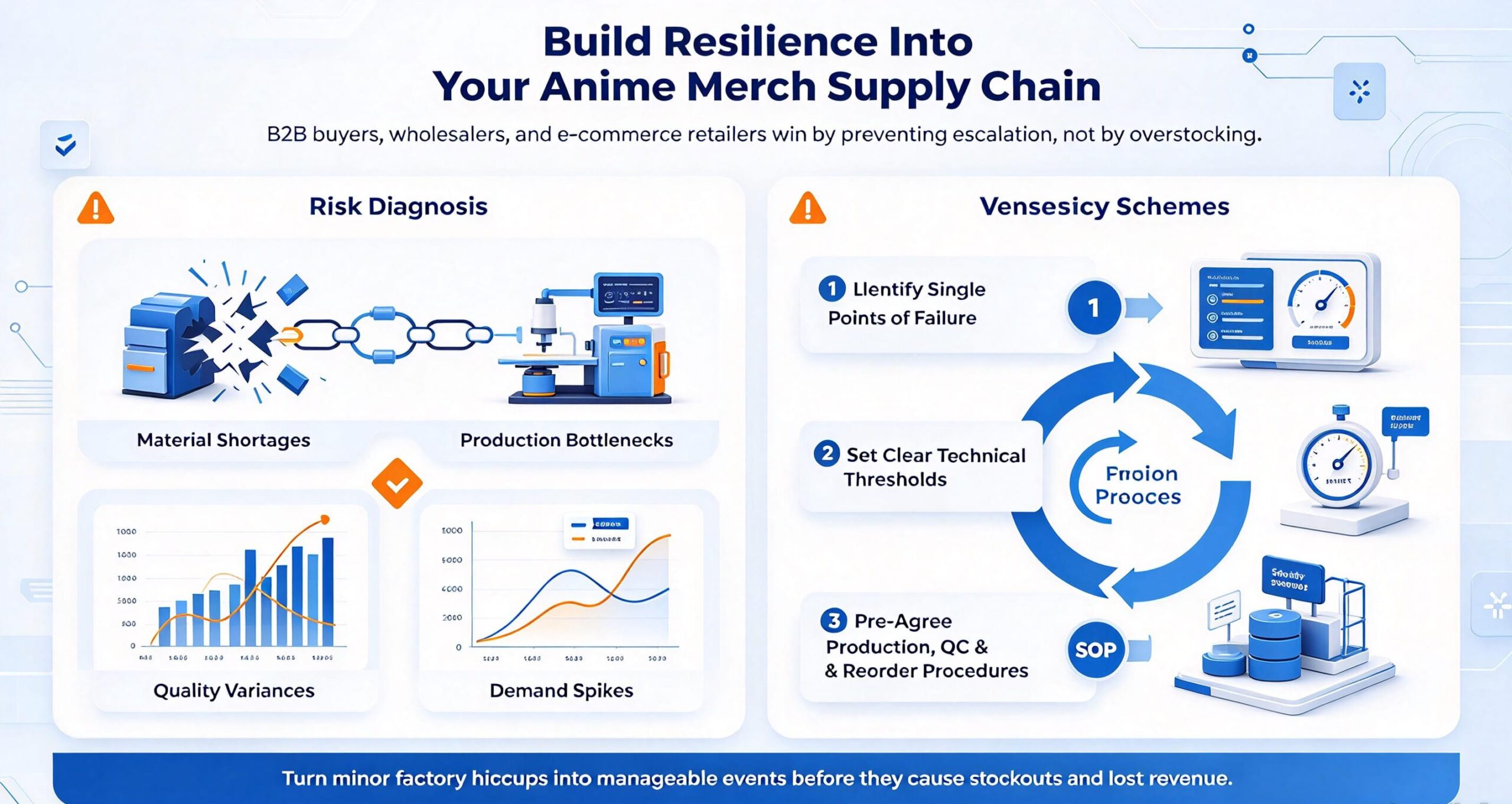
Your anime merchandise supply chain can face unexpected problems even when you work with an experienced manufacturer. Material shortages, production bottlenecks, sudden quality variances, and sudden demand spikes can all jeopardize your release calendar, retail commitments, and brand reputation.
For B2B buyers, wholesalers, and e-commerce retailers, a supply chain backup plan is not an admission of doubt—it is operational insurance. It allows you to intercept minor factory hiccups before they escalate into out-of-stock notices and lost revenue.
You do not need to duplicate every supplier or tie up capital in excessive inventory. Instead, real resilience comes from identifying your single points of failure, establishing clear technical thresholds, and setting pre-agreed procedures for production, quality control, and repeat orders.
The 4 Major Supply Chain Vulnerabilities in Anime Merchandising
-
Material Shortages: Raw virgin cast acrylic sheets, specialized zinc alloy backings, specific galvanic plating baths, holographic films, or custom paperboard packaging fail to arrive on schedule.
-
Production Bottlenecks: Peak-season order surges (e.g., pre-holiday or major conventions), machine maintenance, or labor bottlenecks at precision stages such as UV flatbed printing, diamond edge polishing, or manual assembly.
-
Quality Deviations: Discrepancies between the golden confirmation sample and bulk runs—such as color banding, offset cut lines, improper base-plate tolerances, or trapped air bubbles.
-
Unexpected Demand: A specific character or product variant suddenly goes viral or overtakes pre-order forecasts, exhausting buffer stock and placing sudden strain on re-order pipelines.
2. Identify the Products That Need a Backup Plan First
Not every SKU warrants the same level of risk-mitigation investment. Attempting to create dual-tooling, secondary sampling, and buffer inventory for an entire 100-item catalog will quickly strain your working capital and management bandwidth.
To allocate resources effectively, categorize your catalog into three tiers:
| Product Tier | Description | Recommended Supply Chain Strategy |
| Core Best Sellers | Evergreen character standees, staple keychains, flagship badge sets | Priority Level 1: Lock in raw material stock, reserve standing production capacity, maintain golden samples, and keep an active replenishment schedule. |
| New Launch Products | Seasonal collection drops, movie/event releases, licensed promotional lines | Priority Level 2: Verify pre-production tooling and artwork files early; establish strict production milestones and buffer shipping dates ahead of the launch window. |
| Experimental SKUs | Niche side characters, speculative finishes, or limited-run market tests | Priority Level 3: Run small-batch test orders (low MOQ); adjust and scale production parameters only after market validation. |
Focus your backup planning on products that generate consistent baseline cash flow or anchor major promotional campaigns. For experimental items, agility and controlled order sizes offer far better risk management than complex contingency frameworks.
3. Prepare Backup Materials Before You Need Them
Anime merchandise relies on specific visual, tactile, and structural standards. A substitution made in haste during an emergency can compromise your entire drop. A viable backup material must meet functional and aesthetic requirements—not merely offer faster availability.
When preparing material alternatives, document technical tolerances across your primary product lines:
-
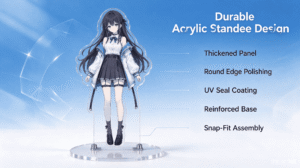
Acrylic Standees & Keychains: If standard optical-grade cast acrylic sheets face raw material supply crunches, pre-evaluate alternative MMA virgin acrylic sheets with identical clarity (92%+ light transmittance) and hardness (≥3H–4H). Document thickness tolerances (e.g., ±0.2 mm) to ensure character tabs fit into their display bases without loose wobbling or excessive friction.
-
Enamel & Metal Badges: Pre-approve secondary base metals (e.g., zinc alloy vs. stamped iron/copper) and confirm electroplating color codes (e.g., imitation gold, shiny nickel, antique bronze) alongside protective epoxies.
-
PVC & Rubber Products: Pre-test raw compound hardness (Shore A durometer ratings) and pantone color formulations to avoid brittle cold cracking or color bleeding.
-
Backing Cards & Retail Packaging: Standardize card stock (e.g., 350gsm C1S art paper vs. kraft board) and inner protective OPP/PET sleeves so packaging vendors can source alternatives without altering carton packing layouts.
Manufacturer Insight: When working with a specialized anime merchandise manufacturer like BOCE GIFTS, keep an approved “Material Specification Data Sheet” on file. We assist clients in testing alternative materials and running physical proofs before mass runs, ensuring you never have to make speculative material decisions under shipment pressure.
4. Decide When You Need a Second Supplier
For businesses scaling their wholesale purchasing, a common recommendation is to find another supplier in China. However, working with multiple vendors is not an automatic solution; it introduces management friction, split purchasing power, and potential color/finish inconsistencies.
When to Qualify a Secondary Manufacturer:
-
Your core product category relies entirely on a single production line that operates at full capacity year-round.
-
Your seasonal peak volume routinely exceeds your primary partner’s monthly throughput.
-
Delivery deadlines directly anchor high-stakes international comic conventions, retail distribution agreements, or licensed release dates.
-
Your primary vendor does not support an expanding product line (such as switching from 2D acrylic cutting to complex multi-layer injected parts or specialized packaging).
The True Cost of Dual-Sourcing
Managing a secondary supplier requires duplicate sample fees, administrative overhead, factory audits, and alignment of color profiles.
[Master Design / Vector Artwork]
           │
     ┌─────┴────────────────────────┐
     ▼                              ▼
Primary Factory                Backup Factory
  • Profile A (ICC)              • Profile B (ICC)
  • Machine A Calibration        • Machine B Calibration
  • Cut tolerance: ±0.15mm       • Cut tolerance: ±0.30mm
           │                              │
           └──────────────┬───────────────┘
                          ▼
            [Risk of Visual Discrepancy]
The Rule for B2B Buyers: Do not assume two factories will produce the exact same standee simply because they received the same AI/PDF file. If you bring a secondary partner onboard, qualify them with a paid trial order during an off-peak period—never during an urgent crisis.
5. Build a Production Capacity Backup Plan
A vendor claiming a generic factory capacity of “500,000 units per month” does not guarantee their capacity will be available for your specific SKU when you need it.
Real production capacity planning requires visibility into specific operational lines:
-
Machine Allocation: How many UV flatbed printers or automated screen lines are calibrated for your specific ink formulations?
-
Post-Processing Capacity: Are manual steps—such as film peeling, double-sided sandwich lamination, assembly, and custom packing—done in-house, or outsourced to third-party workshops?
-
Peak-Season Lead Time Adjustments: What are the factory’s standard production cycles during high-demand quarters (Q3–Q4 pre-holiday rushes and pre–Chinese New Year factory cutoffs)?
-
Component Synchronization: When your release includes an acrylic standee, a foil-stamped backing card, an anti-counterfeit sticker, and a custom barcoded bag, are all components scheduled concurrently to prevent single-component hold-ups?
Always ask your anime merchandise supplier how they handle sudden re-orders: What is the lead time to secure extra machine shifts if initial re-orders exceed original forecasts by 50%?
6. Set Quality Standards That Every Backup Supplier Can Follow
If a supply emergency forces you to reroute production, a smartphone photo or a generic tech pack is not enough to maintain product integrity. You must supply a unified Technical QC Package.
The 7-Part Master QC Dossier
-
The Physical Golden Sample (Approved Reference): Retained by both your procurement team and the manufacturing floor, representing the benchmark for color, surface gloss, and fit.
-
Product Specification Sheet: Exact blueprint dimensions, material chemistry requirements, sheet thickness ratings, and dimensional tolerances.
-
Color Standards: Designated Pantone (PMS) spot colors, CMYK target profiles, and specific guidelines for white ink opacity under backing layers.
-
Finishing & Edge Criteria: Specifications for laser cutting vs. CNC diamond edge polishing, chamfering angles, and base insertion tolerances.
-
Component Standards: Base clasps, ball chains, split rings, and protective peel-off films.
-
Defect Classification Grid:
-
Critical Defect: Incorrect character art, broken acrylic tabs, missing accessories, illegible barcode (0% tolerance).
-
Major Defect: Noticeable surface scratches, ink flaking, off-center laser cut >0.5 mm, base plate too loose/tight (AQL 1.0–1.5).
-
Minor Defect: Tiny edge burr, minor backing card indentation (AQL 2.5–4.0).
-
-
Packaging & Labeling Protocol: Barcode legibility, drop-test carton standards, and moisture-barrier bag sealing requirements.
When onboarding an alternative production source, require a counter-sample measured against this exact checklist before releasing the mass production run.
7. Create a Lead Time and Shipping Contingency Plan
Supply chain timelines rarely fail at a single point; instead, minor two-day delays accumulate across design sign-off, material staging, packaging verification, and freight handoffs.
Total Turnaround Window =
  Design & Proof Approval
  + Raw Material Staging
  + Core Production
  + In-line & Final QC Inspection
  + Packing & Labeling
  + Export Customs Clearance
  + Freight Transit Time
  + Local Distribution Buffer
Risk & Contingency Matrix
| Risk Scenario | Proactive Preventative Measure | Reactive Contingency Action |
| Raw Material Bottleneck | Keep pre-approved alternative sheet/metal specs on file with the factory. | Deploy pre-qualified alternative materials under written sign-off. |
| Peak Production Queue | Reserve factory capacity 4–6 weeks ahead of major seasonal drops. | Authorize partial batch shipments (air-freighting the first 20% to hit launch dates). |
| QC Failure at Final Stage | Mandate inline checkpoint inspections at printing and cutting stages. | Implement immediate localized rework on isolated components while packaging the remainder. |
| Ocean Port Congestion | Build a standard 10–14 day buffer into all sea freight planning. | Switch critical baseline allocations to expedited sea freight or air express. |
Remember: Air express shipping can shave 20 days off transit, but it cannot fix an unprinted order. Your primary buffer must be integrated into the factory scheduling phase.
8. Keep a Smart Inventory Buffer Without Overstocking
Relying entirely on Just-In-Time (JIT) manufacturing is risky for overseas custom production, while over-ordering locks up working capital and creates warehouse dead-stock. A resilient supply chain uses a calculated safety stock model.
Key Inventory Metrics
-
Safety Stock ($SS$): Extra inventory held to buffer against unexpected demand swings or logistics delays.
-
Lead Time Demand ($LTD$): Units sold while waiting for a fresh production run to complete and arrive.
-
Re-Order Point ($ROP$): The precise stock threshold that triggers your next manufacturing PO.
$$\text{Re-Order Point} = \text{Lead Time Demand} + \text{Safety Stock}$$
$$\text{ROP} = (d \times L) + SS$$
(Where $d$ = average daily unit sales, $L$ = total turnaround lead time in days)
Stock Level
  ▲
  │  [Initial Bulk Delivery]
  │   |\
  │   | \
  │   |  \
ROP ──┼───\────────[Place Re-order Here]
  │   |    \
  │   |     \
  │   |      \
SS ───┼───────\═════════════════════════ [Safety Stock Buffer Level]
  │   |        \
  0 ──┴─────────┴─────────────────────► Time
Practical Example: Core Acrylic Standee
-
Average Daily Sales ($d$): 25 units/day
-
Total Cycle Lead Time ($L$): 20 days (Production + Door-to-Door Logistics)
-
Target Safety Stock ($SS$): 150 units (6-day sales buffer)
$$\text{LTD} = 25 \times 20 = 500 \text{ units}$$
$$\text{ROP} = 500 + 150 = 650 \text{ units}$$
When your warehouse stock dips to 650 units, your team immediately triggers the repeat order—ensuring the replenishment batch arrives just as inventory touches the 150-unit safety cushion.
9. Protect Your Best Sellers With a Repeat Order Plan
Emergency supply disruptions are often caused not by factory failures, but by disorganized re-order workflows. For proven best sellers, an efficient re-order structure shortens cycle times by 30% to 50%.
How to Streamline the Repeat Order Pipeline:
-
Freeze Technical Files: Once a product line is approved, lock the vector artwork, layer separations, cutting dies, and packaging barcodes under a permanent internal SKU revision code (e.g.,
SKU-A102-REV2). -
Retain Tooling & Color Targets: Ensure your manufacturing partner archives your custom tooling, color mixing formulas, and precision jigs to eliminate repeat setup delays.
-
Forecast Standing Inquiries: Provide your factory partner with rolling quarterly forecasts. If they know you will re-order 5,000 acrylic standees every 45 days, they can maintain dedicated virgin sheet stock on standby.
-
Document Minor Engineering Changes: If modifying an existing bestseller (e.g., updating a character costume or base logo), treat it as an explicit version update rather than a casual note on a purchase order.
10. Establish a Clear Response Plan for Supply Chain Disruptions
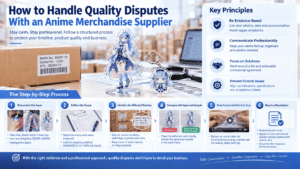
When a disruption occurs—whether a raw sheet supply shortage or a port strike—teams without a plan often lose critical days to miscommunication. Use a standard five-step response protocol:
[ Step 1: IDENTIFY ]   Isolate affected SKUs, order volumes, and committed drop dates.
         │
[ Step 2: ASSESS ]     Determine impact: Launch delay, stockout risk, or aesthetic variance.
         │
[ Step 3: CHOOSE ]     Evaluate options: Split-air shipment, backup material, or secondary line.
         │
[ Step 4: COMMUNICATE] Align with factory, freight partners, and downstream retail accounts.
         │
[ Step 5: RECOVER ]    Verify replacement QC, update inventory systems, and log the root cause.
-
Step 1 — Identify: Quantify the exact issue. Which SKUs are stalled? How many units are affected? What are the hard delivery cutoffs for your sales channels?
-
Step 2 — Assess: Does this issue prevent product functionality, or is it an aesthetic variation? Will this cause an immediate stockout, or merely dip into your designated safety reserve?
-
Step 3 — Choose: Weigh practical solutions against budget constraints. For example, if a custom packaging shipment is delayed, consider packing the bulk merchandise in protective unprinted sleeves and shipping packaging separately, rather than holding the entire production run.
-
Step 4 — Communicate: Provide direct, factual updates to internal stakeholders and key B2B accounts. Share concrete revised delivery windows rather than open-ended delay notices.
-
Step 5 — Recover & Log: Once resolved, trace the breakdown. Did the delay stem from a late design approval, a third-party material stockout, or carrier congestion? Update your operational checklist to prevent a recurrence.
11. Choose a Manufacturer That Supports Supply Chain Resilience
Managing supply chain risk is simpler when your manufacturing partner operates as a technical collaborator rather than a transactional vendor.
When evaluating potential partners, use this operational checklist to gauge their readiness:
-
In-House Manufacturing Control: Do they directly operate core machinery (UV flatbeds, precision laser cutters, polishing equipment), or do they subcontract production out to third parties?
-
Transparent Capacity Management: Can they provide realistic lead-time commitments during seasonal demand spikes?
-
Engineering & Sampling Rigor: Are they willing to produce counter-samples, test alternative material clear-coats, and establish strict dimensional tolerances for your accessories?
-
MOQ Flexibility for Catalog Scaling: Do they offer low-risk initial runs for new SKUs alongside high-volume capacity for proven sellers?
-
Consistent Account Coordination: Do you work with a dedicated technical contact who understands file requirements, packaging compliance, and proactive delay reporting?
The Factory-Direct Advantage: Working factory-direct with a dedicated manufacturer like BOCE GIFTS removes intermediaries, streamlines communication during engineering changes, and ensures that material specs and quality standards remain consistent across initial runs and repeat orders.
12. Build a Backup Plan That Supports Long-Term Growth
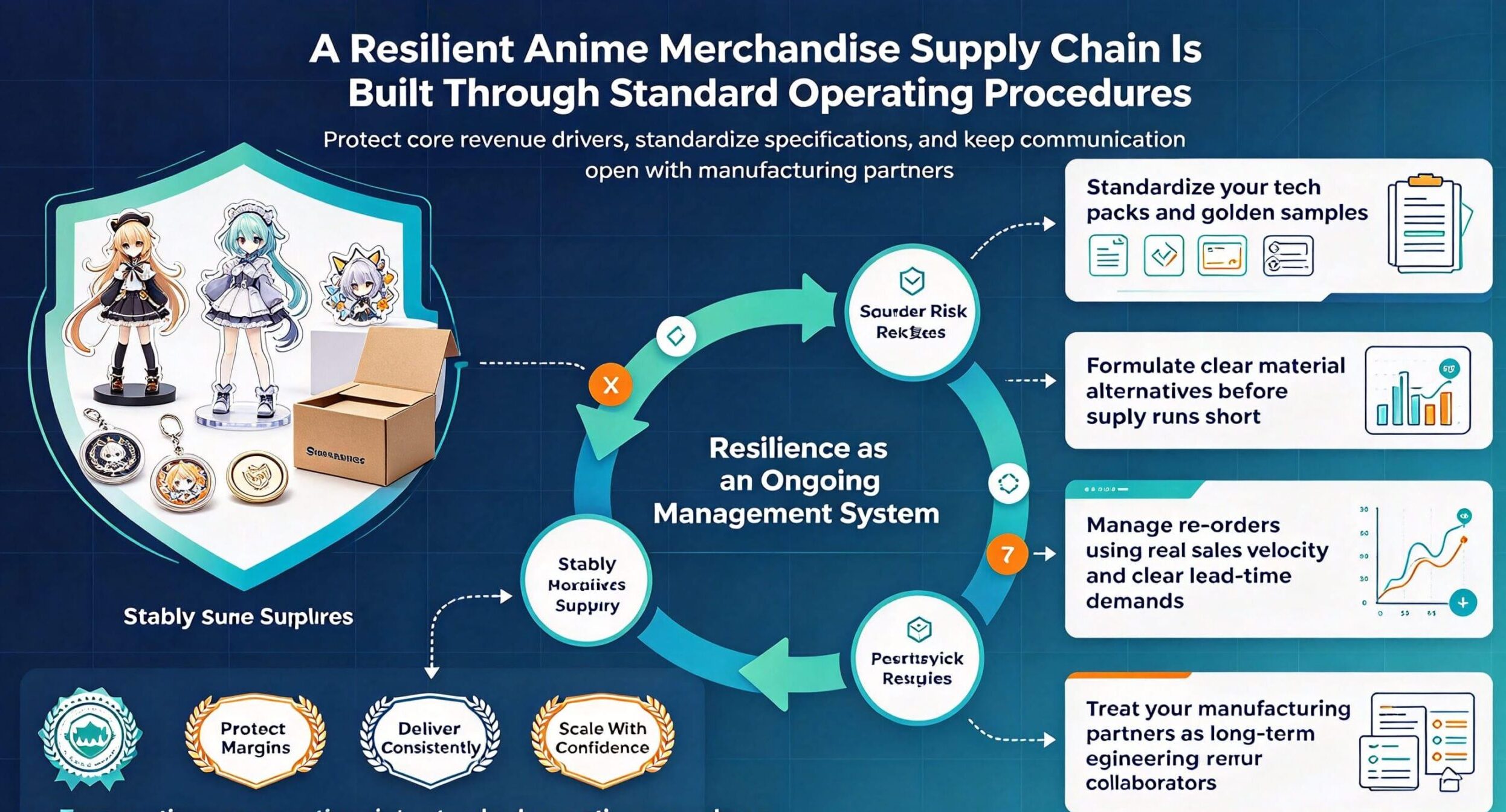
A resilient anime merchandise supply chain is not built overnight, nor does it require preparing for every conceivable edge case. Instead, it is an ongoing management system focused on protecting your core revenue drivers, standardizing product specifications, and keeping open communication channels with your manufacturing partners.
Review your risk profiles at the end of each quarter and prior to high-volume convention or holiday cycles:
-
Standardize your tech packs and golden samples.
-
Formulate clear material alternatives before supply runs short.
-
Manage re-orders using real sales velocity and clear lead-time demands.
-
Treat your manufacturing partners as long-term engineering collaborators.
By turning these contingency practices into standard operating procedures, you can protect your margins, deliver consistently for your customers, and scale your brand with confidence.
Appendix: Anime Merchandise Supply Chain Risk Checklist
Use this audit checklist across your catalog before placing seasonal purchase orders:
| Risk Category | Key Assessment Question | Recommended Action |
| Core SKUs | Which 20% of your products generate 80% of current retail revenue? | Lock in dedicated safety stock and establish repeat order triggers. |
| Critical Materials | Does this product use specialized acrylic, rare metal platings, or custom glitter films? | Pre-approve functional alternative materials and counter-samples. |
| Tooling & Specs | Are complete vector files, cut paths, and Pantone color specs archived? | Assemble a complete Technical QC Dossier for every active SKU. |
| Manufacturing Capacity | Does your factory have scheduled open capacity during your target production month? | Reserve production windows 4–6 weeks prior to seasonal rushes. |
| Lead Time Realism | Does your schedule account for artwork approvals, material prep, sampling, QC, and customs? | Add a 7–10 day buffer to overall launch timelines. |
| Re-Order Metrics | Do you have a defined Re-Order Point ($ROP$) based on verified lead times? | Calculate ROP across all active evergreen items; monitor daily sales velocity. |
| Contingency Roles | Who on your team makes the final call when a production deviation is flagged? | Establish a clear incident protocol with pre-designated decision owners. |
Internal Linking & Content Hub Recommendations (For BOCE Editorial Team)
-
Link to Selection Guides: Link the mention of factory qualification to
"How to Choose an Anime Merchandise Manufacturer in China"and"How to Compare Anime Merchandise Suppliers in China". -
Link to Production & Planning: Anchor discussions on capacity and multi-SKU releases to
"How to Manage Multiple Anime Merchandise SKUs With One Manufacturer". -
Link to Inventory & Scaling: In Sections 8 and 9, embed natural context links to
"How to Plan Re-orders for Anime Merchandise"and"How to Avoid Overstocking Anime Merchandise". -
Product Landing Pages: In Section 3 and Section 6, link the material discussions directly to BOCE’s core product category pages—specifically Custom Acrylic Standees, Acrylic Keychains, and Custom Metal Badges & Lapel Pins. Ensure links appear within actionable, technical sentences rather than disruptive promotional banners.