Inventory planning for custom merchandise sits on a narrow edge. Place too small an order, and your top-selling products sell out weeks before replacement stock arrives at your warehouse. Order too much, and slow-moving designs tie up operating capital, crowd storage space, and choke cash flow needed for your next product drop.
This challenge is acute across the anime merchandise wholesale sector. A retailer might release a new collection where two specific acrylic standee designs sell out in 72 hours, while three secondary characters linger on shelves for four months. Reordering every SKU in equal volumes inevitably triggers both stockouts on high-demand items and overstock on low-velocity variants.
Solving this does not mean ordering tiny quantities at random. It requires a disciplined reorder framework that links retail sales velocity to factory lead times, minimum order quantities (MOQs), and pipeline inventory.
1. Track Sales Velocity by SKU, Not by Collection
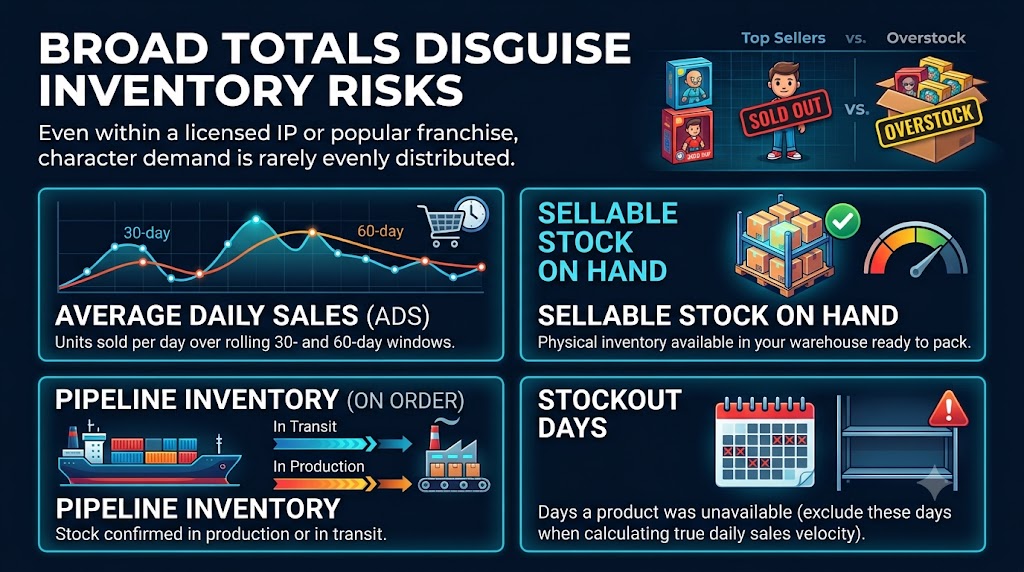
Broad collection totals disguise inventory risks. Even within a licensed IP or popular franchise, character demand is rarely evenly distributed.
Track these data points for every individual design:
-
Average Daily Sales (ADS): Units sold per day over rolling 30- and 60-day windows.
-
Sellable Stock on Hand: Physical inventory available in your warehouse ready to pack.
-
Pipeline Inventory (On Order): Stock confirmed in production or in transit.
-
Stockout Days: Days a product was unavailable (exclude these days when calculating true daily sales velocity).
Classify your catalog into three operating tiers:
For custom acrylic keychains, badges, and standees, evaluate velocity at the character and finish level (e.g., standard acrylic vs. holographic or glitter variants). Never apply uniform reorder volumes across an entire collection.
2. Calculate the Reorder Point (ROP)
The Reorder Point establishes the exact inventory threshold that triggers a purchase order.
Where:
Real-World Example
A retailer sells an average of 25 units per day of a popular character standee. The custom manufacturer in China requires 20 days to complete production and deliver the goods to the warehouse. The retailer maintains a 5-day safety buffer (125 units).
-
Lead-Time Demand:
-
Safety Stock:
-
Reorder Point:
Calculate by Inventory Position, Not Just Physical Stock
Never trigger orders based strictly on shelf count. Calculate your comprehensive Inventory Position:
If you have 300 units on your warehouse shelves, 400 units already in transit, and 50 backorders awaiting fulfillment:
Because 650 units exceeds your ROP of 625 units, you do not place an order yet.
3. Set Safety Stock Based on Real Supply Chain Risks
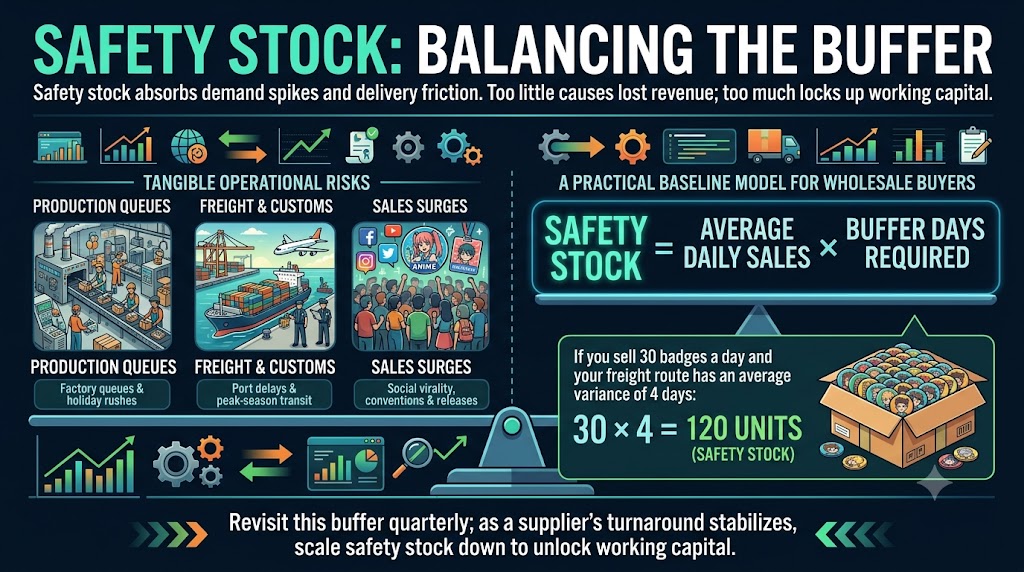
Safety stock absorbs demand spikes and delivery friction. Too little causes lost revenue; too much locks up working capital.
Base your safety buffer on tangible operational risks:
-
Production Queues: Extended factory queues during pre-holiday rushes or major trade cycles.
-
Freight and Customs: Port delays, customs clearance inspections, or peak-season air courier delays.
-
Sales Surges: Organic virality on social media, convention appearances, or major anime episode releases.
A practical baseline model for wholesale buyers:
If you sell 30 badges a day and your freight route has an average variance of 4 days, set a safety stock of . Revisit this buffer quarterly; as a supplier’s turnaround stabilizes, scale safety stock down to unlock working capital.
4. Determine Reorder Quantity (ROQ)
After hitting your Reorder Point, calculate the optimal batch size using the Target Stock Level method:
Where:
Calculation Breakdown
-
Average Daily Sales: 20 units/day
-
Target Coverage: 45 days of supply
-
Safety Stock: 100 units
-
Current Inventory Position: 220 units
Cross-check this 780-unit figure against three constraints before issuing a PO:
-
Factory MOQ: Does 780 units meet the supplier’s tier requirements for that SKU?
-
Shipping Densities: Does this quantity optimize carton packaging or air/sea shipping weight brackets?
-
Working Capital Limits: Does this order leave sufficient cash for upcoming product launches?
5. Calculate Total Replenishment Lead Time
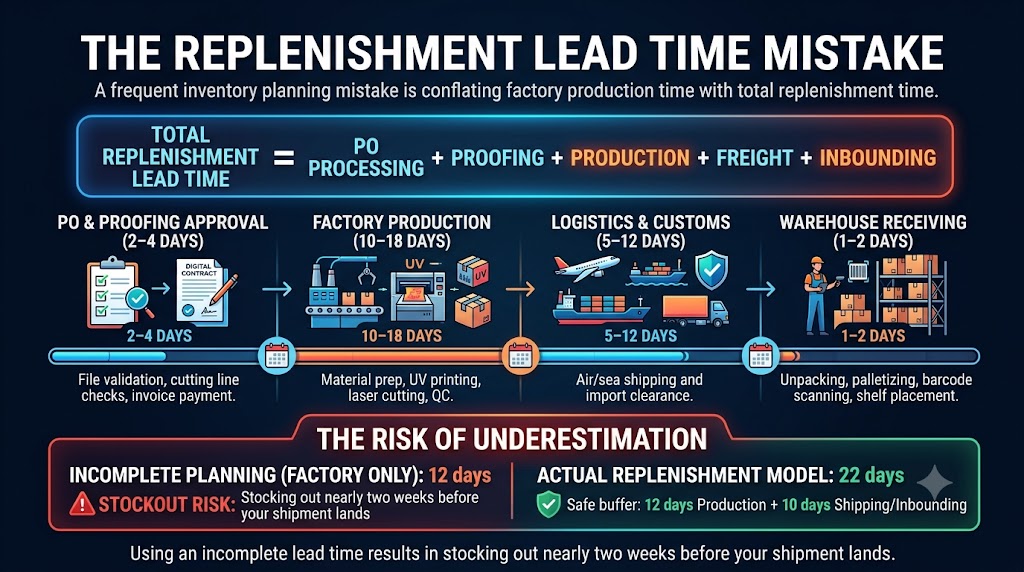
A frequent inventory planning mistake is conflating factory production time with total replenishment time.
-
PO & Proofing Approval (2–4 days): File validation, cutting line checks, and invoice payment.
-
Factory Production (10–18 days): Material prep, UV printing, laser cutting, hardware assembly, and QC.
-
Logistics & Customs (5–12 days): Air express, air freight, or sea shipping plus import clearance.
-
Warehouse Receiving (1–2 days): Unpacking, palletizing, barcode scanning, and shelf placement.
If manufacturing takes 12 days but shipping and inbounding take 10 days, your replenishment model must use 22 days, not 12. Using an incomplete lead time results in stocking out nearly two weeks before your shipment lands.
6. Balance Low MOQ Sampling Against Bulk Reorders
A low minimum order quantity (MOQ) protects cash flow during product launches, but recurring micro-orders introduce hidden expenses.
Product Stage:  [ Test Launch ]       -->      [ Proven Winner ]
Strategy:       Low MOQ / Multi-SKU             Bulk Repeat Order
Core Benefit:   Limits capital exposure         Lowers unit cost & freight
Trade-off:      Higher per-unit cost            Higher upfront cash commitment
-
Test Phase (Low MOQ): Order 50–100 units per design across 5–10 character variants. This limits exposure while consumer demand indicates clear winners.
-
Scale Phase (Bulk Repeat Orders): Once a design establishes steady demand, increase repeat orders to 500–2,000+ units. This secures lower unit pricing, consolidates freight costs, and protects profit margins.
Work with a production partner that accommodates this lifecycle: accessible MOQs for product validation, followed by volume production capacity for recurring replenishment.
7. Coordinate Repeat Production Runs With Your Factory
Emergency orders strain factory schedules and inflate shipping expenses. Prevent inventory gaps by integrating your supplier into your planning cycle:
-
Share Rolling Projections: Provide your manufacturer with 30-to-60-day non-binding demand estimates. This enables factories to reserve raw acrylic sheets, specialized hardware, and print-bed time in advance.
-
Standardize Technical Specs: Lock base dimensions, acrylic thicknesses (e.g., 3mm vs. 4mm), and packaging styles across SKUs. Standardized raw materials accelerate production runs.
-
Batch Production Schedules: Consolidate repeat orders across multiple top-selling designs into unified production runs to meet total batch MOQs while maintaining balanced SKU-level stock.
Wholesale Reorder Pre-Flight Checklist
Run this checklist before issuing repeat production orders:
-
[ ] Evaluated Average Daily Sales (ADS) independently for every SKU.
-
[ ] Accounted for pipeline inventory and backorders in current Inventory Position.
-
[ ] Based safety stock on actual historical shipping and manufacturing variances.
-
[ ] Factored total lead time (proofing + production + shipping + receiving) into ROP calculations.
-
[ ] Balanced SKU-level order volumes instead of splitting batch quantities evenly across collections.
-
[ ] Verified that calculated order quantities meet factory MOQ and budget constraints.
-
[ ] Shared upcoming production schedules with the manufacturing team.
Optimize Your Repeat Merchandise Orders With BOCE GIFTS
Managing inventory requires a dependable manufacturing partner that respects delivery timelines, delivers consistent product quality, and supports flexible order volumes.
BOCE GIFTS works directly with anime brands, independent creators, and global merchandise distributors to streamline custom manufacturing and repeat orders. From custom acrylic standees and glitter keychains to enamel pins and plush badges, our production lines are engineered for fast turnaround, reliable repeat-order matching, and strict quality control.
Ready to balance your stock levels with dependable factory replenishment? Contact BOCE GIFTS today with your SKU specifications, target volumes, and delivery targets to receive a detailed wholesale production quote.
Internal Linking & Content Architecture Strategy
To maximize SEO equity and topical authority across your domain, embed these strategic internal links throughout the published article:
-
In Section 4 (Determine Reorder Quantity):
-
Anchor text: “minimum order quantity requirements”
-
Target: Link to your guide:
Anime Merchandise MOQ: How Much Should You Order?
-
-
In Section 5 (Calculate Total Replenishment Lead Time):
-
Anchor text: “manufacturing lead time for custom acrylics”
-
Target: Link to your guide:
How Long Does It Take to Manufacture Custom Acrylic Standees?
-
-
In Section 6 (Balance Low MOQ Sampling Against Bulk Reorders):
-
Anchor text: “scale your anime merchandise collection”
-
Target: Link to your guide:
How to Scale an Anime Merchandise Collection After a Successful First Order
-
-
In Section 7 (Coordinate Repeat Production Runs):
-
Anchor text: “vetting a custom merchandise supplier in China”
-
Target: Link to your guide:
How to Choose an Anime Merchandise Manufacturer in China
-