Many standees on the market suffer from cracked bases, peeling paint, instant fracturing upon contact with alcohol, and surfaces turning yellow or cloudy. The root cause is that manufacturers, driven by tight deadlines and cost-cutting, use sub-standard base materials and skip multiple critical processing steps.
Whether you are dealing with top rated acrylic charm and standee wholesalers or evaluating a cheap custom acrylic stand manufacturer bulk order, understanding these technical root causes is vital. To produce a truly durable, “collector-grade” standee, upgrades must be made across four core manufacturing stages.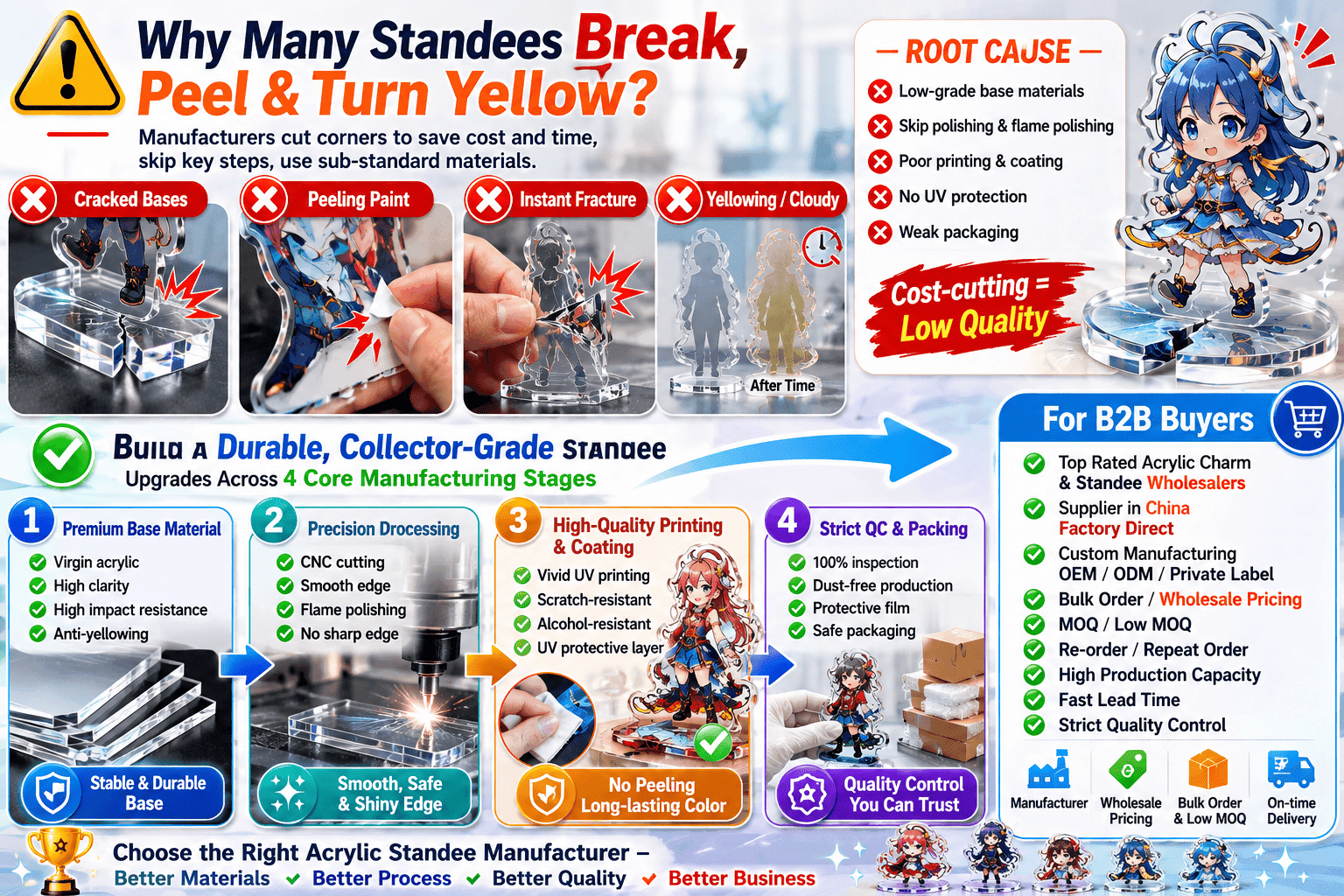
Process Upgrade Guide
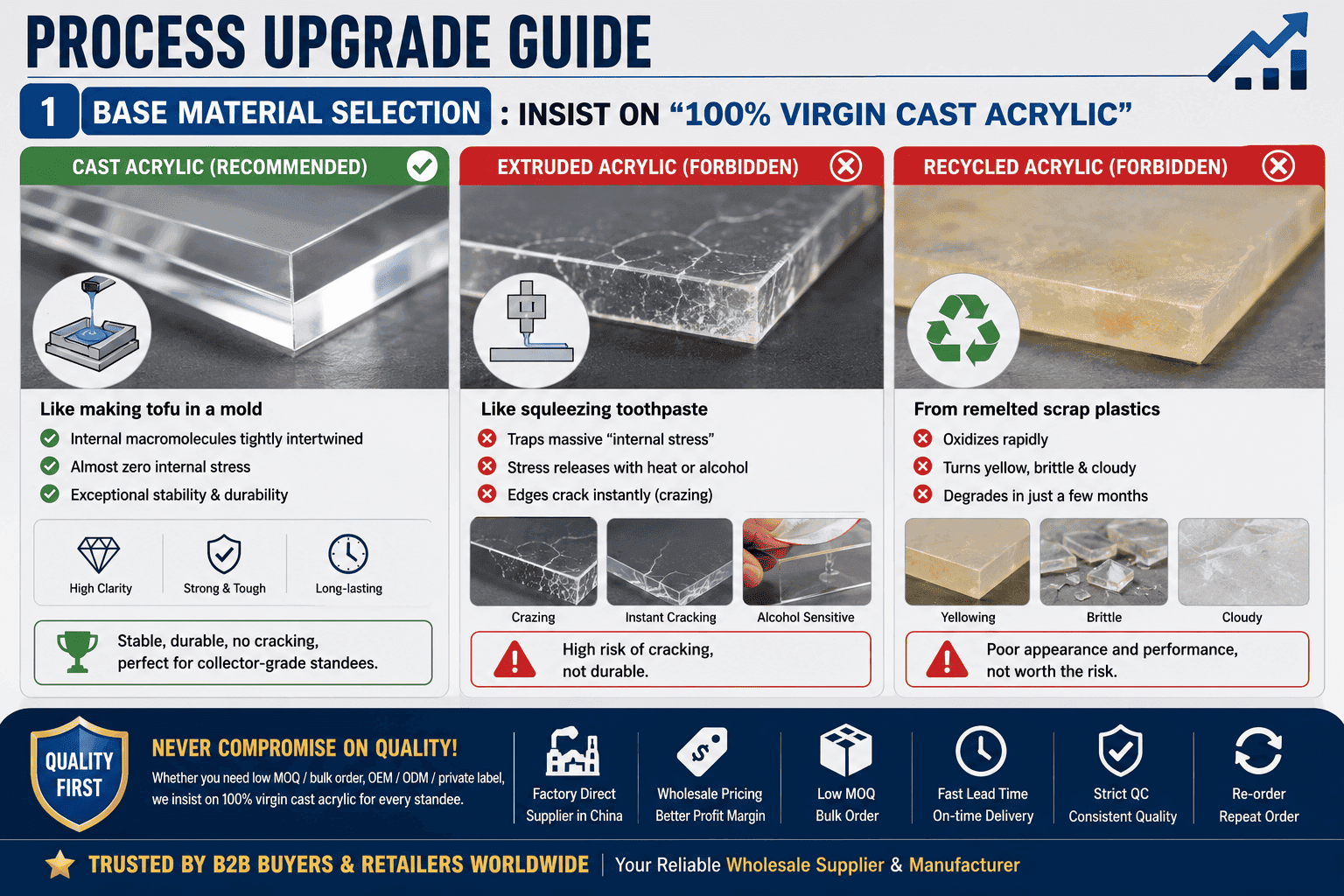
1. Base Material Selection: Insist on “100% Virgin Cast Acrylic”
There are two primary methods for manufacturing acrylic sheets, and their quality varies drastically:
-
Cast Acrylic (Recommended): Like making tofu in a mold, liquid raw materials slowly solidify between two sheets of glass. The internal macromolecules are tightly intertwined with almost zero internal stress, making its physical performance exceptionally stable. Any reputable anime acrylic standee source factory direct will prioritize this material.
-
Extruded Acrylic (Forbidden): Like squeezing toothpaste, it is continuously pushed out by a machine. This sheet traps a massive amount of “internal stress.” When subjected to the thermal shock of laser cutting or exposed to alcohol, this stress releases spontaneously, causing the edges to crack instantly (crazing).
-
Recycled Acrylic (Forbidden): Made by remelting scrap plastics. These sheets oxidize rapidly, turning badly yellow, brittle, and cloudy within just a few months of purchase. Even when negotiating a low wholesale acrylic standee price per unit for 1000pcs, never compromise on recycled material.

2. Assembly Engineering: Use “CNC Milling” to Fix Loose or Tight Slots
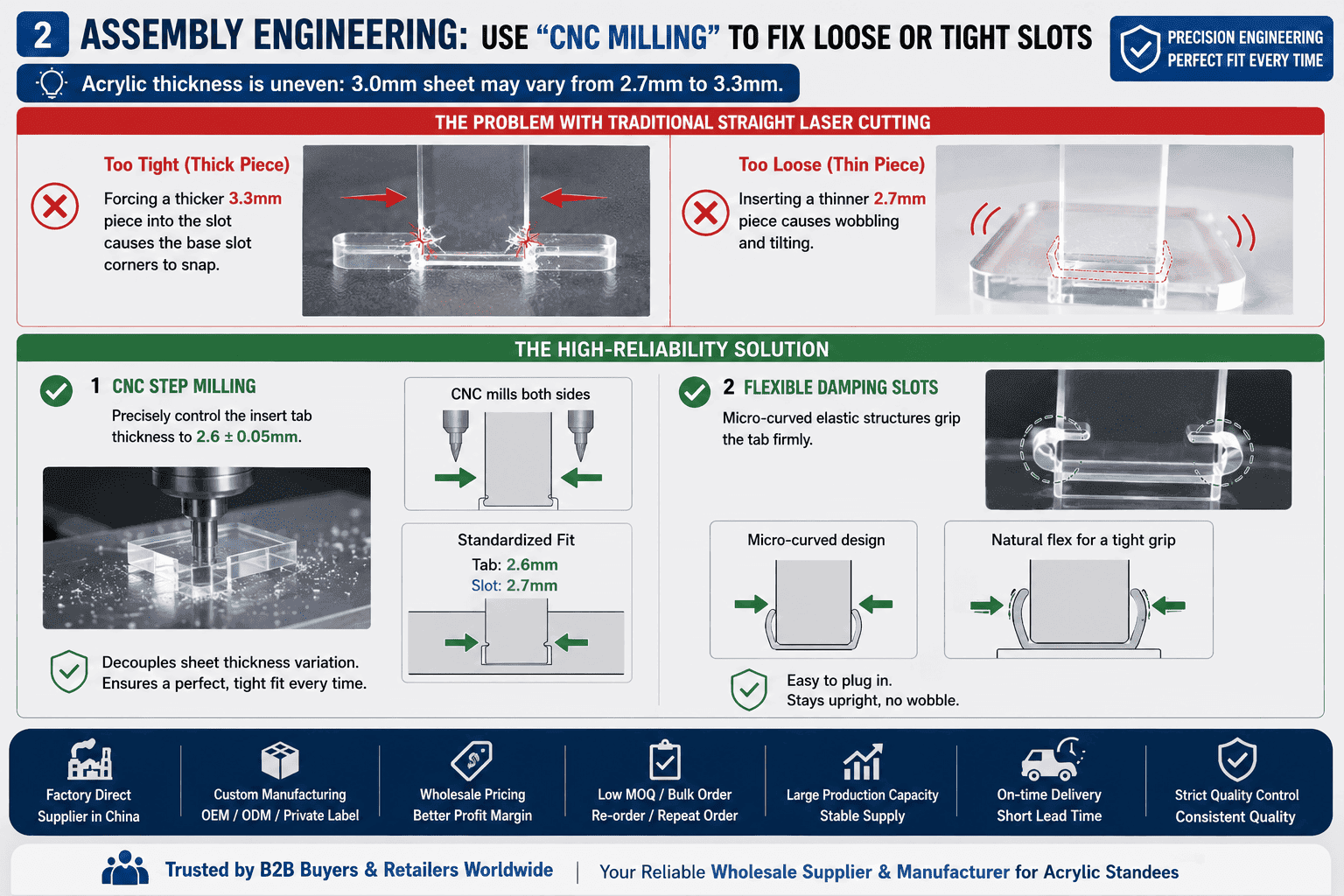
High-quality cast acrylic has an inherent physical trait: its thickness is uneven (for example, a sheet labeled as 3.0 mm might actually fluctuate between 2.7 mm and 3.3 mm across its surface).
-
The Problem with Traditional Straight Laser Cutting: If you laser-cut a rigid 3.0 mm slot, forcing a thicker 3.3 mm piece into it will exert immense pressure, causing the right-angled corners of the base slot to snap instantly. Conversely, if a thinner 2.7 mm piece is inserted, the standee will wobble and tilt severely.
-
The High-Reliability Solution: Partnering with a professional verified acrylic standee factory in China ensures access to proper structural engineering:
-
CNC Step Milling: Use a precise CNC machine to shave down both sides of the standee’s insert tab, locking its thickness precisely at 2.6 ± 0.05 mm. The base slots are then standardized at 2.7 mm. This completely decouples the overall sheet thickness variation from the assembly joint, ensuring a perfect fit every time.
-
Flexible Damping Slots: Design micro-curved elastic structures or bridges on the sides of the tab or slot. This utilizes the natural micro-flexibility of the acrylic to grip the piece firmly, making it easy to plug in while keeping the standee perfectly upright without wobbling.
-
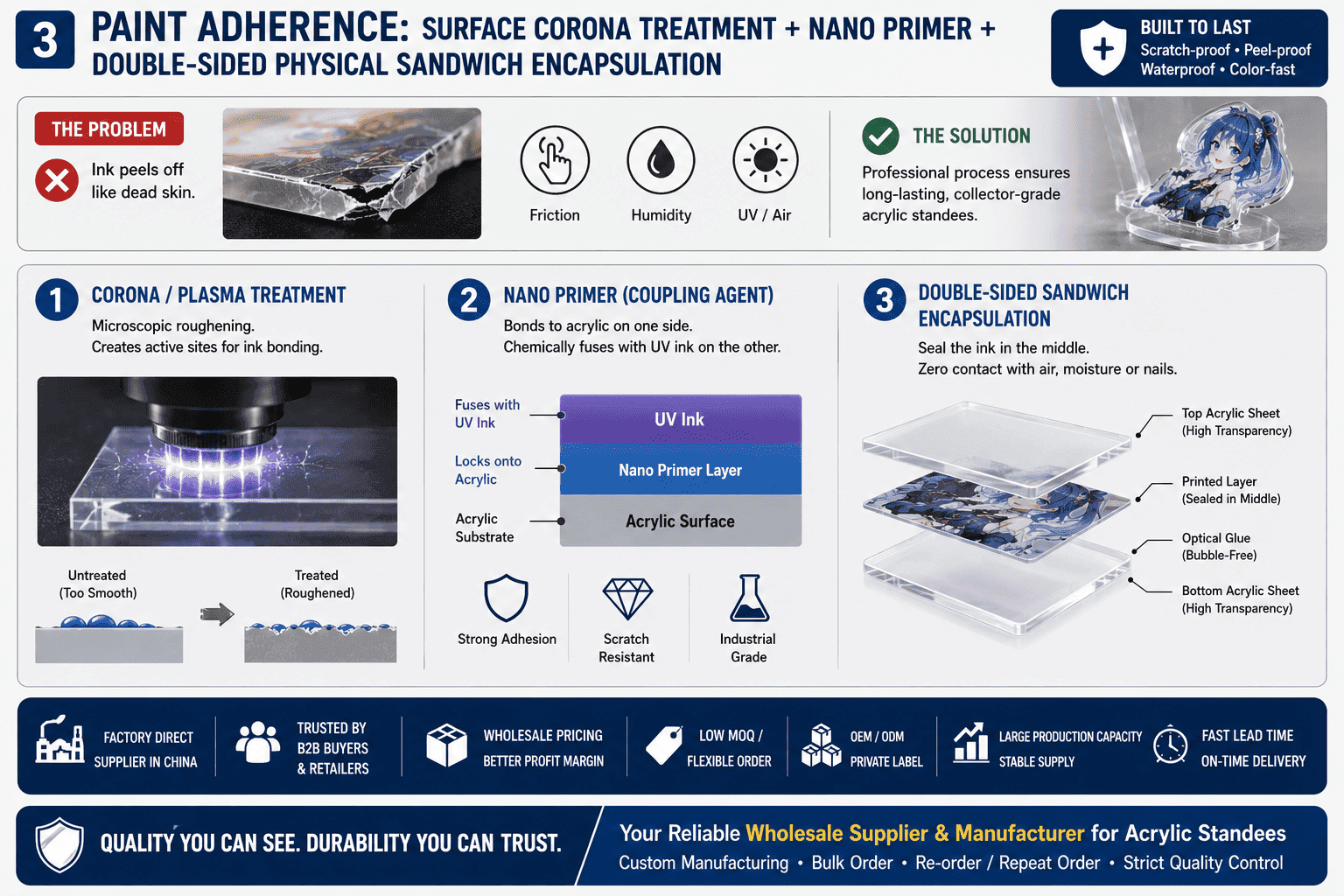
3. Paint Adherence: Surface Corona Treatment + Nano Primer + Double-Sided Physical Sandwich Encapsulation
The surface of acrylic is naturally ultra-smooth, making it difficult for ink to bond permanently. If UV ink is sprayed directly onto it, frequent friction or air humidity will cause the graphic layer to peel off in large flakes like dead skin.
When vetting a low MOQ acrylic standee printing factory or a niche custom anime acrylic stand supplier no minimum, ensure they follow these adhesion standards:
-
Corona/Plasma Treatment: Before printing, bombard the acrylic surface with high-energy electrons to “roughen” it at a microscopic level, creating active sites that readily bond with ink.
-
Nano Primer (Coupling Agent): Apply a specialized nano-primer before printing. It acts like heavy-duty double-sided tape—one side locks onto the acrylic, while the other side chemically fuses with the UV ink under ultraviolet light, reaching industrial-grade scratch resistance.
-
Double-Sided Sandwich Encapsulation (The Ultimate Method): Print the graphic on the back of the first acrylic sheet, and then use high-transparency optical glue to tightly bond a second acrylic sheet over it. This seals the ink right in the middle of two hard plastic layers like a sandwich. The artwork never comes into contact with air, moisture, or fingernails, making it completely immune to scratches and peeling.
4. Crack Prevention: Must Perform “Controlled Thermal Annealing” (Stress-Relief Baking)
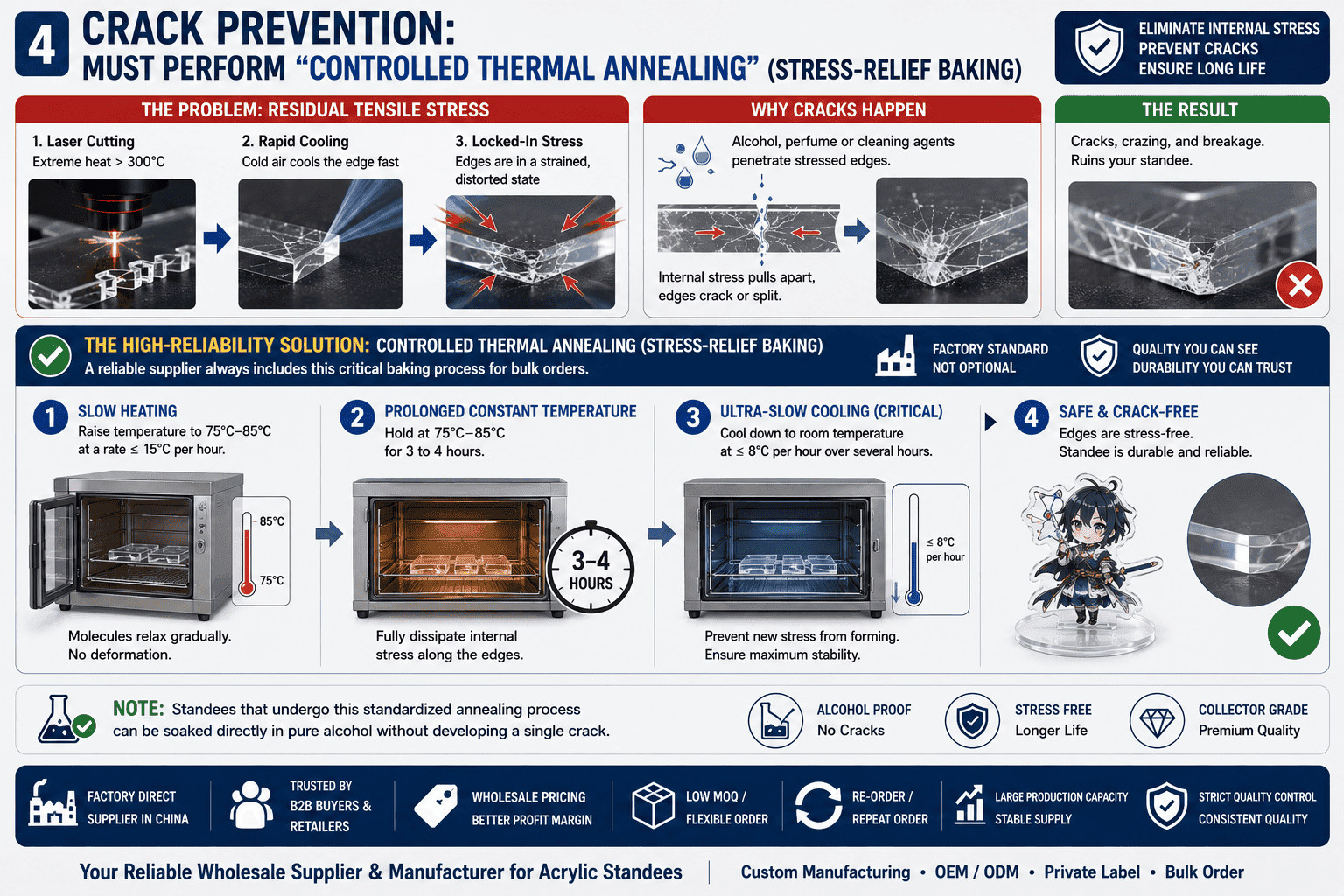
Laser cutting uses extreme temperatures above 300°C to instantly vaporize and cut the acrylic. As the laser passes, the cut edge is blasted by cold ambient air and cools rapidly. This locks the molecules at the edge into a highly strained, distorted state (known professionally as residual tensile stress).
If the standee comes into contact with alcohol, perfume, or cleaning agents in this state, the liquid molecules will quickly worm their way into the strained molecular gaps. Tugged by the internal stress, the edges will spontaneously fracture into a web of tiny cracks or split wide open. A reliable acrylic display stand supplier for bulk orders will always include a dedicated baking phase to eliminate this risk.
-
The High-Reliability Solution: After laser cutting, the standee components must be placed into an industrial oven for stress-relief annealing (baking).
-
Slow Heating: Gradually raise the temperature to 75°C–85°C at a rate not exceeding 15°C per hour. This allows the tense molecules to relax without causing any macro-deformation to the plastic.
-
Prolonged Constant Temperature: Hold this temperature steadily for 3 to 4 hours to completely dissipate the internal stress trapped along the edges.
-
Ultra-Slow Cooling (Critical): After baking, the oven must cool down to room temperature at a strict, sluggish rate of no more than 8°C per hour over several hours. Cooling too fast will create a temperature gradient between the inside and outside of the plastic, trapping brand-new stress.
-
Note: Standees that undergo this standardized annealing process can be soaked directly in pure alcohol without developing a single crack.
-
Sourcing Safeguards: Two-Step Quick Test for Premium Suppliers
Whether you work with an independent brand or source via an acrylic charm standee wholesale dropshipping supplier, you can immediately expose low-quality products using these two simple physical tests:
| Test Item | Low-Quality Standee (Extruded/Recycled/Unannealed) | Premium Standee (Virgin Cast + Standard Annealed) |
| Lighter Micro-Flame Melting Test | Soften a corner slightly with a lighter and touch it with a needle. It will pull out into long, fine plastic threads. | Once softened, it will only bubble or melt locally. It absolutely will not pull into long threads. |
| Pure Alcohol Soaking Test | Drop the cut edge or insert tab directly into medical alcohol. Dense micro-cracks will split open within seconds. | Soak it in pure alcohol for 15 minutes. It remains flawless without a single crack. |
Conclusion
The widespread market complaint that “there are no dependable acrylic standees” is ultimately the result of fast-fashion manufacturing compromising on materials science and precision engineering.
To safeguard your brand reputation, sourcing teams must look past basic cost metrics and partner with an experienced, sedex audited acrylic stand manufacturer. Brands must make “100% virgin cast PMMA sheets” their baseline, and strictly mandate core processes like “CNC tab milling,” “surface adhesion modification,” and “finished product thermal annealing.” Establishing supplier entry barriers based on these technical standards is the only way to break out of the low-quality race to the bottom.