A Complete B2B Guide to OEM/ODM Custom Manufacturing
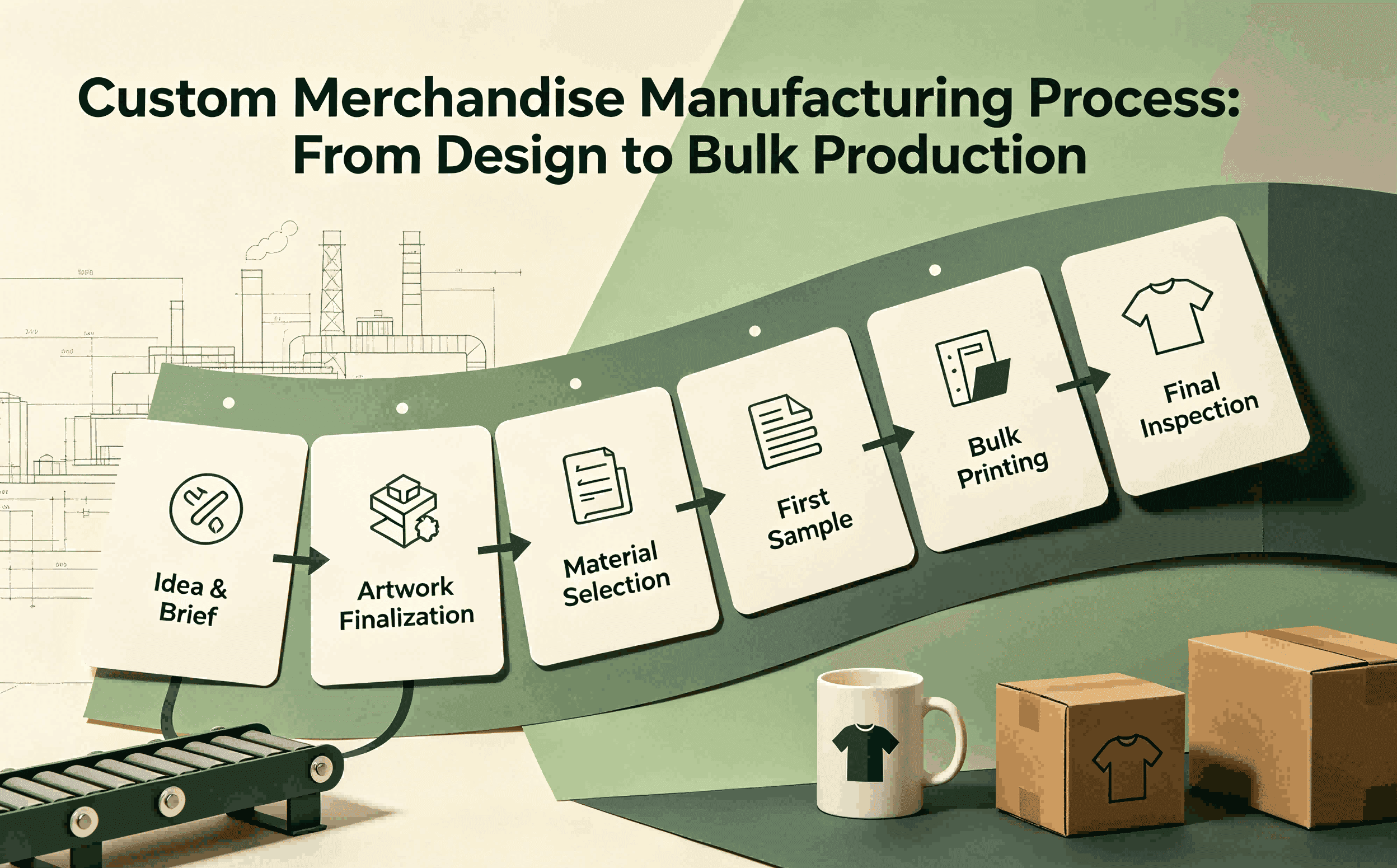
When sourcing custom merchandise from a factory-direct manufacturer in China, production does not simply begin when an artwork file is received. A professional manufacturing workflow requires pre-flight engineering reviews, material verification, detailed landed cost calculations, pre-production prototyping, scheduled production runs, multi-stage quality control, and international logistics management.
Design Submission → Engineering Review → Quotation → Sampling → Sample Approval → Bulk Production → Quality Control → Custom Packaging → Shipping → Re-orders
For B2B buyers, wholesalers, e-commerce brands, and event planners, understanding every stage of this pipeline enables accurate forecasting of costs, minimum order quantities (MOQ), product quality, and lead times before committing capital to bulk production runs.
Step 1: Submit Your Design and Product Requirements
Every custom manufacturing project begins with design specifications and functional requirements submitted by the buyer.
+-------------------------------------------------------------------------+
|                       Product Requirements Checklist                    |
+-------------------------------------------------------------------------+
| * Vector / High-Res Artwork Files   * Packaging Specifications          |
| * Exact Product Dimensions          * Hardware & Accessory Selection    |
| * Base Material & Thickness         * Target Order Volume (MOQ / Units) |
| * Color Profiles (Pantone / CMYK)   * Delivery Destination & Target Date|
+-------------------------------------------------------------------------+
-
OEM (Original Equipment Manufacturer): You supply the final vector graphics, dimensional specifications, and material parameters; the factory executes production exactly to your design blueprint.
-
ODM (Original Design Manufacturer): You provide a brand concept, theme, or rough sketch, and the manufacturer develops the structural CAD/vector files, molds, and functional prototypes using existing base manufacturing solutions.
Step 2: Artwork & Engineering Review (DFM)
A reliable manufacturing partner does not simply send raw files directly to machine operators. A dedicated engineering team conducts a Design for Manufacturability (DFM) review to ensure your concept transitions into mass production without structural or visual defects.
-
Artwork Pre-Flight: Verifying 300+ DPI resolution, vector paths, CMYK color profiles, bleed margins, cut lines, and white ink underbase layers for transparent substrates.
-
Structural & Material Evaluation: Assessing thickness, weight distribution, tensile strength, and interlocking base tolerances (such as mortise-and-tenon acrylic fittings).
-
Production Method Matching: Selecting the optimal industrial technique based on your material:
| Production Method | Ideal Materials | Common Merchandise Applications |
| High-Precision UV Printing | Acrylic, Wood, PVC |
Standees, keychains, display panels |
| Laser Cutting & CNC | PMMA Acrylic, Wood, Metal |
Custom-shaped charms, base plates |
| Die-Casting / Stamping | Zinc Alloy, Iron, Brass | Enamel pins, challenge coins, medals |
| Dye-Sublimation & Screen | Polyester, Canvas, Cotton |
Tote bags, lanyards, apparel |
| Liquid Injection Molding | Silicone, Soft PVC |
2D/3D rubber keychains, wristbands |
Step 3: Quotation and Cost Evaluation
Once engineering validates production feasibility, the manufacturer generates an itemized commercial quotation.
| Cost Component | What It Covers |
| Unit Product Cost | Raw materials, baseline machine run time, and labor assembly. |
| Tooling & Setup | Custom mold creation, CNC programming, or printing plate setup. |
| Print & Surface Finishing |
Multi-pass UV printing, holographic lamination, glitter, epoxy dome coating, or hot foil stamping. |
| Custom Packaging |
Individual OPP bags, printed backing cards, barcode labels, retail boxes. |
| Prototyping / Sampling | Physical pre-production sample creation and machine calibration. |
| Shipping & Logistics | Freight charges, export documentation, customs clearance, and local delivery. |
Factory Unit Price ≠ Landed Cost. Always evaluate the total landed cost—including tariffs, tooling amortizations, and international freight—before comparing supplier bids.
Step 4: Sampling and Prototyping
Creating a physical pre-production sample is standard protocol for verifying material quality, mechanical structure, and color fidelity before releasing purchase orders for mass production.
-
Color Matching: Verifying CMYK ink-layer density and Pantone accuracy under standard D65 lighting.
-
Material Integrity: Inspecting material transparency (e.g., ensuring 100% virgin PMMA acrylic without cloudiness or odors).
-
Dimensional Accuracy: Checking cut edges, millimeter tolerances, and structural joint tightness.
-
Sample Lead Time: Standard merchandise samples typically require 3–5 business days, depending on mold complexity and surface finishing requirements.
Step 5: Sample Approval
The buyer reviews the physical prototype or high-resolution sample photography and provides one of two responses:
-
Approval to Produce: The sample is formally approved and archived as the Golden Production Standard for the factory’s quality assurance team.
-
Engineering Revisions: The buyer requests adjustments (e.g., color calibration, dimensional adjustment, repositioned cut-lines). A revised counter-sample or digital engineering proof is generated for sign-off.
Step 6: Bulk Production Scheduling & Capacity Planning
With sample sign-off and deposit payment completed, the factory purchases raw materials and schedules the bulk production run across active assembly lines.
Raw Material Sourcing → Machine Calibration → Batch Printing / Cutting → Assembly → In-Process QC
-
Production Capacity: Large B2B orders require suppliers with dedicated production capacity to avoid mid-run bottlenecks.
-
Seasonal Lead Time Buffers: Global supply chains experience heavy volume surges ahead of major retail windows (such as Q3/Q4 pre-holiday orders for Halloween and Christmas). Advanced scheduling prevents delivery delays during peak freight seasons.
Step 7: Multi-Stage Quality Control (QC)
To maintain consistent yield rates across thousands of units, professional manufacturers apply a three-tiered inspection workflow rather than relying solely on post-production checks.
[Pre-Production QC]           [In-Process QC (IPQC)]          [Final QC & AQL 2.5]
Raw materials, ink chemistry,   Printing alignment, edge        Cosmetics, scratches, counts,
and tooling calibration         smoothness, and assembly        packaging, and carton drop-tests
-
Pre-Production QC: Raw material verification (confirming grade-A materials and defect-free raw sheets).
-
In-Process QC (IPQC): Continuous inline checks for print-head alignment, registration accuracy, ink curing, and laser cut precision.
-
Final Inspection (AQL Standard): Comprehensive cosmetic and functional audits using AQL (Acceptable Quality Limit) 2.5 / 4.0 criteria, verifying scratch-free surfaces, accurate accessory assembly, barcode readability, and export carton drop-test durability.
Step 8: Custom Packaging and Private Labeling
For retailers and brands, retail-ready packaging enhances perceived value and streamlines distribution. Direct manufacturers provide end-to-end private labeling services:
-
Primary Packaging: High-clarity OPP self-adhesive bags, biodegradable frosted polybags, or custom-molded clamshells.
-
Branded Retail Assets: Full-color cardboard backing cards, header cards, foil-stamped hang tags, and branded blind boxes.
-
Logistics Labeling: High-density barcode/UPC stickers, SKU tracking labels, and shipping carton compliance markings.
Step 9: Shipping, Customs, and Global Delivery
The optimal freight method balances order volume, budget constraints, and target delivery windows:
-
Express Courier (FedEx / DHL / UPS): Best for pre-production samples, urgent event restocks, and shipments under 100 kg (Transit: 3–7 business days).
-
Air Freight: Ideal for medium-volume, time-sensitive wholesale orders (Transit: 7–12 business days).
-
Sea Freight (FCL / LCL): The most cost-effective method for bulk wholesale shipments and large container volumes (Transit: 20–35+ business days depending on destination port).
Step 10: Re-Orders and Archival Management
A successful manufacturing run establishes the baseline for efficient future re-orders. A reliable B2B supplier systematically archives your production assets:
-
Final approved vector cut paths and print-ready artwork files
-
Digital color-match values and Pantone references
-
Custom steel molds, injection dies, and machine toolpaths
-
Packaging die-lines and carton packing patterns
Archiving these parameters eliminates upfront tooling charges, bypasses sample iterations, and reduces bulk production lead times on repeat orders.
Custom Merchandise Manufacturing Timelines
Manufacturing lead times vary based on product construction, order quantity, and customization complexity:
| Production Phase | Typical Duration | Key Influencing Factors |
| Artwork & DFM Review | 1–2 Business Days | File readiness, vector formatting, layer separation |
| Engineering & Quotation | 1–3 Business Days | Custom tooling requirements, packaging complexity |
| Sample Prototyping | 3–5 Business Days | Custom molds, specialized surface finishes |
| Buyer Sample Approval | Buyer Dependent | Physical shipping transit vs. digital photo proofing |
| Bulk Manufacturing | 7–15+ Business Days | Order volume, line allocation, seasonal factory demand |
| QC & Retail Packaging | 2–3 Business Days | Custom labeling, backing card insertions, bagging |
| Global Shipping | 3–35 Business Days | Express Courier vs. Air Freight vs. Ocean Vessel |
Real-World Case Study: 2,000-Piece Custom Acrylic Standee Order
[Design Submission] ─────────► [DFM Review] ─────────► [Sample & Sign-Off]
2,000-piece anime IP           Vector bleed verified;        3-day physical sample verified;
standee with custom base       0.1mm base slot calibrated     approved as Golden Standard
                                                                     │
[Global Fulfillment] ◄──────── [Final AQL QC] ◄──────── [Mass Production]
DDP sea freight to warehouse;  100% scratch/film inspection;  High-speed UV print & laser cut
retail-ready for retail launch individual OPP card backing    completed in 8 business days
-
Design Submission: The client provided character artwork requiring a 15 cm main character silhouette, double-sided printing, a custom interlocking base, and retail backing cards.
-
Engineering Evaluation: The DFM team adjusted base-slot clearances by 0.1 mm to guarantee a firm snap-fit tolerance without adhesive requirements and structured a double-layer “sandwich” print configuration to protect ink from surface abrasions.
-
Sampling: A physical prototype was produced and shipped within 3 business days, confirming color fidelity and mechanical stability.
-
Bulk Production: 2,000 units ran across high-speed UV flatbed and laser cutting lines, finishing ahead of schedule in 8 business days.
-
Quality Control & Packaging: Technicians inspected every unit for PMMA surface clarity, applied protective masking films, affixed custom barcode backing cards, and packed the goods into reinforced cartons.
-
Fulfillment: The order shipped via consolidated DDP sea freight directly to the client’s distribution warehouse.
BOCE Gifts: Factory-Direct Custom Manufacturing
BOCE Gifts operates direct manufacturing facilities in China, supplying global retailers, wholesalers, anime/gaming IP brands, and corporate marketing teams with end-to-end OEM and ODM production solutions.
+-------------------------------------------------------------------------+
|                  Core BOCE Gifts Manufacturing Lines                    |
+-------------------------------------------------------------------------+
| * Premium Acrylic Standees & Keychains * Die-Cast Badges & Enamel Pins  |
| * Custom Canvas Bags & Totes           * Promotional Gifts & Lanyards   |
| * Molded Silicone & PVC Merchandise    * Custom Retail Packaging        |
+-------------------------------------------------------------------------+
-
Direct Factory Sourcing: Direct factory communication with dedicated production engineers.
-
Flexible Low MOQs: Low minimum order quantities (from 100 pcs/design) to support market testing alongside scalable bulk capacity.
-
Dedicated Production Capacity: 50+ manufacturing lines ensuring stable throughput during peak retail cycles.
-
Comprehensive Quality Control: Strict raw material verification (100% Virgin PMMA) combined with inline and pre-shipment AQL audits.
-
Accelerated Repeat Orders: Systematic asset archiving for rapid turnarounds on seasonal restocks.
Frequently Asked Questions (FAQ)
What is the first step in custom merchandise manufacturing? The first step is submitting vector artwork (AI, PDF, or high-resolution PSD) alongside detailed product specifications, including dimensions, base material, order volume, accessory choices, and packaging requirements.
How long does custom merchandise manufacturing take from start to finish?
A typical project requires 3–5 business days for sampling and 7–15 business days for bulk manufacturing, plus transit time depending on the selected shipping method (Express, Air, or Ocean).
Do I need a physical sample before placing a bulk order? Physical samples are recommended for orders requiring custom tooling, intricate color matching, or specific structural snap-fits. For rapid turnarounds on standard products, high-resolution photo and video proofs can expedite the schedule.
What digital file formats are required for OEM manufacturing? Vector files in Adobe Illustrator (.AI), Editable PDF (.PDF), or EPS formats configured in CMYK color mode at 300+ DPI with clearly labeled cut-lines and layer separations yield the highest manufacturing precision.
What is the difference between OEM and ODM manufacturing?
OEM (Original Equipment Manufacturing) involves manufacturing a product built strictly to your original designs and technical drawings. ODM (Original Design Manufacturing) utilizes the factory’s existing structural designs and product molds, customized with your branding, colors, and graphics.
How does MOQ affect overall production cost?
Higher order quantities lower the per-unit price by amortizing fixed engineering setup, machine calibration, mold fabrication, and batch printing costs over a larger volume of units.
How do manufacturers verify quality during bulk production runs?
Reputable factories implement a three-phase quality control framework: Pre-Production QC (raw material inspection), In-Process QC (inline print, cut, and assembly monitoring), and Final QC (AQL 2.5 defect audits and carton drop-tests).
Can we customize private-label retail packaging? Yes. Comprehensive private-label services include full-color branded backing cards, header cards, custom-printed OPP bags, retail display boxes, and thermal-printed barcode/SKU stickers.
How are repeat orders handled for past merchandise designs?
All approved vector die-lines, color formulas, mold tools, and packaging specifications are securely archived in the manufacturer’s ERP system, allowing repeat runs to skip prototyping and proceed directly to mass production.