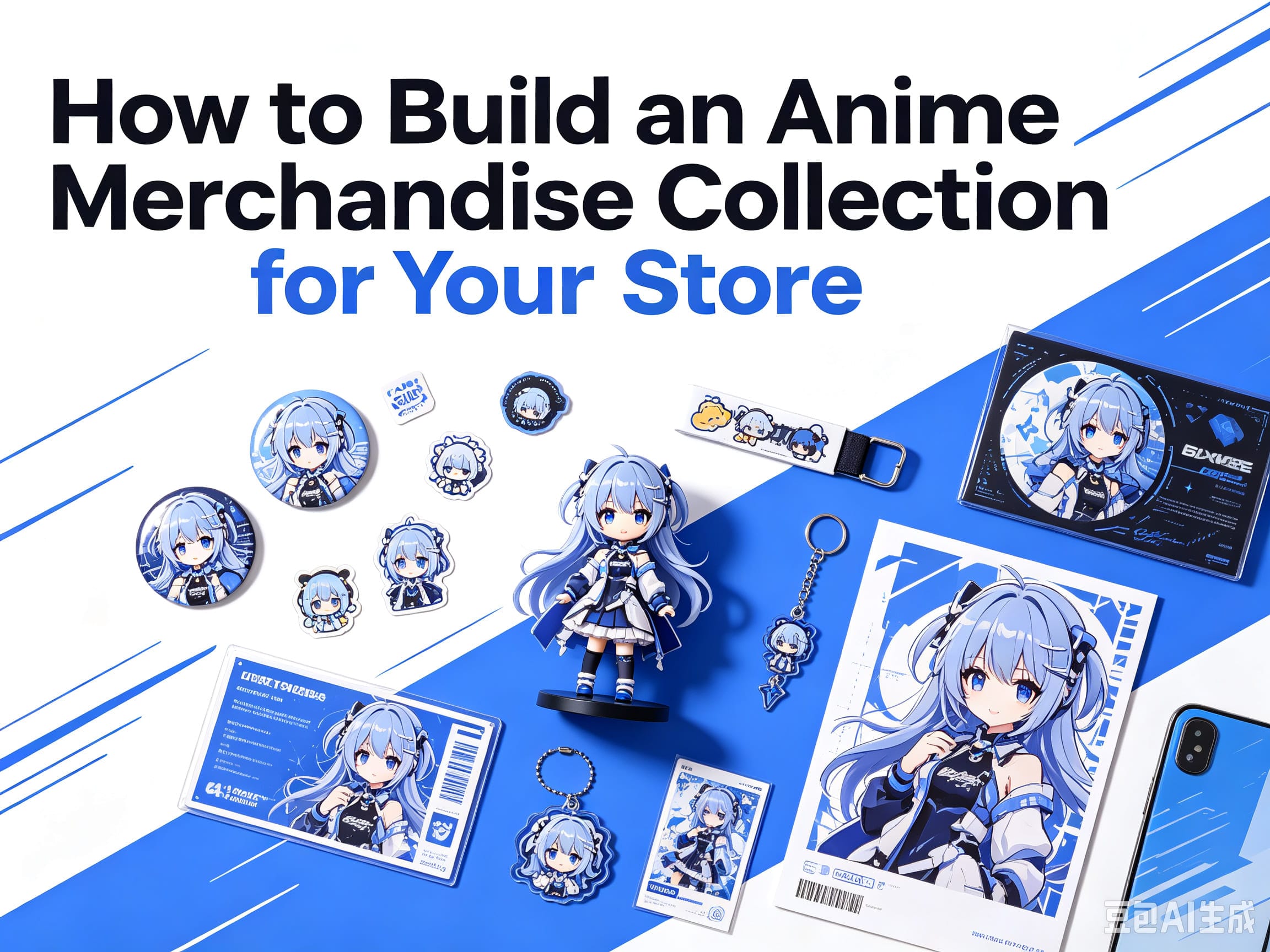
Many retailers struggle not because they lack anime merchandise, but because their product mix is unbalanced. Selling only acrylic standees leaves shelves visually repetitive. Stocking exclusively keychains caps your average order value (AOV). Sourcing dozens of unrelated products at once spikes your inventory risk.
The core operational question for an anime retailer is not “What anime merchandise should you buy?” but rather “How do you build a balanced, commercially viable anime merchandise collection?”
A structured collection balances customer price points, maximizes shelf presence, controls upfront capital, and simplifies long-term replenishment. This step-by-step B2B guide covers everything from audience mapping and product hierarchy to MOQ planning, sample approvals, and factory-direct re-ordering.
1. Define Your Target Customers Before Choosing Products
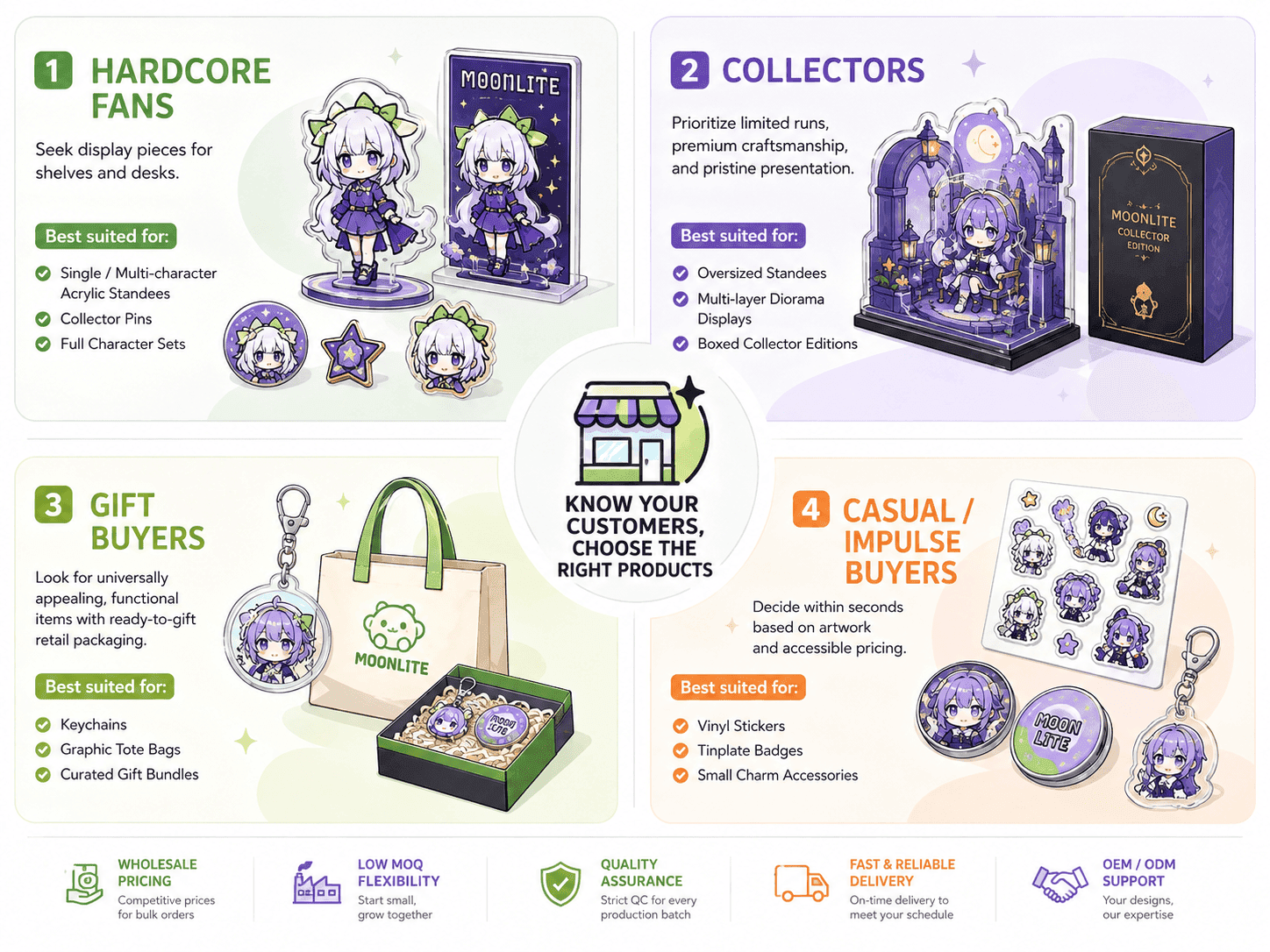
Before sending design files to a manufacturer, segment who is shopping in your store. Different buyer personas exhibit distinct price tolerances and merchandising preferences. Aligning product selection to customer intent ensures higher sell-through rates.
-
Hardcore Fans: Seek display pieces for shelves and desks. Best suited for single/multi-character acrylic standees, collector pins, and full character sets.
-
Collectors: Prioritize limited runs, premium craftsmanship, and pristine presentation. Best suited for oversized standees, multi-layer diorama displays, and boxed collector editions.
-
Gift Buyers: Look for universally appealing, functional items with ready-to-gift retail packaging. Best suited for keychains, graphic tote bags, and curated gift bundles.
-
Casual / Impulse Buyers: Decide within seconds based on artwork and accessible pricing. Best suited for vinyl stickers, tinplate badges, and small charm accessories.
2. Choose a Core Hero Product
Launching an uncoordinated batch of 15 different items splits your budget and dilutes retail focus. Instead, anchor your collection around a single Hero Product that establishes visual dominance on the shelf or product landing page.
For modern anime retail, custom acrylic standees serve as the premier anchor:
-
High Visual Impact: Standees provide vertical presence, transforming 2D character art into tangible, 3D retail displays.
-
Customization Flexibility: Manufacturers support variable acrylic thickness (3mm to 8mm), diamond edge polishing, and double-sided sandwich printing to protect artwork from scratches.
-
Structural Versatility: Acrylic bases support single characters, multi-tier scene dioramas, or interchangeable background plates.
-
OEM/ODM Adaptability: High-resolution digital and UV printing allow low barrier-to-entry setup for rapid product iterations.
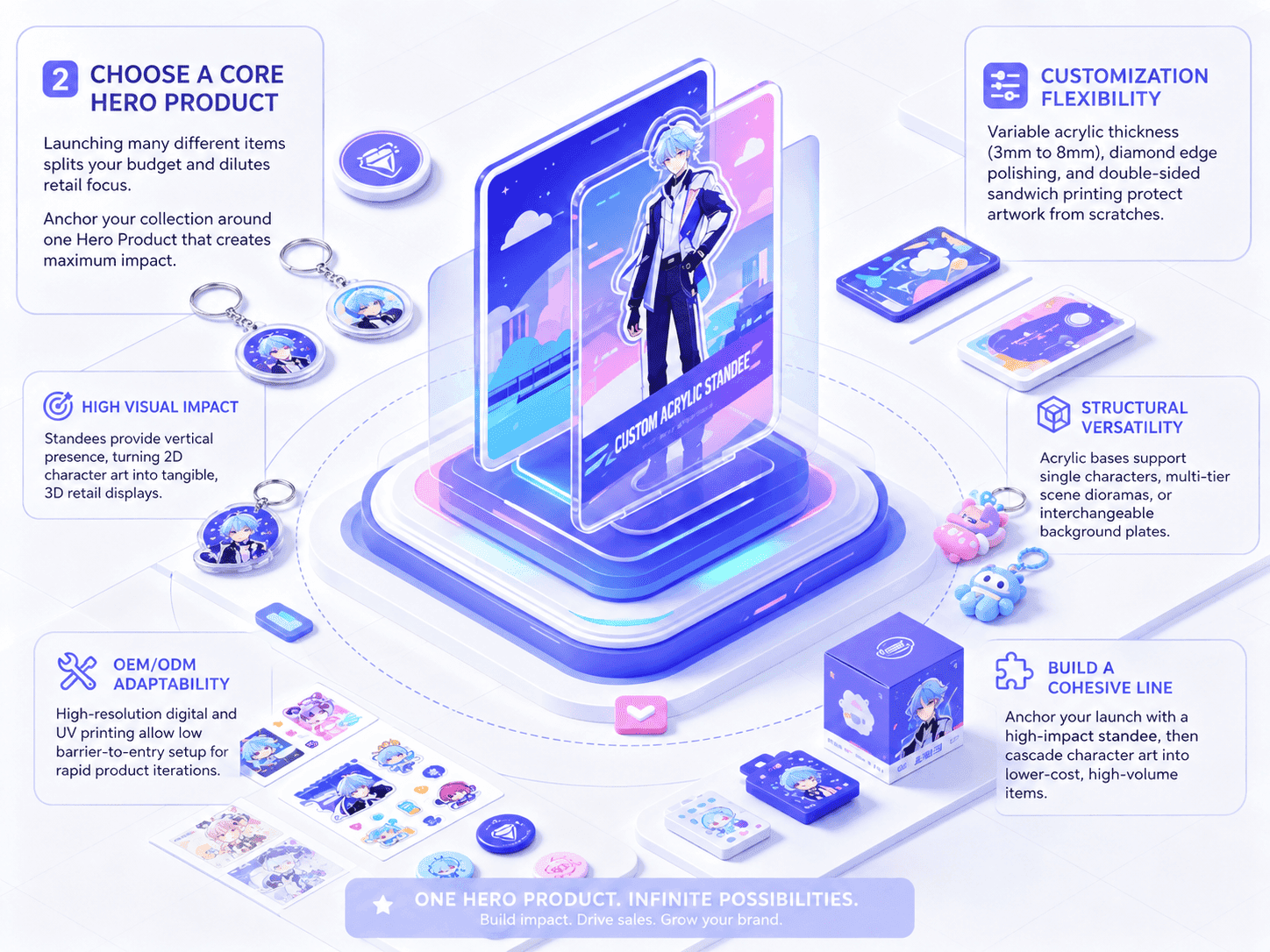
Anchor your launch with a high-impact standee, then cascade character art into lower-cost, high-volume items.
3. Build a Cohesive Product Mix
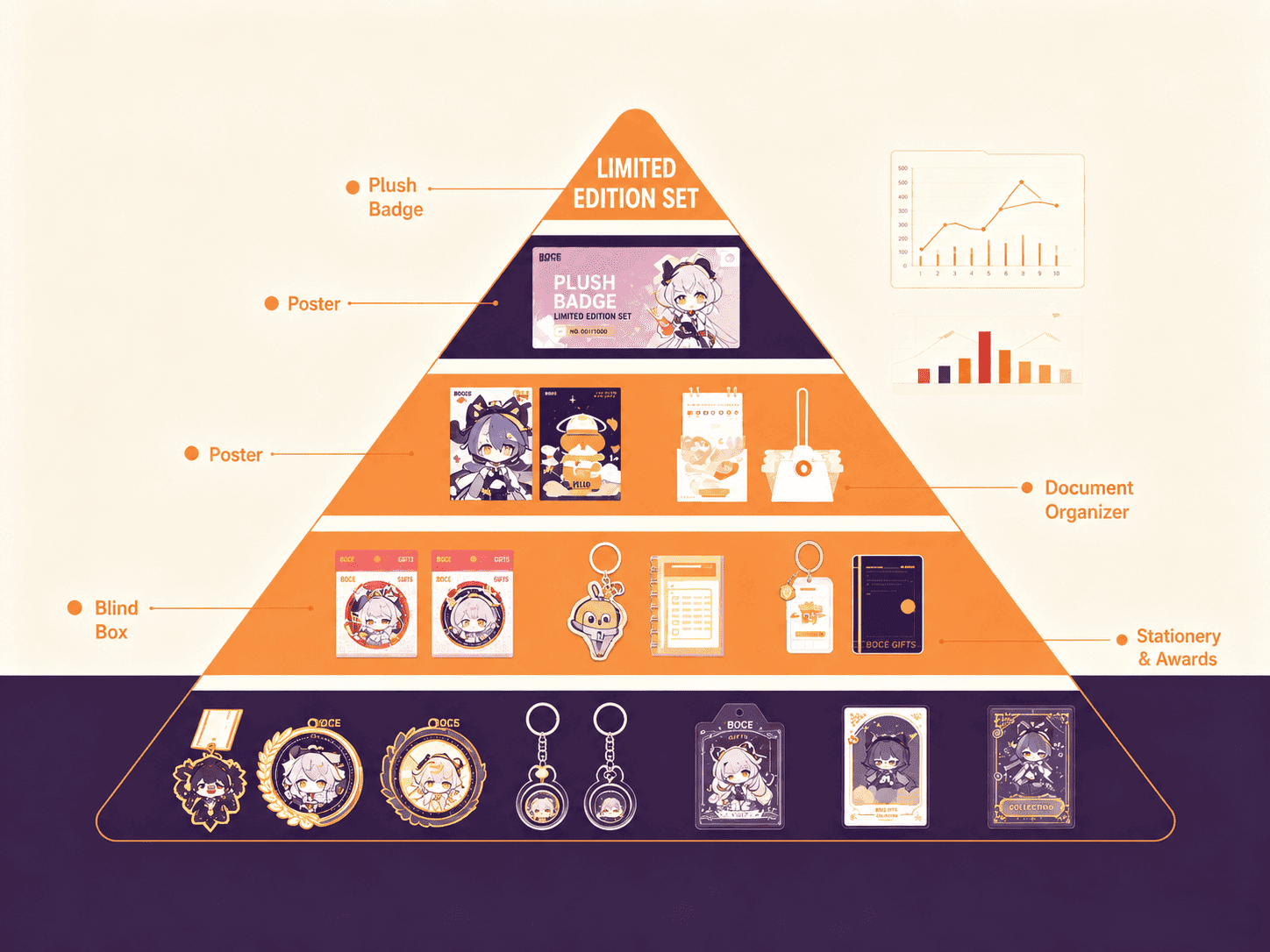
Once your hero product is established, build an ecosystem around it. A commercial collection features items that serve specific economic functions: visual anchors, basket builders, and impulse drivers.
| Product | Role in Collection | Merchandising Purpose |
| Acrylic Standee | Hero Product | Visual anchor, justifies top-tier retail pricing |
| Acrylic Keychain | Mid-Tier Workhorse | High-utility, everyday carry, solid margins |
| Pin Badge | Low-Cost Collectible | Ideal for trade events, ita-bags, and shelf displays |
| Die-Cut Sticker | Impulse Item | Zero-friction basket builder at checkout |
| Apparel (T-Shirt) | High-Value Merch | Broadens lifestyle appeal and expands ticket size |
| Tote Bag | Practical Lifestyle | Excellent canvas for line art, high utility |
| Branded Base/Riser | Retail Display | Elevates collection presentation in physical stores |
This hierarchy leads customers naturally from a $3 checkout add-on to a $25 centerpiece display.
4. Establish Good-Better-Best Price Levels
A balanced collection prevents customer drop-off by providing multiple entry points. Tier your catalog across three distinct price brackets:
-
Entry Level ($2–$5 Retail): Stickers, buttons, and mini badges. These minimize purchasing friction and capture impulse buys at checkout.
-
Mid Range ($5–$15 Retail): Double-sided acrylic keychains, shaker charms, metal enamel pins, and standard lifestyle accessories. This tier typically drives your bulk sales volume.
-
Premium ($15–$35+ Retail): Deluxe multi-layer acrylic standees, character dioramas, apparel, and boxed box sets. These drive top-line revenue and reinforce brand prestige.
A multi-tiered pricing architecture ensures every fan leaves with merchandise, regardless of budget.
5. Build Around Character Sets
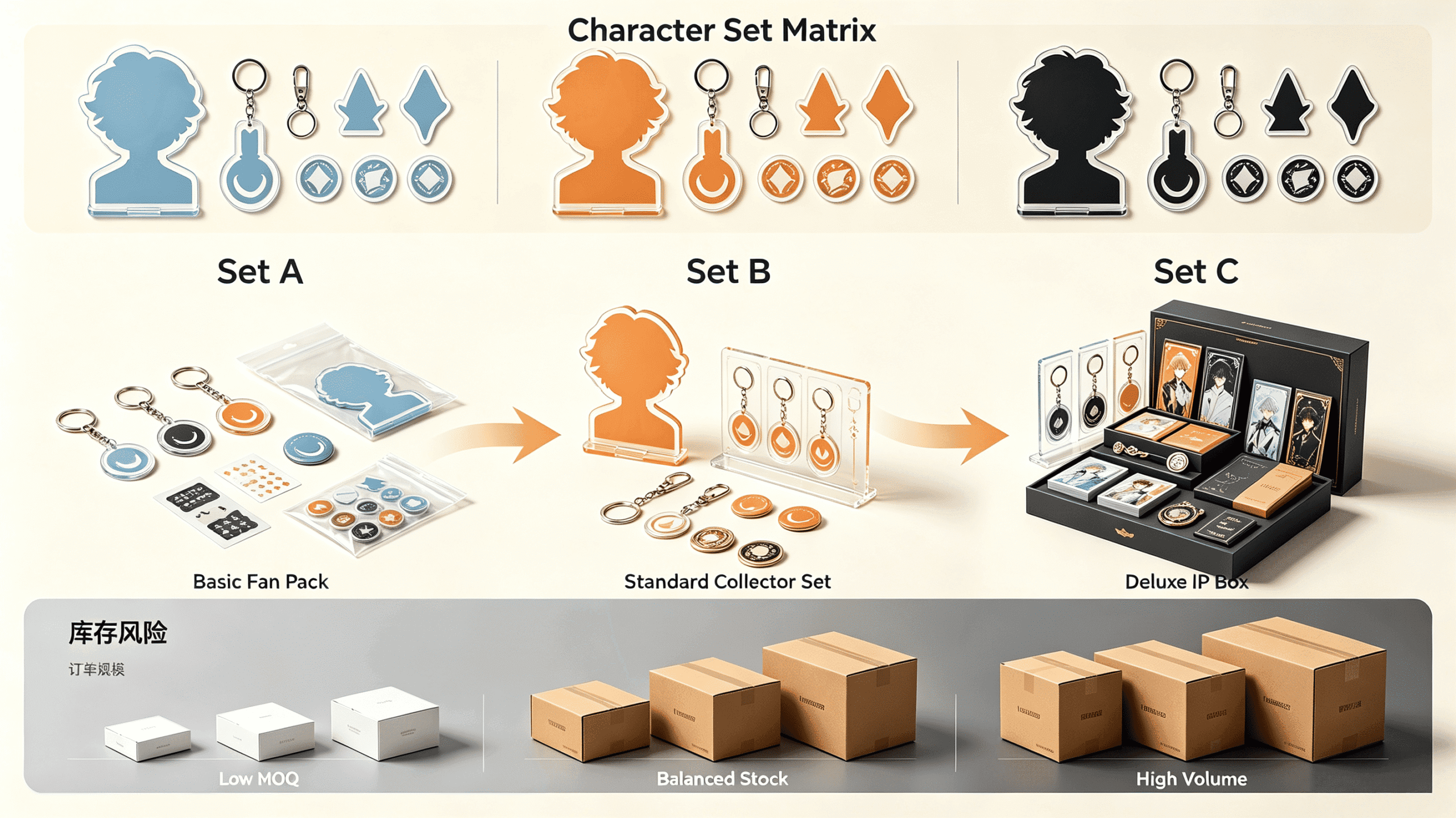
Anime retail performance relies heavily on character affinity. Rather than ordering isolated items for random characters, deploy a matrix strategy across your primary intellectual property (IP) or cast.
-
Character A: Standee + Keychain + Badge + Sticker Set
-
Character B: Standee + Keychain + Badge + Sticker Set
-
Character C: Standee + Keychain + Badge + Sticker Set
This structure drives multi-item basket purchases from completionist collectors while enabling direct comparison of character popularity to inform your replenishment cycle.
6. Bundle Products into Retail-Ready Sets
Transform loose inventory into curated gift sets to elevate perceived value and lift average transaction value (ATV).
-
Basic Fan Pack: Keychain + Badge + Die-cut Sticker (Packed in a branded polybag).
-
Standard Collector Set: Hero Acrylic Standee + Matching Keychain + Badge.
-
Deluxe IP Box: Large Multi-tier Standee + Keychain Set + Enamel Pin + Collector Art Card housed in custom rigid packaging.
Curated sets streamline gifting for non-fan shoppers and convert slow-moving individual SKUs into high-value bundles.
7. Balance Unit Cost, MOQ, and Inventory Risk
Selecting the correct Minimum Order Quantity (MOQ) requires balancing volume pricing against capital exposure.
| Order Quantity | Primary Advantage | Operational Risk | Recommended Use Case |
| 50–100 pcs | Minimal inventory liability | Higher unit manufacturing cost | Initial market validation & niche characters |
| 300–500 pcs | Optimized wholesale pricing | Balanced working capital | Core collection launch & standard retail stock |
| 1,000+ pcs | Maximum profit margin | Higher upfront capital & storage | Proven bestsellers & evergreen catalog items |
When testing new artwork or secondary characters, partner with a factory direct supplier that offers flexible, low-MOQ sample runs before committing to container or pallet-level bulk orders.
8. Vet OEM/ODM Manufacturing Capabilities
Your supply chain directly governs product margins, delivery reliability, and brand reputation. When screening an anime merchandise manufacturer in China, evaluate key industrial criteria:
-
Production Capability: Direct access to UV flatbed printers, high-precision laser cutters, diamond polishing lines, and clean assembly rooms.
-
Material Integrity: Grade-A cast acrylic sheets that resist yellowing, delamination, and surface clouding.
-
Engineering Support: In-house prepress teams to inspect bleed lines, white-ink backing layers, and base-plate tolerances.
-
Supply Chain Transparency: Clear communication on raw material sourcing, seasonal production bottlenecks, and international freight options.
Working with an experienced OEM/ODM partner removes friction from prepress file correction through export customs clearance.
9. Follow a Systematic Sample Approval Workflow
Never commit capital to full production runs without signing off on physical pre-production samples. Maintain a strict manufacturing sequence:
Vector Artwork & Layer Check
  → Prepress Proofing
  → Physical Sample Production
  → Retailer Sign-off
  → Bulk Manufacturing
  → In-line QC
  → Packaging
  → Global Logistics
Pre-Production Inspection Checklist
-
Color Fidelity: Match printed output against standardized Pantone/CMYK proofs under 5000K daylight lighting.
-
White Layer Opacity: Verify that white backing layers prevent background transparency on colored acrylic designs.
-
Surface & Edge Quality: Check for zero burrs, smooth laser cuts, diamond-polished edges, and protective peel-off masking films.
-
Hardware & Tolerances: Ensure keyrings, clasps, and display base joints lock securely without cracking the acrylic under mild pressure.
10. Design Protective, Shelf-Ready Packaging
Packaging must balance visual merchandising appeal with protective durability for international shipping and retail handling.
-
Backing Cards (Header/Card Stock): Ideal for keychains and pins. Use 350+ GSM cardstock with matte lamination and euro-slots for standardized retail peg displays.
-
Custom Printed Blind Bags/Boxes: Crucial for mystery collections and gashapon-style retail drops to drive repeat purchases.
-
Rigid Gift Boxes: Fitted EVA or velvet trays protect multi-piece acrylic dioramas and premium sets during transit, creating a high-end unboxing experience.
High-grade retail packaging directly justifies upper-tier price points and protects acrylic surfaces from transit abrasion.
11. Engineer Your Long-Term Re-order Strategy
A sustainable retail model uses the initial production run to gather operational data for future inventory turns.
Initial Low-MOQ Run → Retail Sales Data Analysis → Identify Top 20% Performers → High-Volume Bulk Re-order → Launch New Character Wave
-
Test Broadly, Replenish Deeply: Launch character waves in controlled quantities (100–300 units per SKU).
-
Track Velocity Metrics: Identify top-performing character designs and core SKUs within the first 14–21 days of shelf availability.
-
Automate Restock Triggers: Calculate factory production lead times (typically 10–18 business days) plus air/sea transit times to trigger bulk replenishment before inventory hits safety stock thresholds.
-
Leverage Repeat Tooling: Re-orders skip prepress setup, unlocking faster factory turnaround times and maximized volume margins.
Case Study: A Turnkey 6-Product Character Wave
Here is an operational framework for a retail store launching a new original IP or licensed character wave:
[HERO DISPLAY]
Acrylic Standee (15cm, Double-sided, 4mm Diamond Edge)
    │
    ├─► [MID-TIER VOLUME]
    │     ├── Acrylic Keychain (6cm with Epoxy Finish)
    │     └── 100% Combed Cotton Graphic T-Shirt
    │
    ├─► [ENTRY-LEVEL / CHECKOUT IMPULSE]
    │     ├── 58mm Matte-Finish Tinplate Badge
    │     └── Waterproof Die-Cut Vinyl Sticker Pack
    │
    └─► [LIFESTYLE UTILITY]
          └── 12oz Heavyweight Canvas Tote Bag
This matrix supplies complete price coverage from $2.50 to $32.00, maintains visual consistency across items, and allows store owners to safely commit 60% of re-order capital into the top-selling standees and keychains.
Partner With BOCE GIFTS for End-to-End Production
Building a scalable merchandise program requires more than sourcing disparate products—it demands an integrated manufacturing partner.
BOCE GIFTS provides comprehensive custom manufacturing, OEM/ODM engineering, and wholesale export services for global anime retailers, IP holders, and B2B buyers.
Our Core Manufacturing Solutions:
-
Factory-direct acrylic standees (standard, multi-layer, shaker, and diorama displays)
-
Custom acrylic keychains (epoxy, holographic, glitter, and rotating mechanics)
-
Tinplate badges, soft enamel pins, and metal accessories
-
Screen-printed apparel and custom canvas tote bags
-
Tailored retail packaging solutions (printed backing cards, blind boxes, rigid gift sets)
From rapid prototyping and low-MOQ market tests to high-volume bulk production runs, BOCE GIFTS pairs strict QC standards with predictable lead times. Contact our engineering and production team today to review your artwork, build your sample proofs, and launch your next retail collection.
Related B2B Sourcing Guides
-
Main Pillar: Anime Merchandise Wholesale: A Complete B2B Buying Guide
-
Product Focus: Custom Anime Acrylic Standee Manufacturing & Pricing
-
Product Focus: Wholesale Acrylic Keychain Finishes: Epoxy vs. Holographic vs. Double-Sided
-
Procurement: Anime Merchandise MOQ & Lead Time Planning for Retailers