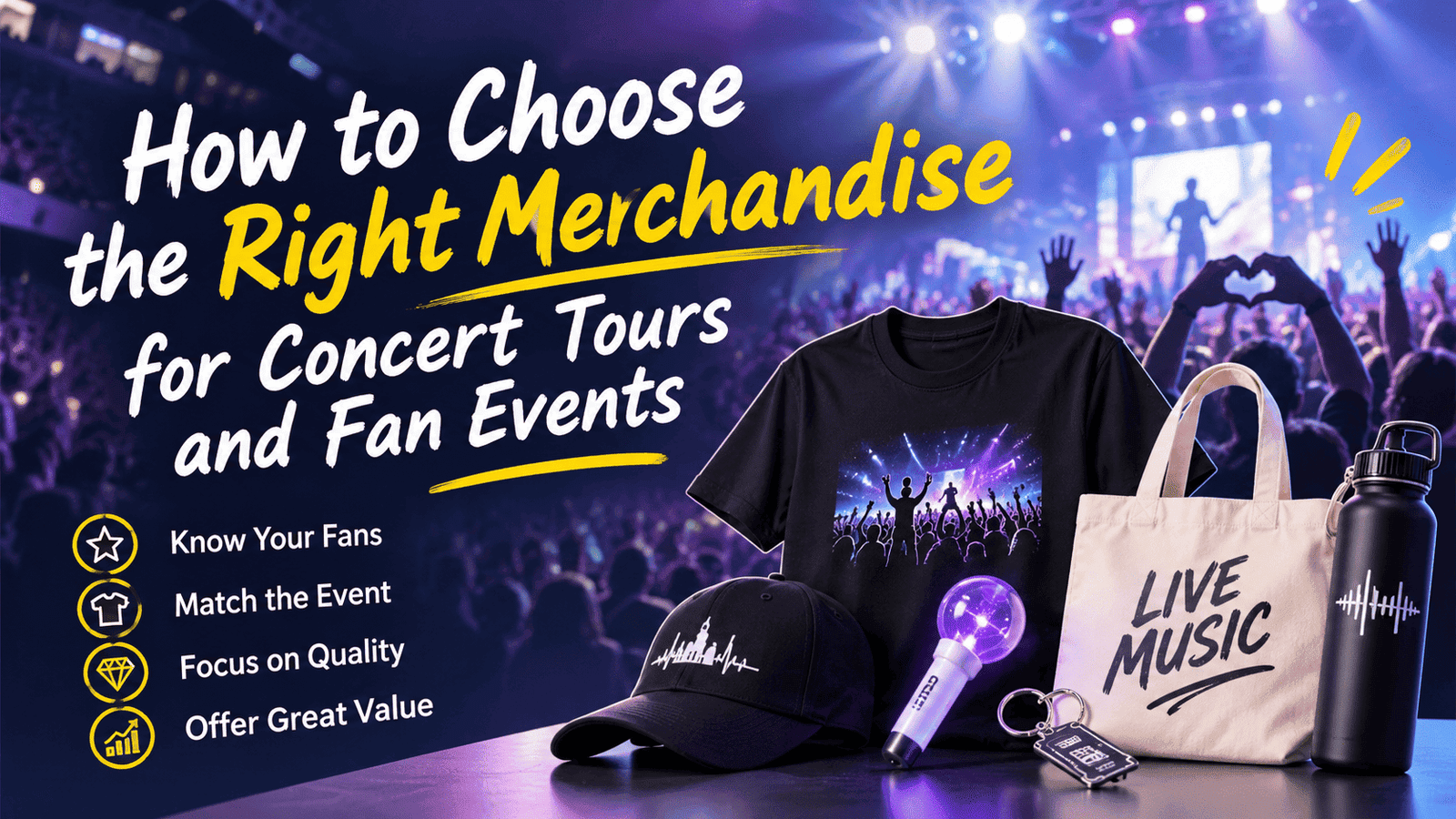
Concert merchandise creates more than extra revenue. It gives fans something to collect, helps artists build stronger connections with their audiences, and creates additional brand exposure long after an event ends.
However, a successful merchandise project requires more than choosing attractive products. Entertainment companies, artist management teams, concert organizers, and merchandise retailers need to make practical decisions about product selection, retail pricing, order quantities, manufacturing costs, quality standards, and delivery schedules.
For a multi-city concert tour, these decisions become even more important. You need to control inventory across different locations, avoid stock shortages, and maintain consistent product quality throughout the tour.
This guide explains how to plan a custom concert merchandise collection, calculate your purchasing budget, manage bulk orders, and choose a reliable manufacturer for long-term cooperation.
1. Define Your Merchandise Sales Strategy Before Choosing Products
Before contacting a manufacturer, decide what role your merchandise will play in your event.
Are you selling affordable souvenirs to a large audience? Are you creating collectible products for dedicated fans? Or are you developing a complete merchandise collection for online and offline retail?
Your answers will influence product selection, pricing, order quantities, and packaging.
Identify Your Main Customer Groups
Different customer groups may have different purchasing motivations.
- Casual concert attendees often look for affordable souvenirs.
- Dedicated fans may purchase multiple designs or collectible items.
- Collectors may prefer limited editions and complete product sets.
- Retail customers may prioritize practical products they can use every day.
You should also consider the age range, purchasing habits, interests, and spending expectations of your audience.
Set Your Target Retail Price
Decide your expected retail price before selecting the final product specifications.
For example, you may organize your collection into three price levels:
| Product Level | Example Products | Sales Purpose |
|---|---|---|
| Entry-level | Acrylic keychains, badges, wristbands | Attract more buyers |
| Mid-range | Acrylic standees, photocard holders, tote bags | Increase product value |
| Premium | Multi-item gift sets, limited-edition collections | Target collectors and higher-value purchases |
These are product positioning examples, not fixed retail price recommendations.
Your final pricing should account for manufacturing costs, shipping, event expenses, sales fees, and your desired profit margin.
2. Select Products Based on Sales Potential and Customer Value
A product should have a clear reason for customers to buy it. Do not choose merchandise simply because it looks attractive.
Consider three important factors:
Purchase Motivation
Ask why your audience would want the product.
- Acrylic keychains offer affordable, portable collectibles.
- Acrylic standees let fans display their favorite artist or character.
- Photocard holders support everyday fan activities.
- T-shirts help fans express their connection to an artist.
- Tote bags offer practical value beyond the event.
- Limited-edition gift sets create a stronger collecting experience.
Product Differentiation
If every product uses the same artwork, customers may have little reason to purchase several items.
You can create different product designs around:
- Different tour locations.
- Album covers and music eras.
- Artist outfits and visual concepts.
- Special performances or event dates.
- Character designs and exclusive artwork.
For example, a concert tour could offer one standard acrylic keychain collection and additional location-specific designs. This gives fans a reason to collect items from different tour stops.
Production and Inventory Complexity
More designs do not always mean more sales.
Every additional design can increase artwork preparation, sample approval, inventory management, and production coordination.
Start with a focused collection. Use pre-order data and actual sales results to decide which products deserve additional designs.
3. Build a Merchandise Collection That Encourages Multiple Purchases
A well-planned collection can increase average order value without forcing customers to buy expensive products.
Instead of selling unrelated items, connect your products through a consistent visual theme.
Create Three Product Groups
Group A: Individual Souvenirs
These products suit customers who want a simple event memory.
Examples:
- Acrylic keychains
- Badges and pins
- Silicone wristbands
- Small collectible accessories
Group B: Collectible Merchandise
These products offer more visual detail and display value.
Examples:
- Acrylic standees
- Photocard holders
- Character merchandise
- Multi-design acrylic collections
Group C: Merchandise Bundles
Combine complementary products into one package.
For example:
- One acrylic standee
- Two matching acrylic keychains
- One photocard holder
- One custom tote bag
You can offer individual products and a complete bundle at the same time.
This gives customers different spending options and helps your team test which combinations perform better.
Keep Your Visual Identity Consistent
Use consistent colors, typography, logos, and artwork across your collection.
You do not need to make every product identical. Instead, create a recognizable visual connection between different product categories.
This approach works especially well for artist merchandise, album launches, fan meetings, and licensed entertainment products.
4. Calculate the Right Order Quantity for Each Tour Location
One of the biggest purchasing mistakes is ordering the same quantity for every concert location.
Different cities may have different ticket sales, audience sizes, and merchandise demand.
You should create a separate sales forecast for each tour stop.
Step 1: Estimate the Number of Potential Buyers
Use this formula:
Estimated Buyers = Expected Attendees × Estimated Purchase Rate
For example:
- Expected attendees: 10,000
- Estimated merchandise purchase rate: 15%
- Estimated buyers: 1,500
The 15% purchase rate is an example assumption. Use historical sales, pre-orders, and audience data to build your own forecast.
Step 2: Estimate the Number of Items
If each buyer purchases an average of 1.5 items:
Estimated Item Sales = 1,500 × 1.5 = 2,250 units
This gives you a starting point for inventory planning.
Step 3: Compare Demand Across Tour Stops
Consider this example:
| Tour Location | Expected Attendees | Estimated Purchase Rate | Estimated Buyers |
|---|---|---|---|
| City A | 10,000 | 15% | 1,500 |
| City B | 6,000 | 15% | 900 |
| City C | 4,000 | 15% | 600 |
| Total | 20,000 | — | 3,000 |
Do not automatically divide the total order quantity equally across all locations.
Adjust your forecast according to ticket sales, pre-order data, local demand, and previous event performance.
Step 4: Keep a Replenishment Reserve
Do not send your entire inventory to the first event.
Keep track of:
- Opening stock for each location.
- Actual sales by product.
- Remaining inventory.
- Fast-selling designs.
- Products that need replenishment.
- Time required for production and shipping.
For multi-city tours, discuss repeat-order arrangements and production capacity with your manufacturer before the first event.
5. Calculate Your Real Merchandise Cost and Profit
A low factory price does not automatically create a profitable merchandise project.
Your purchasing decision should include the full cost of bringing products to your event or warehouse.
Understand Your Total Cost
Include these expenses in your budget:
| Cost Category | What to Include |
|---|---|
| Manufacturing | Materials, printing, cutting and assembly |
| Customization | Special finishes, artwork preparation and tooling if applicable |
| Packaging | Individual bags, boxes, labels and inserts |
| Shipping | International freight and local delivery |
| Import expenses | Applicable duties, taxes and customs charges |
| Storage | Warehouse and inventory handling |
| Sales operations | Booth fees, staffing and payment processing |
Example: Calculate the Cost of 2,000 Acrylic Keychains
Suppose your project has the following costs:
| Cost Item | Example Cost |
|---|---|
| Manufacturing | $1,600 |
| Individual packaging | $200 |
| International shipping | $400 |
| Import and handling expenses | $200 |
| Total | $2,400 |
Your landed cost per unit is:
$2,400 ÷ 2,000 = $1.20 per unit
If your retail price is $5 per unit:
- Retail price: $5.00
- Landed cost: $1.20
- Gross profit before selling expenses: $3.80 per unit
If you sell 1,500 units:
1,500 × $3.80 = $5,700
This example does not include booth fees, payment processing, staffing, unsold inventory, or other operating expenses.
Compare Quotations on the Same Specifications
When you request wholesale pricing from different manufacturers, use the same product requirements.
Compare:
- Material and thickness.
- Product dimensions.
- Printing method.
- Number of designs.
- Order quantity.
- Packaging requirements.
- Shipping terms.
- Quality control standards.
A factory-direct quotation can help you understand the manufacturing cost more clearly, but you should always compare the complete project cost.
6. Prepare Artwork and Product Specifications Before Production
Clear specifications help your manufacturer understand exactly what you need.
Incomplete artwork or unclear product requirements can lead to extra revisions, incorrect samples, and production delays.
Prepare Your Artwork Files
Before submitting your designs, confirm:
- Final artwork dimensions.
- Image resolution.
- Color requirements.
- Logo and text placement.
- Cutting outlines.
- Printing sides.
- Individual design quantities.
- Packaging artwork.
For acrylic standees and keychains, also confirm transparent areas, white ink requirements, acrylic thickness, base or attachment dimensions, and protective film requirements.
Confirm Materials and Product Finishes
Different materials offer different appearances, costs, and practical uses.
For example:
- Acrylic works well for standees, keychains, and collectible display products.
- Silicone works well for flexible wristbands.
- Cotton and polyester fabrics suit different apparel and bag requirements.
- Metal materials work well for certain badges and pins.
Ask your manufacturer to explain suitable material options based on your design, budget, and intended use.
Confirm Design Rights and Authorization
Before producing merchandise, make sure your company has the necessary authorization to use artist names, photographs, logos, album artwork, character designs, and other protected content.
Confirm the approved artwork and licensing requirements before placing your bulk order.
7. Set a Realistic Production and Delivery Schedule
Concert merchandise has a fixed event deadline. A delayed shipment can affect your sales and event operations.
Start your sourcing process early and work backward from the required delivery date.
Recommended Planning Structure
| Planning Stage | Main Tasks |
|---|---|
| 8–10 weeks before | Confirm product selection, budget and manufacturer |
| 6–8 weeks before | Finalize artwork and approve samples |
| 3–6 weeks before | Arrange bulk production and quality checks |
| 1–3 weeks before | Ship products and prepare event inventory |
This is an illustrative planning structure, not a guaranteed production timeline. Actual lead time depends on product complexity, order quantity, sample approval, production capacity, and shipping destination.
Confirm These Dates with Your Manufacturer
- Artwork approval deadline.
- Sample completion date.
- Bulk production start date.
- Estimated production completion date.
- Shipping date.
- Required delivery date.
For urgent projects, ask your supplier to confirm what they can realistically produce within your available timeframe.
Do not assume that every product category will share the same production lead time.
8. Establish Quality Control Standards Before Bulk Production
Product quality affects customer satisfaction, brand reputation, and the cost of handling complaints.
Do not wait until the shipment arrives to check whether the products meet your expectations.
Approve a Physical Sample
When the design or material requires physical verification, request a sample before bulk production.
Check:
- Material appearance and thickness.
- Printing color and alignment.
- Product dimensions.
- Cutting and edge quality.
- Assembly and fitting.
- Surface scratches or defects.
- Packaging protection.
For acrylic standees, check whether the base and slot fit correctly. For acrylic keychains, check the printing, edges, holes, and attachment hardware.
Agree on Inspection Requirements
Before production, confirm which product details matter most and how your manufacturer will check them.
You can establish:
- Approved sample standards.
- Acceptable appearance and color differences.
- Critical dimensions.
- Printing requirements.
- Assembly requirements.
- Packaging standards.
- Defect reporting procedures.
Keep approved samples, artwork, and specifications as references for future repeat orders.
9. Choose a Manufacturer That Can Support Your Entire Project
Your manufacturer affects more than the unit price. The right wholesale supplier can help you coordinate product specifications, production schedules, quality control, and repeat orders.
When comparing a supplier in China, ask the following questions.
Manufacturing Capability
- Do you manufacture these products directly?
- Can you support OEM / ODM projects?
- Can you handle multiple product categories?
- What is your production capacity?
- Can you support additional orders during a tour?
MOQ and Wholesale Pricing
- What is the MOQ for each product?
- Can you combine multiple designs in one order?
- Can you offer low MOQ options for selected products?
- How does pricing change with order quantity?
- Does your quotation include individual packaging?
Do not assume that one total order quantity automatically meets the MOQ for every design or product.
Production and Quality Control
- Can you provide samples before bulk production?
- How do you inspect materials and printing?
- Can you check product dimensions and assembly?
- Can you share production updates?
- How do you handle defective products?
Delivery and Repeat Orders
- What is your estimated lead time?
- Can you meet the required event deadline?
- Can you arrange separate shipments for different locations?
- Can you keep the approved specifications for repeat orders?
A reliable manufacturer should explain production limits, communicate clearly, and help you plan realistic delivery arrangements.
10. Manage Inventory and Repeat Orders Across Multiple Events
Your first event can provide valuable information for the rest of your tour.
Track sales by product, design, and location instead of looking only at total revenue.
Monitor Your Product Performance
Record:
- Initial inventory.
- Units sold.
- Remaining stock.
- Sales by design.
- Sales by location.
- Customer preferences.
- Products with low demand.
Use these records to decide which products to reorder, which designs to discontinue, and which products deserve a larger quantity at the next event.
Keep Your Production Records
For every product, save:
- Approved artwork.
- Material specifications.
- Dimensions and thickness.
- Printing requirements.
- Packaging details.
- Approved sample photos.
- Previous order quantities.
These records help your manufacturer maintain consistency and make repeat orders easier.
If you work with the same manufacturer across several events, discuss production capacity and replenishment lead time in advance.
11. Common Mistakes When Ordering Concert Merchandise
Choosing Products Without a Sales Strategy
Do not select products only because they look attractive. Consider customer demand, retail pricing, and total production costs.
Ordering Too Many Designs
Too many variations can increase production complexity and leave you with unsold stock. Start with a focused collection and expand based on actual sales data.
Ignoring the Full Cost
A low factory price may not include packaging, shipping, import expenses, or local handling. Calculate your landed cost before setting retail prices.
Approving Artwork Too Late
Late design changes can delay samples and bulk production. Finalize your artwork and obtain internal approval before the production deadline.
Skipping Sample Approval
A digital design cannot show every detail of the finished product. Check a physical sample when the product requires verification.
Failing to Plan for Repeat Orders
A popular product can sell out before the end of a tour. Discuss reorder lead time and production capacity with your manufacturer before the first shipment.
12. Source Custom Concert Merchandise from BOCE GIFTS
BOCE GIFTS is a China-based wholesale supplier specializing in custom promotional gifts and fan merchandise.
We help B2B buyers, entertainment companies, artist management teams, event organizers, and retailers develop custom merchandise for concert tours, fan meetings, album launches, and promotional campaigns.
Our product range includes:
- Custom acrylic standees
- Acrylic keychains
- PVC keychains
- Photocard holders
- Custom lanyards
- Silicone wristbands
- Badges
- T-shirts and tote bags
We support custom manufacturing, OEM / ODM projects, bulk orders, and private label requirements.
You can discuss multiple product categories with one wholesale supplier, review material and customization options, request wholesale pricing, and plan production according to your project requirements.
Whether you need a small collectible collection or a large bulk order for a concert tour, our team can help you evaluate suitable products and manufacturing options.
Planning your next concert merchandise collection?
Send us your product ideas, artwork, estimated quantity, and required delivery date.
Contact us at to discuss your custom merchandise project.
Frequently Asked Questions
1. What are the best products for concert merchandise?
Popular options include T-shirts, acrylic keychains, acrylic standees, photocard holders, badges, wristbands, lanyards, and tote bags. The right selection depends on your audience, retail price, product design, and sales channel.
2. How do I calculate the quantity of merchandise for a concert?
Start with expected attendance and an estimated purchase rate. Then calculate the average number of items per buyer. Adjust your forecast using pre-order data, previous event sales, and available inventory.
3. Can I order multiple merchandise designs from one manufacturer?
Many custom merchandise manufacturers can support multiple designs in one project. However, MOQ and pricing may differ by product and design. Confirm the quantity requirements before placing your bulk order.
4. How early should I order concert merchandise?
Start planning several weeks or months before your event. Complex designs, large quantities, sample approval, and international shipping can require additional time. Confirm your actual production and delivery schedule with your supplier.
5. How can I reduce the cost of a concert merchandise order?
Compare quotations using identical product specifications, review different material options, simplify unnecessary design variations, and plan packaging and shipping early. Always compare total landed costs rather than factory prices alone.
6. Can a China manufacturer support OEM / ODM concert merchandise?
Yes. Many manufacturers in China offer OEM / ODM services for custom products. Ask about their actual manufacturing capabilities, available customization options, MOQ, quality control, and production capacity.
7. How can I maintain consistent quality across repeat orders?
Keep approved samples, artwork, product specifications, and packaging records. Confirm the same requirements with your manufacturer before each repeat order and review quality inspection results.
8. Can I use one supplier for different concert merchandise products?
Some wholesale suppliers can coordinate several product categories, such as acrylic products, apparel, lanyards, wristbands, and bags. Check which products they manufacture directly and how they manage quality control and delivery for each category.