You do not need a large budget to launch an anime merchandise collection. The real challenge for B2B buyers, retailers, and independent creators is deciding where and how to allocate capital.
If you launch too many products at once, you spread your capital thin across excessive SKUs, inflate minimum order quantities (MOQs), and multiply your inventory risk. If you launch only a single item, you miss out on average order value (AOV) and fail to give retail buyers enough selection.
A limited budget does not mean a weak merchandise collection. It means you need a smarter product mix.
By anchoring your launch with a single Hero Product, adding coordinated Supporting Products, controlling initial order quantities with low MOQs, and using repeat orders to scale, you can build a resilient, high-margin anime catalog without cash-flow strain.
1. Don’t Start With Too Many Products
1. Don’t Start With Too Many Products
When launching a new character or original IP, the initial impulse is often to offer everything all at once. You want your catalog to look complete, versatile, and instantly appealing to every type of fan:
⚠️ The Common “Catalog Trap” Checklist:
Acrylic Standees
Keychains
Enamel Pins
Button Badges
Stickers
T-Shirts
Tote Bags
Ita Bags
Photocard Holders
Keychains
Enamel Pins
Button Badges
Stickers
T-Shirts
Tote Bags
Ita Bags
Photocard Holders
While this looks impressive on a product mock-up board, splitting a tight budget across 9–10 distinct categories creates severe supply chain friction:
❌
The Fragmented Trap
10 SKUs × 20 pcs each: Skyrocketing setup fees, worst-tier wholesale unit costs, multiple international shipping parcels, and maximum dead-stock risk.
✅
The Strategic Allocation
1 Hero SKU + 2 Low-MOQ Items: Favorable pricing tiers on your anchor item, unified packaging, and cash reserves retained for rapid re-orders.
Key Takeaway for B2B Buyers: A broad catalog does not indicate commercial strength if it dilutes your purchasing power. Focus your capital on a single core product that carries your design, and let verified market demand dictate when to introduce secondary SKUs.
2. Start With One Hero Product
Every successful retail collection is built around a single anchor SKU that establishes visual dominance, communicates value, and drives intent.
For the anime and ACG sector, the Acrylic Standee is the industry standard benchmark for a Hero Product.
       [ HERO PRODUCT: Acrylic Standee ]
                       │
       ┌───────────────┴───────────────┐
       ▼                               ▼
[ Keychain / Badge ]         [ Photocard Holder ]
       │                               │
       └───────────────┬───────────────┘
                       ▼
         [ Collector Sets & Ita Bags ]
An acrylic standee commands high perceived value on a retail shelf or e-commerce storefront, shows character artwork with edge-to-edge fidelity, and serves as an anchor item. Once your customer decides to buy the standee, low-friction add-ons (keychains, badges, stickers) become natural cart-builders.
3. Build Your Product Mix Around Three Commercial Roles
Do not select products based solely on production convenience. Choose products based on the commercial role each SKU plays within your collection:
| Product Role | Commercial Purpose | Typical Price Tier | Example Categories |
| Hero Product | Anchors the visual presentation, drives primary interest, commands top margin | High ($18 – $35+) | Acrylic Standee, Ita Bag, Collector Figure |
| Supporting Product | Increases average cart value, complements the hero item via cross-selling | Mid ($8 – $15) | Acrylic Keychain, Photocard Holder, Compact Mirror |
| Entry Product | Eliminates purchase friction, captures low-intent or impulse buyers | Low ($3 – $6) | Tinplate Badge, Holographic Sticker, Postcard |
By assigning each SKU a clear operational role, you eliminate product cannibalization and ensure every manufacturing dollar works toward higher basket sizes.
4. Allocate Your Budget Dynamically, Not Equally
A common purchasing mistake is dividing working capital evenly across product types (e.g., 5 SKUs allocated 20% each). Equal distribution ignores the reality that unit costs, MOQs, and inventory turn rates differ dramatically between acrylics, paper goods, and textiles.
Use a weighted capital-allocation model:
-
Hero Product (~50% of budget): Secures favorable volume tiers, keeps per-unit manufacturing costs low, and ensures adequate inventory on your core revenue generator.
-
Supporting Products (~30% of budget): Funds moderate runs of high-affinity impulse items.
-
Entry Products (~20% of budget): Capitalizes low-cost items with minimal inventory carrying costs.
Procurement Rule: Dynamic allocation must adjust based on actual manufacturing lead times, freight dimensions, and minimum threshold tiers. Use this split as an operational baseline, not a rigid formula.
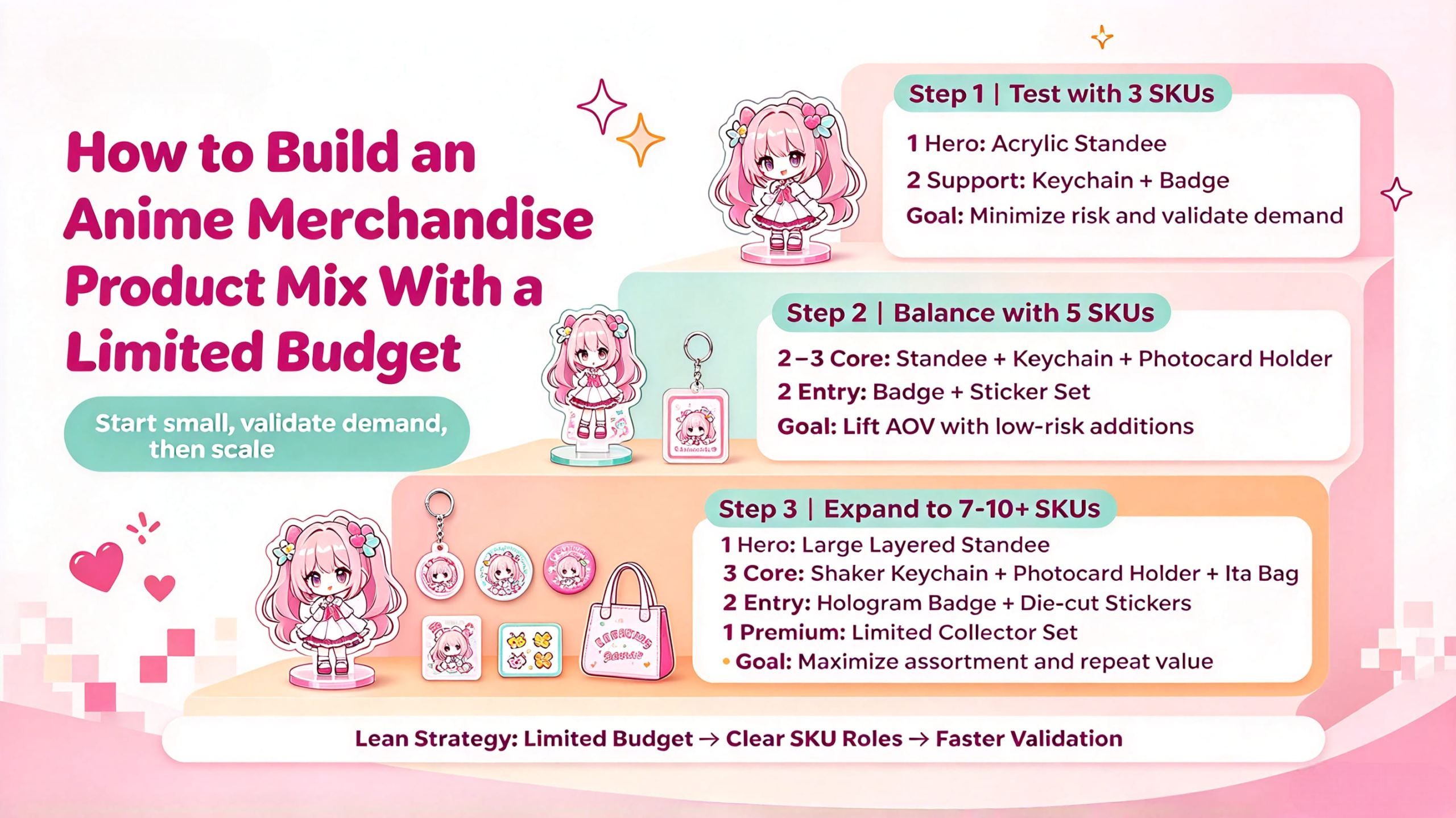
5. Three Budget Models for Anime Collections
Match your SKU count directly to your available working capital:
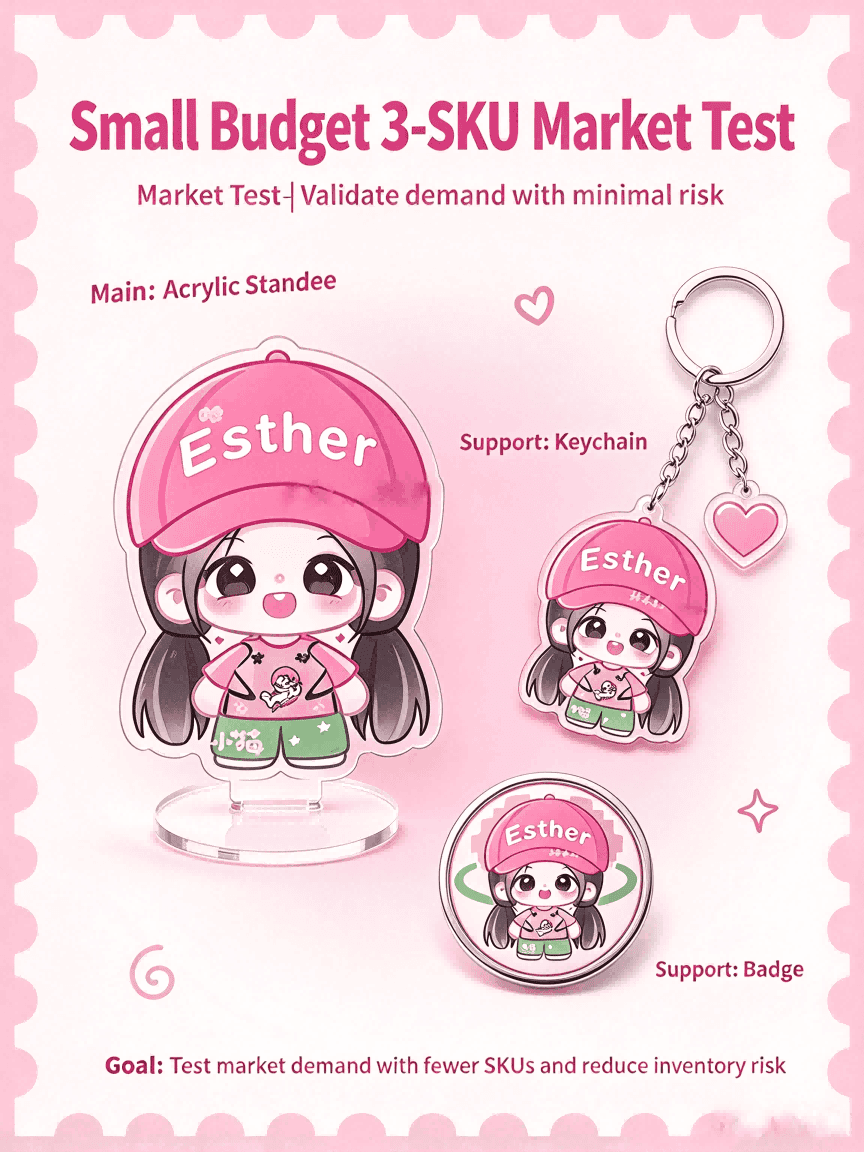
[ Small Budget: 3 SKUs ]
├─ 1 Hero: Acrylic Standee
└─ 2 Supporting: Keychain + Badge
└─ Goal: Validate demand & minimize carrying costs
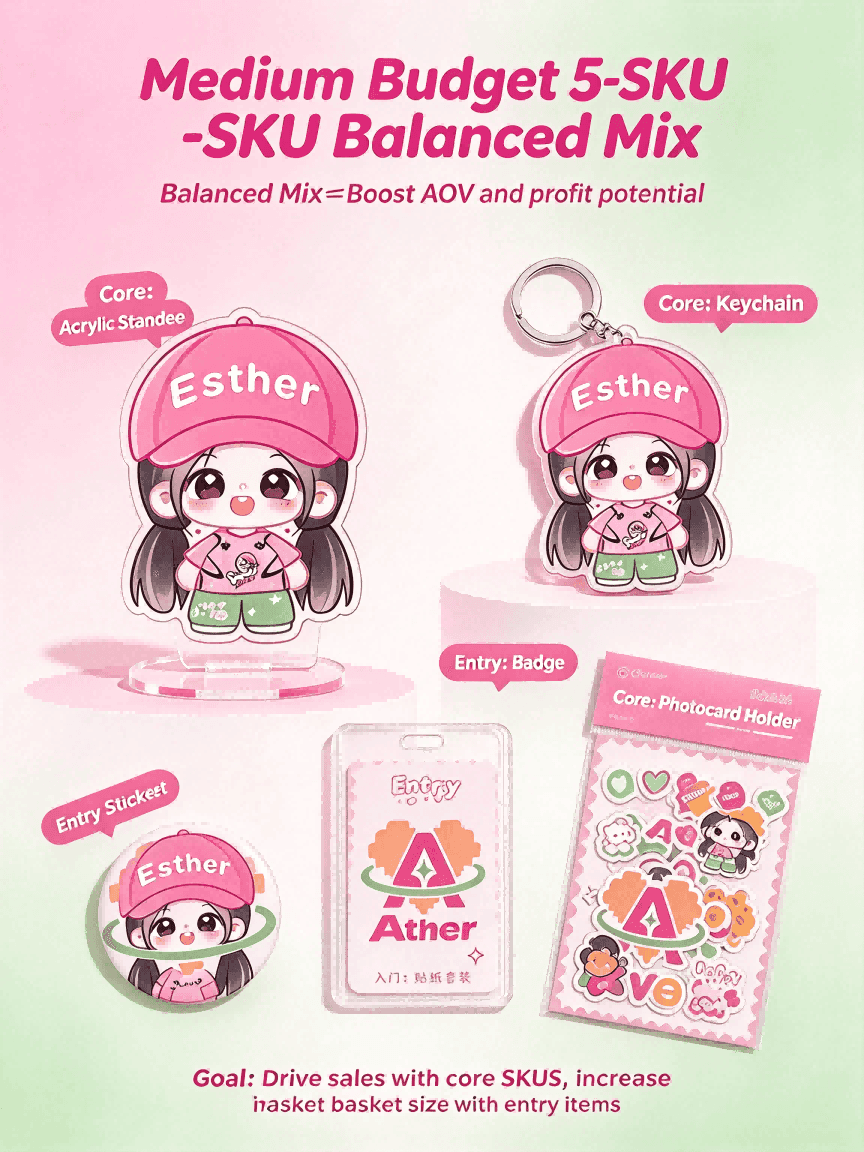
 [ Medium Budget: 5 SKUs ]
├─ 2–3 Core: Standee + Keychain + Photocard Holder
└─ 2 Entry: Badge + Vinyl Sticker Set
└─ Goal: Build balanced margin & lift AOV
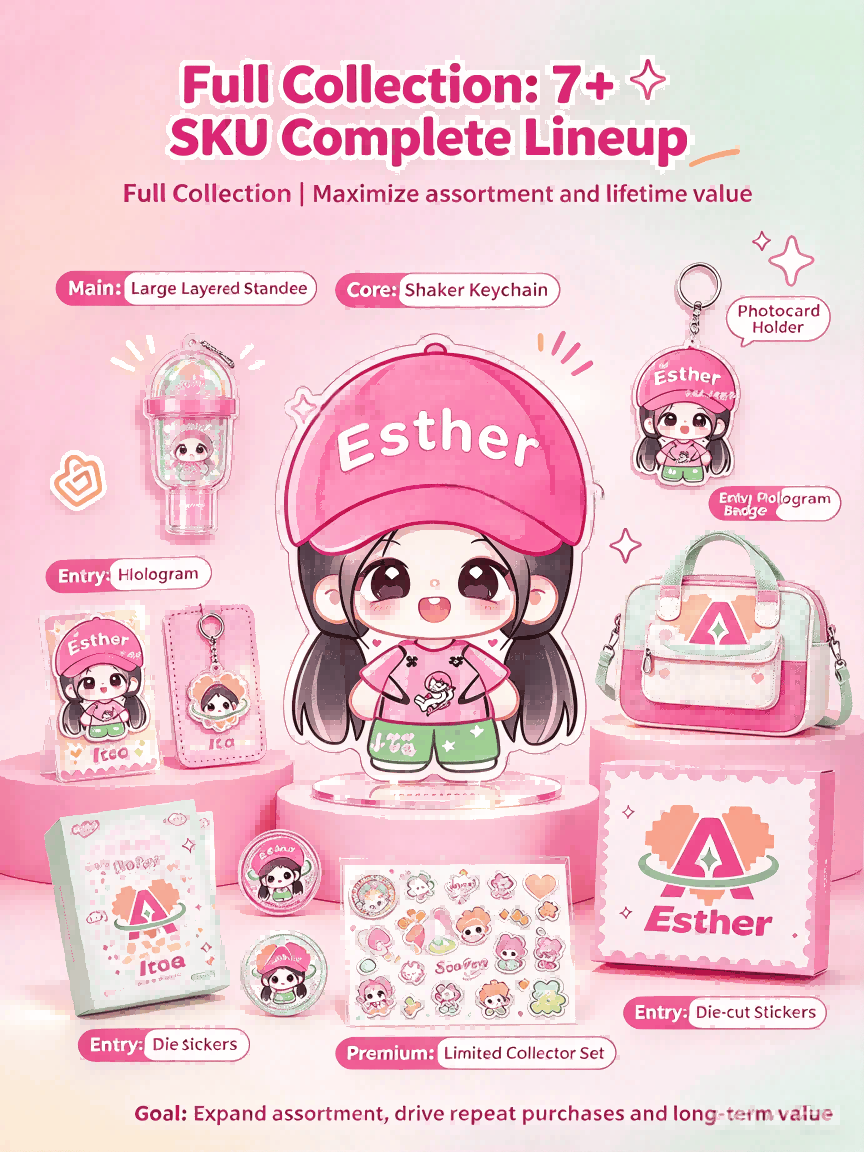
[ Full Collection: 7–10+ SKUs ]
├─ 1 Hero: Large Layered Standee
├─ 3 Core: Shaker Keychain + Photocard Holder + Ita Bag
├─ 2 Entry: Hologram Badge + Die-cut Stickers
└─ 1 Premium: Limited Edition Collector Set
└─ Goal: Maximize wholesale assortment & lifetime customer value
[ Medium Budget: 5 SKUs ]
├─ 2–3 Core: Standee + Keychain + Photocard Holder
└─ 2 Entry: Badge + Vinyl Sticker Set
└─ Goal: Build balanced margin & lift AOV
[ Full Collection: 7–10+ SKUs ]
├─ 1 Hero: Large Layered Standee
├─ 3 Core: Shaker Keychain + Photocard Holder + Ita Bag
├─ 2 Entry: Hologram Badge + Die-cut Stickers
└─ 1 Premium: Limited Edition Collector Set
└─ Goal: Maximize wholesale assortment & lifetime customer value
 [ Medium Budget: 5 SKUs ]
├─ 2–3 Core: Standee + Keychain + Photocard Holder
└─ 2 Entry: Badge + Vinyl Sticker Set
└─ Goal: Build balanced margin & lift AOV
[ Medium Budget: 5 SKUs ]
├─ 2–3 Core: Standee + Keychain + Photocard Holder
└─ 2 Entry: Badge + Vinyl Sticker Set
└─ Goal: Build balanced margin & lift AOV
 [ Full Collection: 7–10+ SKUs ]
├─ 1 Hero: Large Layered Standee
├─ 3 Core: Shaker Keychain + Photocard Holder + Ita Bag
├─ 2 Entry: Hologram Badge + Die-cut Stickers
└─ 1 Premium: Limited Edition Collector Set
└─ Goal: Maximize wholesale assortment & lifetime customer value
[ Full Collection: 7–10+ SKUs ]
├─ 1 Hero: Large Layered Standee
├─ 3 Core: Shaker Keychain + Photocard Holder + Ita Bag
├─ 2 Entry: Hologram Badge + Die-cut Stickers
└─ 1 Premium: Limited Edition Collector Set
└─ Goal: Maximize wholesale assortment & lifetime customer value
Model A: Small Budget (3 SKUs) — Market Test
-
Focus: 1 Hero (Standee) + 2 Supporting (Keychain + Tinplate Badge)
-
Strategy: Keep MOQs tight, share packaging formats where possible, and treat this tier as an active market test to gauge character popularity.
Model B: Medium Budget (5 SKUs) — Balanced Retail Mix
-
Focus: 2–3 Core (Standee + Keychain + Photocard Holder) + 2 Entry (Badge + Sticker Pack)
-
Strategy: Introduce entry-level pricing to capture impulse buyers while using the photocard holder to tap into secondary community trends (photocard collection).
Model C: Scale Budget (7–10+ SKUs) — Full Merch Line
-
Focus: Full spectrum from stickers up to lifestyle carry items (Ita bags) and boxed collector sets.
-
Strategy: Only transition to this stage once sales data confirms repeat-order volume on core acrylics and accessories.
6. Maximize One Artwork Across Multiple SKUs
Custom artwork production and print-plate setup fees eat away at limited margins. Maximize production efficiency through artwork reuse:
                  ┌─► Acrylic Standee (Full-body illustration)
                  ├─► Acrylic Keychain (Chibi/Character crop)
[ ONE ARTWORK ] ──┼─► Badge (Close-up portrait crop)
                  ├─► Photocard Holder (Border element integration)
                  └─► Die-Cut Sticker (Isolated character asset)
By leveraging one central illustration across multiple product formats:
-
Design overhead drops to zero for secondary SKUs.
-
Visual consistency remains locked, creating cohesive retail collections.
-
Setup and prepress approvals are streamlined with your manufacturer.
7. Use Low MOQs to Mitigate Inventory Risk
MOQ is not simply a barrier to purchase; it is your primary lever for managing risk.
-
Apply Low MOQs to: Unproven characters, experimental finishes (e.g., liquid sand, specialized flocking), and secondary accessory items.
-
Apply High-Volume Bulk Runs to: Proven sellers with established sales velocity, where unit cost reduction directly expands bottom-line profit.
Before committing capital to an unproven run, confirm your supplier’s capabilities:
-
Can they combine multiple character designs within a single production tier?
-
What is the cost penalty for running a 50-piece pilot test versus a 500-piece bulk run?
-
Can the factory hold digital print files ready for immediate re-order execution?
8. The Procurement Loop: Test, Validate, Re-Order
A professional merchandising business scales via repeat orders, not speculative over-purchasing.
┌────────────────────────────────────────────────────────┐
│                   THE SOURCING LOOP                    │
└────────────────────────────────────────────────────────┘
                       LIMITED BUDGET
                             │
                             ▼
                   CHOOSE 1 HERO PRODUCT
                             │
                             ▼
                 ADD 2 SUPPORTING PRODUCTS
                             │
                             ▼
                    LOW-MOQ PILOT RUN
                             │
                             ▼
                    MEASURE SALES DATA
                             │
             ┌───────────────┴───────────────┐
             ▼                               ▼
     [ Winning SKUs ]                [ Slow Movers ]
             │                               │
             ▼                               ▼
    RE-ORDER BEST SELLERS              DROP OR PIVOT
             │
             ▼
       ADD NEW SKUs
             │
             ▼
   FULL MERCHANDISE COLLECTION
-
Step 1 (Pilot Test): Launch your 3-SKU collection with conservative order quantities.
-
Step 2 (Data Review): Track sell-through rate, re-order velocity, and customer basket composition over the first 14 to 30 days.
-
Step 3 (Re-Order Winners): Direct 70% of replenished working capital into larger, higher-margin volume tiers for verified top performers.
-
Step 4 (Strategic Expansion): Reinvest the remaining capital into introducing one new SKU type or character design.
9. Account for Manufacturing Lead Times
A disjointed collection hurts sales momentum. When sourcing multiple product categories, production timelines vary significantly:
-
Acrylic goods (Standees, Keychains): Fast turnaround (typically 5–10 production days).
-
Paper and small metal goods (Stickers, Badges): Moderate turnaround (5–8 production days).
-
Cut-and-sew textiles (Ita Bags, Apparel): Longer development and production cycles (15–25+ production days).
If your launch date is tied to a specific retail window, comic convention, or concert tour, verify your manufacturer can synchronize production schedules so all SKUs arrive together, avoiding split-shipment air freight fees.
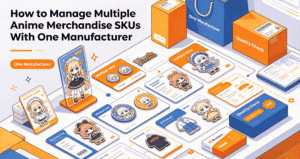
10. Simplify Operations With a Single Manufacturing Partner
Managing four separate vendors for standees, badges, packaging, and bags multiplies operational drag:
[ Multi-Vendor Fragility ]
Vendor A (Acrylic)  ──┐
Vendor B (Badges)   ──┼─► 4 Freight Bills + 4 Quality Checks + Misaligned Deliveries
Vendor C (Stickers) ──┤
Vendor D (Packaging)──┘

[ Unified Sourcing Advantage ]
One Manufacturer ───► Consolidated QC + Unified Shipping + One Point of Contact
Consolidating your core catalog with a versatile, factory-direct anime merchandise manufacturer yields clear advantages:
-
Consolidated Logistics: Ship acrylics, badges, and packaging in a single consolidated carton or pallet, reducing landed international shipping costs.
-
Unified Quality Control: Consistent color matching across substrates (paper vs. acrylic vs. metal).
-
Simplified Project Management: One production point of contact, one milestone calendar, and one set of trade terms.
11. Know When to Stop Adding SKUs
Catalog expansion should always be driven by demand, not novelty. Put product additions on hold if you experience:
-
Rising quantities of slow-moving inventory across older characters.
-
Order values stalling despite adding more SKU options.
-
Shipping and fulfillment complexity eating away at unit-level margins.
-
Customer confusion caused by too many near-identical product variations.
When in doubt, prune the underperformers and double down on proven winners.
A limited budget does not restrict you to a weak product offering. Anchor your strategy around a distinct Hero Product, build out low-friction supporting SKUs, maximize your artwork assets, and let verified market demand fund your catalog’s growth.
Ready to Build Your Custom Anime Collection?
BOCE GIFTS is a factory-direct anime merchandise manufacturer in China. We help B2B buyers, retailers, wholesalers, and independent brands build coordinated, high-margin merchandise collections from a single piece of artwork.
-
Direct Factory Production: Cast acrylic standees, shaker keychains, tinplate badges, photocard holders, and ita bags.
-
B2B-Focused Terms: Accessible low MOQs for market testing, volume-tiered wholesale pricing for bulk orders, and fast re-order turnarounds.
-
End-to-End Execution: Free prepress file review, white-ink layout setup, strict export quality control, and synchronized global logistics.
[Contact BOCE GIFTS Today] to review your artwork, discuss your target budget, and plan an optimized product mix for your next launch.