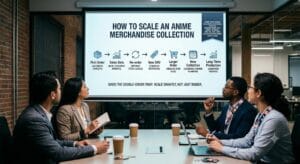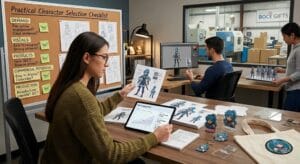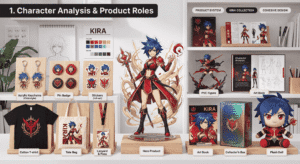
Finding a China merchandise manufacturer is only the first step in building a scalable retail or brand business. The true test of your supply chain begins after the initial contract is signed and the first deposit clears.
Many B2B buyers, independent retailers, and merchandise brand owners find themselves trapped in an exhausting cycle: they source a supplier, place an order, encounter quality drift or communication breakdowns on the second run, and are forced to start the sourcing process all over again.
To build a profitable, resilient merchandise business, you must answer four critical operational questions:
-
Can your supplier maintain identical product quality across repeat production runs?
-
Can you place a re-order without unexpected material, color, or dimensional variances?
-
Can your factory translate 2D artwork into complex physical products across multiple categories?
-
Does their production capacity have the headroom to scale alongside your sales velocity?
For serious B2B buyers, a reliable merchandise manufacturer in China should do far more than ship a single bulk order. Your objective is to transition from transactional purchasing to a structured production partnership that becomes faster, more cost-effective, and more predictable with every production cycle.
A long-term manufacturing relationship is not established when you sign your first purchase order—it is built when both parties establish a standardized, repeatable production workflow.
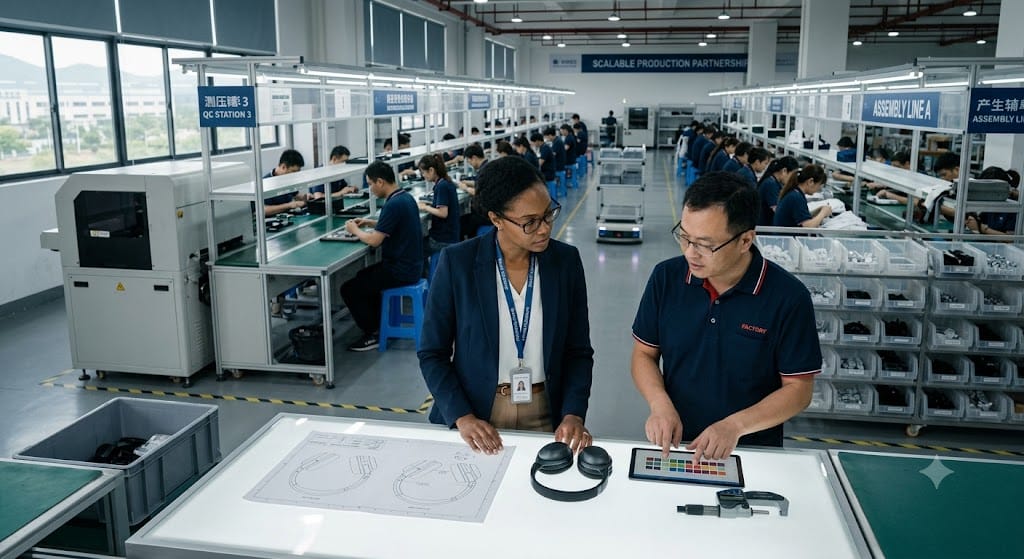
1. Choose a Manufacturer Based on Long-Term Fit (Beyond Unit Price)
The most common procurement mistake in custom manufacturing is selecting a supplier based solely on the lowest initial quotation.
When evaluating a China merchandise supplier, an artificially low unit price often masks hidden operational costs: substandard raw materials, high defect ratios, missed delivery deadlines, and zero engineering support. To secure a long-term production partner, evaluate potential factories across eight core competencies:
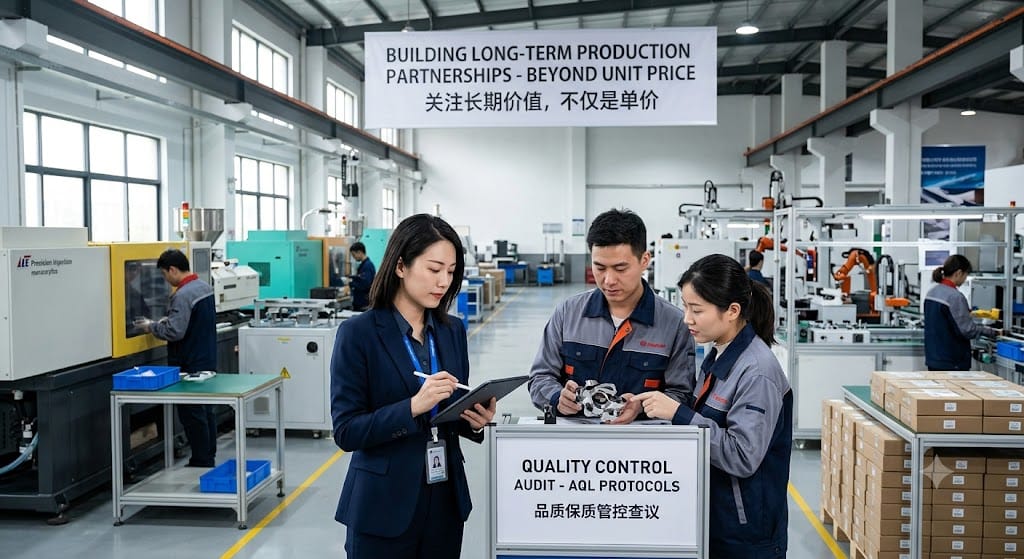
Supplier Evaluation Matrix: Long-Term vs. Short-Term Fit
| Evaluation Factor | What Transactional Buyers Look At | What Long-Term Sourcing Professionals Audit |
| Product Capability | Can they produce my immediate SKU? | Does their machinery support our full product roadmap (e.g., acrylics, metals, novelty items, packaging)? |
| Quality Control (QC) | “Do you guarantee good quality?” | Is there a documented QC protocol with defined Acceptable Quality Limits (AQL) at incoming, in-line, and pre-shipment stages? |
| Lead Time | Best-case turnaround quotation | Realistic production schedules during peak seasons, material buffer lead times, and dispatch reliability. |
| Production Capacity | Daily output claims | Scalable capacity, workshop automation levels, and peak-season floor space reservation. |
| Technical Communication | Basic English fluency | Ability to identify design flaws, provide prepress file audits, and suggest DFM (Design for Manufacturability) fixes. |
| Customization Depth | Simple logo printing | Full OEM / ODM engineering, custom mold fabrication, structural packaging development, and surface finish options. |
| Re-Order Consistency | “We can reproduce it anytime” | Automated digital archiving of vector proofs, ICC color management profiles, and physical sample preservation. |
| Product Development | Factory catalog availability | In-house prototyping capability, rapid sampling, and material innovation support. |
2. Start With a Sample as a True Production Test
In professional merchandise procurement, a sample is not a promotional gift or a mere visual preview—a sample is an operational proof of capability.
Never judge a custom merchandise manufacturer strictly by how attractive a finished sample looks on a desk. Handcrafted, high-attention samples produced by a factory’s master technician can easily mask systemic weaknesses in mass production lines.
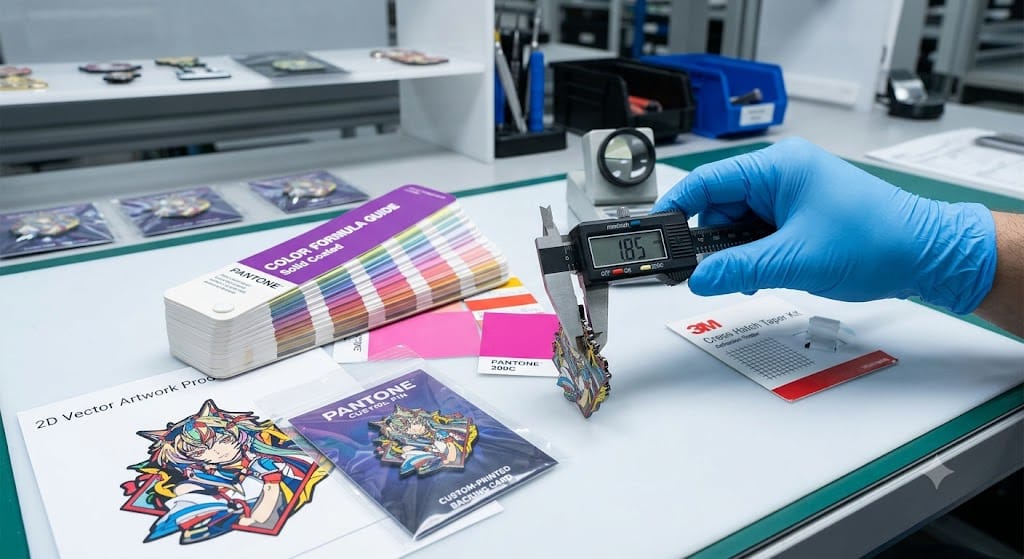
Use the sampling stage to systematically validate eight manufacturing checkpoints:
-
Artwork & Prepress Fidelity: Are vector paths, fine text lines, and gradients rendered cleanly without rasterization artifacts?
-
Color Accuracy: Does the output match target Pantone codes or CMYK proofs under standardized D65 lighting?
-
Substrate Integrity: Is the raw material premium grade (e.g., virgin optical-grade cast acrylic, lead-free zinc alloys, high-density fabrics)?
-
Physical Dimensions & Tolerances: Do cutlines, sheet thicknesses, and component clearances fall strictly within specified engineering tolerances (e.g., $\pm 0.2\text{ mm}$ for acrylic mortise-and-tenon bases)?
-
Print Adhesion & Curing: Does the UV or screen printing withstand standardized 3M cross-hatch tape adhesion tests without flaking?
-
Edge & Surface Finishing: Are cut edges diamond-polished, laser-finished without burrs, or chamfered according to specifications?
-
Assembly & Hardware Strength: Are jump rings, lobster clasps, keyrings, and fasteners rated for repeated mechanical stress?
-
Packaging Execution: Does the protective backing card, polybag, or retail box fit the product precisely without shifting or scratching?
If an anime merchandise manufacturer struggles to hit structural or color tolerances during a low-pressure sampling phase, they will inevitably fail during a multi-thousand-piece bulk run.
3. Treat the First Bulk Order as a Test of the Production System
Do not place a massive, high-risk production run on your very first transaction. Instead, utilize your first bulk order as an end-to-end stress test of the manufacturer’s operating system.
A professional wholesale supplier welcomes this audit process, which spans three distinct production phases:
[ Pre-Production ]  → Final artwork sign-off, digital proofing, packaging spec freeze
       ↓
[ In-Line Run ]     → Production status, material QA, mid-run inspection photos/videos
       ↓
[ Pre-Shipment ]    → Final AQL inspection, drop-test validation, export documentation
Phase 1: Pre-Production Validation
-
Pre-Press Proofs: Does the engineering team generate a detailed production diagram confirming bleed areas, white-ink backing layers, cutting lines, and accessory placements before touching machines?
-
Production Schedule: Does the account manager supply a clear production timeline indicating raw material procurement, printing, cutting, assembly, and packing milestones?
Phase 2: In-Line Production Monitoring
-
Proactive Status Reports: Does the manufacturer provide unprompted, transparent progress updates, backed by real photographs or video clips of the active production floor?
-
Early Anomaly Detection: If an issue arises (e.g., ink color drift, a delay in specialized hardware sourcing), does the factory report it immediately with practical technical alternatives, or do they hide it until the delivery date?
Phase 3: Pre-Shipment Quality Control
-
Comprehensive QC Reporting: Does the factory conduct an internal pre-shipment inspection checking unit counts, individual polybag seals, barcode labels, and exterior carton crush ratings?
-
Logistics & Export Documentation: Are commercial invoices, packing lists, and export declarations filled out accurately to prevent customs delays?
4. Eliminate Variances With a Product Specification Sheet
The primary point of failure in manufacturing relationships occurs during re-orders:
“Why is the acrylic base loose on our second order?”
“Why is the enamel color slightly darker on this batch?”
Ambiguous, verbal agreements guarantee inconsistent manufacturing. To build long-term manufacturing consistency, professional buyers generate and maintain a formal Product Specification Sheet (Tech Pack) for every SKU.
+-------------------------------------------------------------------------------+
|                        PRODUCT SPECIFICATION SHEET                            |
+----------------------+--------------------------------------------------------+
| Project / SKU Name   | Chibi Character Acrylic Standee - Wave 1               |
| Internal SKU Code    | AC-ST-0042-B                                           |
| Material Grade       | 100% Virgin Cast PMMA Acrylic (Grade A, High Clarity)  |
| Thickness & Tolerance| 4.0 mm (± 0.15 mm)                                     |
| Base Dimensions      | 60 mm x 60 mm x 4.0 mm, Diamond-Polished Edges         |
| Figure Dimensions    | 120 mm x 85 mm                                         |
| Printing Technology  | Double-Sided Sandwich UV Printing (CMYK + W + CMYK)    |
| Critical Colors      | Pantone 212C (Hair), Pantone 293C (Uniform), Pure 000C |
| Tolerances           | Base Insertion Fit: Snug fit, 0° tilt, manual lock     |
| Packaging            | 300g Coated Cardboard Backer, 4C Print + OPP Bag       |
| Master Carton Spec   | Double-Wall Corrugated 5-Ply, Max 15 kg per carton     |
| Reference Sample ID  | REF-SAMPLE-2026-088 (Signed & Sealed)                  |
+----------------------+--------------------------------------------------------+
The “Golden Sample” Rule
Whenever a sample is formally approved, establish two physical Golden Samples:
-
The Buyer Sample: Retained at your office as your benchmark for incoming receiving inspections.
-
The Factory Master Sample: Signed, dated, and stored in the manufacturer’s sample archive to calibrate setup parameters before every subsequent production run.
5. Build Consistency Into Every Re-Order
The first bulk order establishes the baseline; the repeat order proves whether you have a true production partner.
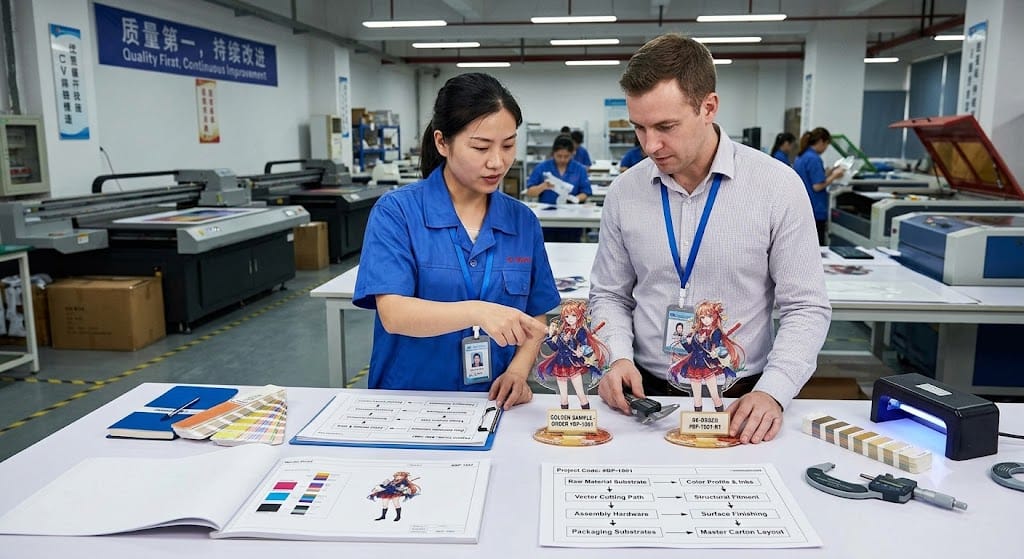
In custom manufacturing, consistency is not an accident—it is the result of locked parameters. A reliable China merchandise manufacturer must lock down eight critical variables between orders:
[ Raw Material Substrate ] ─── [ Color Profile & Inks ]
              │                           │
              ▼                           ▼
[ Vector Cutting Path ]    ─── [ Structural Fitment ]
              │                           │
              ▼                           ▼
[ Assembly Hardware ]      ─── [ Surface Finishing ]
              │                           │
              ▼                           ▼
[ Packaging Substrates ]   ─── [ Master Carton Layout ]
When placing a re-order, instruct your supplier to reference the unique Project Code and Golden Sample ID. This prevents the factory floor from re-interpreting your vector files or switching to an alternate raw material supplier between runs.
6. Communicate Forecasts, Not Just Purchase Orders
Transactional buyers place isolated orders only when inventory levels hit zero, leaving their suppliers scrambling for raw materials and scheduling production lines under emergency conditions.
Strategic sourcing professionals operate via rolling demand forecasts. Instead of sending an unexpected purchase order for 5,000 units on short notice, inform your manufacturer:
“We are issuing a PO for 5,000 units today. Based on our current sales velocity and marketing campaigns, we anticipate placing an additional 10,000-unit re-order toward the end of Q3.”
Why Rolling Forecasts Benefit B2B Buyers:
-
Secured Line Capacity: The factory can reserve dedicated machine time, safeguarding your production run against peak-season bottlenecks (such as pre-holiday rushes or the pre-Chinese New Year crunch).
-
Raw Material Reservation: Manufacturers can bulk-purchase acrylic sheets, metal alloys, paper stock, or custom accessories in advance, insulating you from market price volatility.
-
Shorter Lead Times: Because raw components and tooling are staged, manufacturing lead times can be reduced significantly.
-
Volume Price Breaks: Suppliers can plan production runs efficiently, unlocking volume-based pricing without requiring you to take delivery of all inventory in a single shipment.
7. Address Production Issues Early and Systematically
In manufacturing, technical issues will occasionally arise: unexpected dye-lot variances, transit-damaged master cartons, raw material delays, or subtle pre-press layer misalignments.
A successful long-term partnership is not defined by the total absence of problems—it is defined by how professionally, quickly, and systematically those problems are resolved.
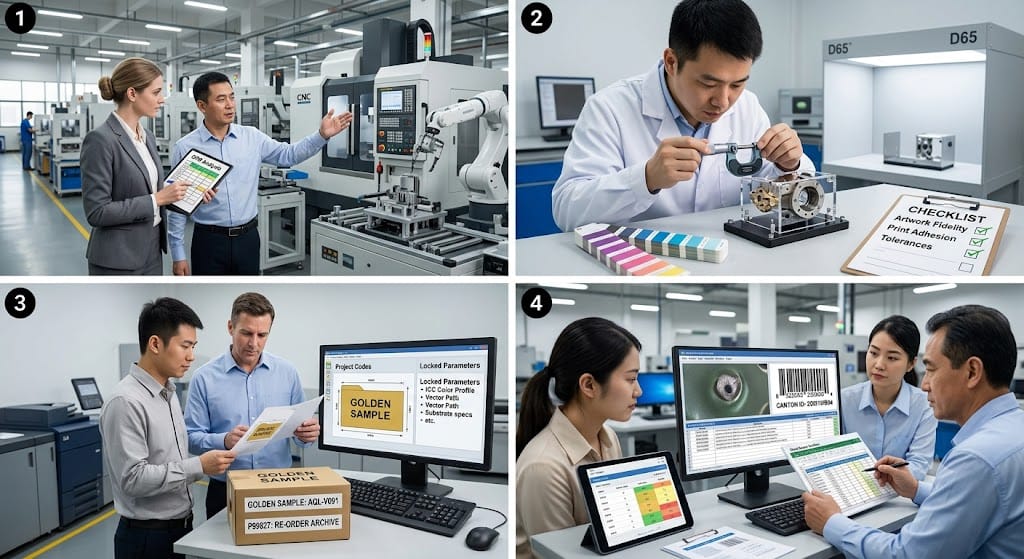
Never wait until a damaged or defective sea freight container arrives at your distribution center to voice complaints. Establish an objective Quality Discrepancy Protocol:
Issue Identified
       ↓
Provide Photographic & Video Evidence with Barcode/Carton IDs
       ↓
Log Defect Rate against Agreed AQL Thresholds
       ↓
Joint Root-Cause Analysis (Machinery, Operator, Material, Transit)
       ↓
Action Plan (Replacement Run, Credit Note, Process Rectification)
By approaching issues with structured data (sample photos, macro videos, batch numbers, and exact defect percentages) rather than emotional blame, you position your brand as an enterprise-grade client whom the factory will prioritize.
8. Expand From a Single SKU to Multi-Category Manufacturing
Once you have verified that a manufacturer delivers consistent quality on your core item (e.g., custom acrylic standees), do not start the sourcing cycle from scratch for related merchandise.
Transitioning from an isolated product supplier to a comprehensive production partner involves building a cohesive product ecosystem under one roof:
Core Product (Acrylic Standees)
       ↓
Direct Extensions (Acrylic Keychains, Badges, Character Shakers)
       ↓
Hard-Surface Accessories (Zinc Alloy Pins, Enamel Badges, Medals)
       ↓
Sewn Goods & Lifestyle (Ita Bags, Plush Pendants, Apparel, Tote Bags)
       ↓
Turnkey Retail Collections (Full Character Blind Boxes, Box Sets)
Working with an established custom manufacturing partner who provides multi-category production delivers distinct operational advantages:
-
Consolidated Shipping: Combine multiple product lines into shared sea or air freight shipments, significantly lowering per-unit landed logistics costs.
-
Unified Visual Identity: Maintain consistent color profiles, brand typography, and packaging materials across diverse merchandise types.
-
Reduced Procurement Friction: Work with a single trusted engineering team, standardizing billing, project management, and QC standards across your entire catalog.
9. Provide Production and Market Context to Your Manufacturer
Transactional buyers issue bare-minimum commands: “Make 2,000 of this keychain.”
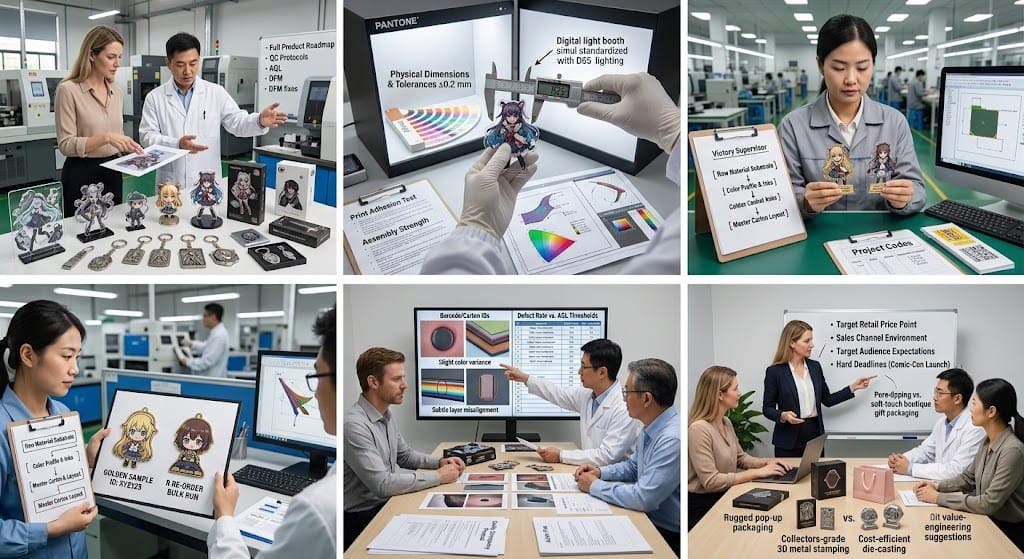
Strategic brand owners provide meaningful operational context. When you brief your custom merchandise manufacturer, share high-level commercial parameters:
-
Target Retail Price Point: Helps the engineering team recommend optimal production techniques (e.g., standard die-casting vs. multi-level 3D zinc alloy stamping).
-
Sales Channel Environment: Merchandising sold at high-traffic pop-up events needs rugged, tamper-evident packaging; items bound for high-end boutique display require soft-touch gift packaging and foiled backer cards.
-
Target Audience Expectations: Collectors demand microscopic flaw tolerances and premium surface finishes; promotional event giveaways prioritize speed and cost efficiency.
-
Hard Deadlines: Clearly distinguish between flexible re-stock dates and immovable event dates (such as Comic-Con launches, retail pop-ups, or seasonal holiday campaigns).
The more practical context you share, the better your manufacturer can suggest value-engineering opportunities, alternate finishing methods, and packaging upgrades that protect your profit margins.
10. Scale Up Through OEM, ODM, and Private Label Production
As your business grows, your procurement model should evolve from simple custom-printed novelties to fully proprietary product development:
[ OEM: Original Equipment Manufacturing ]
You provide completed vector artwork, mechanical CAD files, and material specs.
The factory builds the custom tooling and manufactures the physical product to your exact blueprint.
                                │
                                ▼
[ ODM: Original Design Manufacturing ]
You provide a character concept, functional brief, or creative style guide.
The factory's engineering team develops the internal structure, interlocking mechanisms,
material choices, and production tooling.
                                │
                                ▼
[ Turnkey Private Label ]
Full-suite brand development: bespoke structural retail packaging, custom barcode tags,
foil-stamped anti-counterfeit labels, branded hardware, and retail-ready unboxing experiences.
Transitioning into private label merchandise establishes high barriers to entry against competitors. When your manufacturer supports full OEM/ODM engineering, you transform basic promotional items into premium retail assets.
11. Negotiate Based on Lifetime Business Value, Not Single Orders
Aggressive procurement tactics—such as forcing a factory down to zero-margin pricing on a single low-volume run—always backfire in manufacturing. When a factory is squeezed past its sustainable margin, it is forced to cut corners: using reclaimed acrylic resins, running printing machines at low-resolution high-speed passes, or skipping manual QA inspections.
Instead of fighting over pennies on an individual SKU, negotiate based on the aggregate value of your production program:
-
Consolidated Annual Volume: Discuss pricing tiers based on total projected annual spend across all product lines rather than isolated purchase orders.
-
Standardized Componentry: Standardize packaging dimensions, base designs, or hardware fittings across multiple designs to lower tooling and purchasing costs.
-
Tooling Amortization: Negotiate partial or full tooling/mold refunds once cumulative production volumes surpass agreed manufacturing thresholds.
-
Payment Term Evolution: As payment history solidifies, progress from 100% upfront deposits to commercial terms (e.g., 30% deposit, 70% upon bill of lading confirmation), optimizing your working capital.
12. Standardize Your Re-Order Workflow
A mature manufacturing relationship should make re-ordering simpler, faster, and more automated than your initial production run.
Implement an eight-step Re-Order SOP to streamline purchasing:
1. Velocity Monitoring   ── Track sales run-rates and calculate safe replenishment triggers
           │
2. Demand Forecasting    ── Calculate target order size based on production and transit lead times
           │
3. Spec Confirmation     ── Issue PO referencing existing Golden Sample ID & locked Spec Sheet
           │
4. Production Run Lock   ── Factory verifies archived digital assets and reserves production capacity
           │
5. Deposit Execution     ── Milestone confirmation and release of raw material inventory
           │
6. In-Line Verification  ── Automated status check against the master reference sample
           │
7. Pre-Shipment QA Check ── Standardized AQL inspection sign-off
           │
8. Logistics & Customs   ── Release of commercial documents and balance payment
Your overarching supply-chain objective: every successive re-order should require fewer human touchpoints and less friction than the order before it.
13. Align Your Production Schedule With Your Manufacturer’s Calendar
A reliable manufacturing partnership is built on shared operational visibility. Share your 6-to-12-month commercial roadmap with your account team:
-
Major retail launch schedules and pre-order delivery deadlines.
-
Planned convention appearances, corporate events, and trade shows.
-
Seasonal holiday collections (e.g., Q4 Halloween and Christmas merchandise).
-
International supply-chain bottlenecks, specifically the Chinese New Year (CNY) shutdown, during which Chinese factories, raw material vendors, and logistics networks pause operations for 3 to 4 weeks.
When your manufacturer understands your growth trajectory, they can schedule production buffers, procure raw materials ahead of seasonal price spikes, and hold dedicated manufacturing capacity for your brand.
14. Know When to Scale the Relationship: The 5-Stage Maturity Model
Track your manufacturing partnership along this progressive maturity framework:
[ Stage 1: Testing ]
Sample development + Low MOQ test run
Goal: Validate print resolution, cut fidelity, communication agility, and baseline lead times.
       │
       ▼
[ Stage 2: System Validation ]
First commercial bulk order
Goal: Audit full-scale production workflows, packaging durability, export handling, and QC.
       │
       ▼
[ Stage 3: Operational Repeatability ]
Routine, low-friction re-orders
Goal: Lock in technical specs, eliminate batch-to-batch variance, automate PO issuance.
       │
       ▼
[ Stage 4: Catalog Expansion ]
Multi-SKU and multi-category scaling
Goal: Introduce new product categories, cross-product packaging sets, and consolidated freight.
       │
       ▼
[ Stage 5: Strategic Partnership ]
Full OEM / ODM & Turnkey Private Label
Goal: Custom tooling development, dedicated factory floor capacity, and collaborative product engineering.
15. What a Long-Term China Merchandise Manufacturer Should Provide
Use this operational checklist to evaluate whether your current supplier has the capabilities of a true long-term partner:
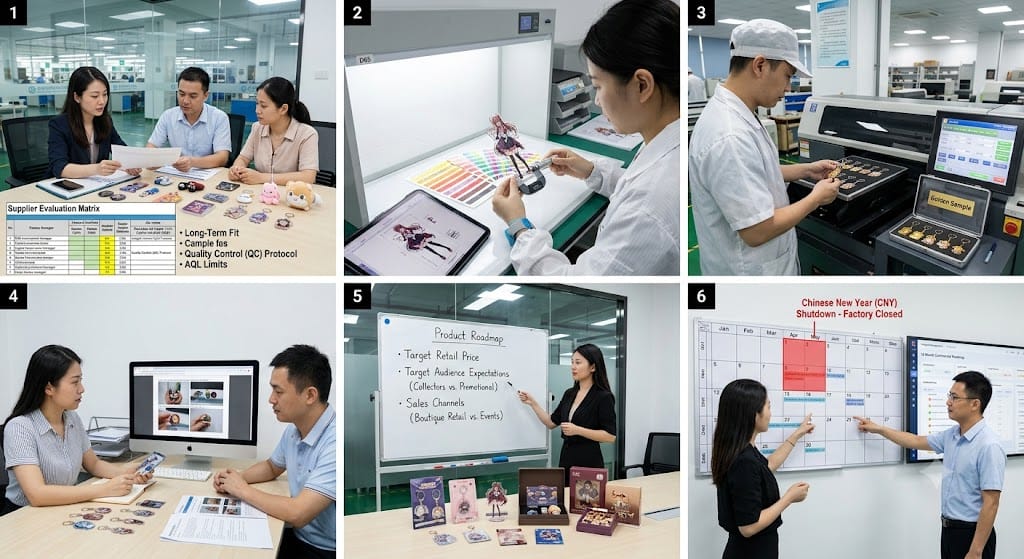
-
[ ] Repeatable Quality Standards: Measurable batch consistency verified against physical master samples.
-
[ ] Agile Prepress Support: In-house prepress specialists capable of auditing cutlines, bleeds, and vector color profiles.
-
[ ] Direct Factory Pricing: Transparent cost structures without unverified third-party trading markups.
-
[ ] Low MOQ Flexibility: Accessible minimums for pilot runs, coupled with industrial scalability for large orders.
-
[ ] Structured QC Systems: Documented incoming, in-line, and pre-shipment inspections following standard AQL protocols.
-
[ ] Material Traceability: High-grade, virgin raw materials (RoHS, REACH, and EN71 compliant where applicable).
-
[ ] Comprehensive OEM/ODM Engineering: Full-suite structural prototyping, custom mold building, and packaging development.
-
[ ] Transparent Operational Communication: Proactive reporting of production schedules, machine queues, and transit tracking.
16. Case Example: An Anime Retailer’s 12-Month Sourcing Roadmap
Here is how an independent anime merchandise brand successfully transitioned a factory from an unknown vendor into their primary manufacturing hub over a one-year cycle:
Month 1: Prototyping
Buyer requests custom acrylic standee samples with double-sided printing and custom bases.
Factory provides DFM feedback to correct loose base mortise tolerances. Sample approved.
       │
Month 2: Initial Run
Buyer issues first bulk order (500 pcs per character across 4 characters; 2,000 pcs total).
Factory executes run on schedule; minor packaging scuffs noted on 12 units and replaced instantly.
       │
Month 3: Velocity & Re-Order
Product launches online; 2 characters sell out in 3 weeks.
Buyer triggers immediate re-order referencing the Golden Sample ID. Batch #2 arrives identical to Batch #1.
       │
Month 4: Horizontal Expansion
Buyer leverages existing character artwork to launch zinc alloy hard enamel pins and acrylic charms.
Factory coordinates production internally, consolidating both product lines into a single air shipment.
       │
Month 6: Custom Private Labeling
Buyer scales to blind-box mystery character packs.
Factory engineers custom foil tear-pouches, bespoke counter display boxes, and applied barcode labeling.
       │
Month 12: Strategic Alignment
Buyer signs an annual manufacturing arrangement with scheduled quarterly releases.
Factory guarantees reserved line capacity during the busy Q4 peak season and locks in volume-discounted raw material rates.
The relationship flourished because each subsequent milestone removed operational friction, standardized technical benchmarks, and lowered landed unit costs.
17. The 7 Pillars of a Long-Term Manufacturing Partner
When auditing whether a factory is worth retaining as an anchor partner, evaluate them against seven non-negotiable criteria:
-
Consistency: Can they reproduce identical physical tolerances, print resolutions, and color matches six months later?
-
Communication: Do they communicate technical realities clearly, directly, and promptly?
-
Problem-Solving: When production snags occur, do they provide practical engineering solutions rather than excuses?
-
Capacity: Can their facility scale effortlessly from a 1,000-piece pilot run to a 50,000-piece seasonal rollout?
-
Flexibility: Can they accommodate mixed SKUs, multiple design variants, and realistic low MOQs for market testing?
-
Development Capability: Can they develop new product formats, custom surface finishes, and complex assemblies from your sketches?
-
Re-Order Simplicity: Does placing a re-order take minutes because your production data and samples are securely archived?
Conclusion
Building a successful, long-term relationship with a China merchandise manufacturer does not happen by luck, nor does it happen after a single smooth transaction.
It is the direct result of a structured procurement strategy: validating prototypes through rigorous sampling, locking down technical specifications, executing predictable bulk orders, treating re-orders as consistency tests, and systematically expanding into new product categories.
-
Start with a focused product line.
-
Standardize your first successful bulk production run.
-
Lock in a disciplined re-order workflow.
-
Scale into diversified collections, custom OEM/ODM tooling, and private label merchandise.
The ideal manufacturing partnership should make every successive order easier, faster, and more profitable than the last.
Partner With a Direct Custom Merchandise Manufacturer in China
Are you looking for an experienced, factory-direct manufacturing partner who understands the demands of modern B2B buyers, global retailers, and merchandise brands?
At BOCE GIFTS, we support international businesses across every phase of product development—from initial rapid sampling and low-MOQ pilot runs to large-scale bulk manufacturing and turnkey private label production.
-
Direct Factory Manufacturing: High-precision acrylic standees, keychains, metal enamel pins, badges, lifestyle merchandise, and custom packaging.
-
Low MOQ & Rapid Prototyping: Test new designs quickly with low capital risk before committing to large inventory runs.
-
Rigorous Quality Control: Standardized in-line quality inspections and locked reference sample archiving for batch-to-batch consistency.
-
Full OEM / ODM Capabilities: In-house DFM assistance, custom mold development, and complete retail packaging solutions.
Contact BOCE GIFTS Today to submit your artwork, request a sample evaluation, and discuss building a long-term production program for your brand.