When sourcing custom merchandise wholesale, Minimum Order Quantity (MOQ) dictates far more than just how many units arrive at your warehouse. It directly governs your unit economics, tooling amortization, cash flow velocity, inventory holding risk, and final profit margins.
For B2B buyers, retailers, and brand owners, navigating factory MOQs is a balancing act: a low MOQ preserves capital and limits downside risk during product testing, while a higher MOQ unlocks the economies of scale necessary to protect retail margins.
What Does MOQ Mean in Wholesale Sourcing?
In B2B manufacturing, Minimum Order Quantity (MOQ) represents the lowest number of units a factory is willing to produce under a specific set of production conditions.
However, professional procurement teams evaluate MOQ across several distinct operational tiers rather than treating it as a single flat number:
-
MOQ Per Order: The total combined production volume required for a supplier to open a production slot.
-
MOQ Per Design / Artwork: The minimum run required for a single graphic file or print setup (e.g., 100 units per character design).
-
MOQ Per SKU / Variant: The minimum quantity per specific colorway, size, or accessory attachment.
-
MOQ Per Mold / Tooling: The threshold required to offset the physical fabrication of custom tooling (e.g., custom injection molds or zinc alloy die-castings).
-
MOQ Per Material Batch: The minimum run dictated by raw material suppliers (e.g., custom Pantone-dyed fabric or specialized glitter acrylic sheets).
Understanding which tier drives a supplier’s MOQ enables buyers to structure purchase orders more effectively during negotiations.
Why Do Custom Merchandise Manufacturers Set MOQ?
Factories do not establish MOQs arbitrarily. In custom manufacturing, every order incurs fixed setup and operational costs that must be amortized across the total unit volume.
-
Raw Material Procurement: Direct manufacturers rarely stock infinite variations of raw acrylic, specialty metals, silicone, or fabrics. Material mills impose their own minimum order thresholds on factories.
-
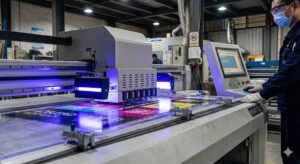
Machine Calibration & Tooling Setup: Setting up UV flatbed printers, calibrating laser/CNC cutting beds, cutting die lines, or mounting stamping plates consumes non-billable technician hours and trial materials.
-
Labor Allocation: Custom merchandise requires pre-flight graphic proofs, manual jig placement, assembly, individual protective film peeling, quality control inspections, and packing. Small batches tie up skilled assembly lines with disproportionate overhead.
-
Packaging Production Runs: Custom printed backing cards, branded polybags, blister packs, and barcode labels rely on commercial offset printing, which carry strict plate minimums.
-
Production Line Efficiency: Manufacturing profitability depends on continuous throughput. Frequent changeovers between 50-piece micro-orders disrupt factory schedules and increase defect rates.
How MOQ Affects Wholesale Pricing
Wholesale pricing follows an inverse curve relative to order volume. As order quantities rise, fixed setup charges and material waste shrink on a per-unit basis.
| Order Quantity | Unit Cost | Inventory Risk | Best Strategic Fit |
| 50 – 100 pcs | Premium / High | Very Low | Design validation, market testing, limited creator drops |
| 300 – 500 pcs | Moderate | Low–Medium | Boutique retailers, seasonal product launches |
| 1,000 – 2,500 pcs | Cost-Optimized | Medium | Established e-commerce brands, high-velocity SKUs |
| 5,000+ pcs | Lowest / Tier-1 | High | Wholesale distributors, enterprise retail chains, corporate gifting |
The Math of Fixed Cost Amortization
Consider a custom merchandise project requiring a $500 custom mold or setup fee:
$$\text{Tooling Amortization at } 100 \text{ units} = \frac{\$500}{100} = \$5.00 \text{ per piece}$$
$$\text{Tooling Amortization at } 1,000 \text{ units} = \frac{\$500}{1,000} = \$0.50 \text{ per piece}$$
$$\text{Tooling Amortization at } 5,000 \text{ units} = \frac{\$500}{5,000} = \$0.10 \text{ per piece}$$
At low order volumes, tooling and setup fees can easily exceed the base material cost of the product itself.
Low MOQ vs. High MOQ: Strategic Trade-Offs
Choosing between a low or high MOQ is not a question of which is universally better, but which aligns with your operational stage and cash flow model.
Low MOQ Strategy                         High MOQ Strategy
[Capital Preservation]                   [Margin Maximization]
       │                                        │
       ├── Lower upfront financial outlay       ├── Deepest wholesale unit pricing
       ├── Faster design iteration & testing    ├── Stable inventory for steady demand
       ├── Minimal warehousing liability        └── Priority factory scheduling & support
       │                                        │
       ▼                                        ▼
Trade-off: Higher COGS, lower net margin   Trade-off: Higher upfront capital & holding risk
-
Low MOQ Advantages: Limits capital exposure on unproven artwork, minimizes dead inventory, and allows multi-SKU testing across diverse customer demographics.
-
Low MOQ Disadvantages: Higher unit cost of goods sold (COGS), less leverage for custom packaging, and higher per-unit air shipping expenses.
-
High MOQ Advantages: Unlocks tier-one factory pricing, expands gross margins, enables bespoke OEM structural modifications, and lowers freight costs via consolidated sea shipping.
-
High MOQ Disadvantages: Ties up operating capital, requires dedicated warehousing, and exposes buyers to trend shifts or design obsolescence.
Recommended MOQs by B2B Buyer Profile
-
Startups & Independent Creators (50–100 pcs/design): Prioritize agility. Validate audience demand across multiple character or logo designs using digital manufacturing processes before committing significant capital.
-
Boutique Retailers & Pop-Up Shops (100–300 pcs/SKU): Balance product variety with shelf presence. Order enough volume to justify custom backer cards without cluttering backroom storage.
-
E-Commerce & Amazon/Shopify Sellers (300–1,000 pcs): Launch with manageable batches, track sell-through velocity, and immediately transition top 20% bestseller SKUs into bulk repeat orders.
-
Wholesalers & Regional Distributors (1,000–5,000+ pcs): Maximize price spread across established distribution networks. Focus on high-capacity production lines and full container-load freight optimization.
-
Enterprise Brands & Corporate OEM/ODM Programs (5,000+ pcs): Require bespoke product molds, pantone-matched materials, custom retail packaging, and strict AQL inspection standards.
5 Ways to Negotiate a Lower MOQ with Factories
Lowering order thresholds does not require aggressive bargaining; it requires structuring orders to reduce the factory’s operational friction.
-
1. Aggregate Total Order Volume Across Multiple SKUs: Instead of requesting 100 units of a single item, offer a combined order of 500 units split across 5 designs ($5 \times 100\text{ pcs}$) utilizing identical raw materials and base dimensions.
-
2. Standardize Base Specifications: Select factory-standard material thicknesses (e.g., 3mm or 4mm clear acrylic), standard plating finishes (e.g., stock nickel or imitation gold), and in-stock hardware attachments to eliminate custom material batch requirements.
-
3. Utilize Tooling-Free Manufacturing Techniques: Choose high-precision digital UV printing and laser cutting over traditional silkscreen printing or injection molds, removing fixed plate fees.
-
4. Share a Phased Procurement Roadmap: Present a quarterly purchasing forecast. Factories are far more willing to accept a low initial pilot run if they see a clear reorder schedule for proven sellers.
-
5. Accept Standard Bulk Packaging for Pilot Runs: Use factory-standard polybags or standard display packaging for initial testing, deferring fully custom printed retail boxes to larger follow-up orders.
Why a Lower MOQ Is Not Always Better
Securing an ultra-low MOQ can backfire if it compromises commercial viability:
$$\text{Lower MOQ} \longrightarrow \text{Higher Unit COGS} \longrightarrow \text{Compressed Retail Margins} \longrightarrow \text{Vulnerability to Ad/Shipping Spikes}$$
If market research confirms strong product demand, ordering 100 pieces at $3.00/unit yields $300 in spend, but ordering 1,000 pieces at $1.10/unit yields $1,100 in inventory that generates substantially higher net profit once sold. Sourcing at suboptimal volume artificially inflates your cost structure and restricts marketing spend.
Don’t Compare MOQ Alone — Compare Total Landed Cost
Evaluating suppliers purely on MOQ or quoted FOB unit price leads to inaccurate procurement budgeting. Professional buyers evaluate total landed cost:
┌─────────────────────────────────────────────────────────────┐
│                     TOTAL LANDED COST                       │
├─────────────────────────────────────────────────────────────┤
│  [Base Product Cost]      Unit production price             │
│  [Customization / Setup]  Print setups, film charges, plates│
│  [Tooling / Mold Cost]    One-time custom mold creation     │
│  [Packaging & Labeling]   Backer cards, barcodes, polybags  │
│  [Quality Control & QA]   Batch inspection & lab testing    │
│  [Freight & Import Duty]  Air/Sea shipping, tariffs, customs│
└─────────────────────────────────────────────────────────────┘
A supplier quoting a 100-piece MOQ with high unit pricing and separate setup fees may result in a higher landed cost per unit than a direct factory offering a 300-piece MOQ with integrated tooling and packaging.
Procurement Case Study: Custom Acrylic Keychains
A merchandise retailer needs custom acrylic keychains for an upcoming product launch. They evaluate two manufacturing proposals:
-
Supplier A (Trading Company / Low MOQ Focus):
-
MOQ: 100 pieces
-
Unit Price: $2.60 / pc
-
Setup Fee: $40
-
Requirement: 500 pieces needed across 5 designs
-
Total Production Cost: $(500 \times \$2.60) + \$40 = \$1,340$
-
-
Supplier B (Direct Factory / Scaled Pricing):
-
MOQ: 500 pieces (Allows 5 designs $\times$ 100 pcs)
-
Unit Price: $1.15 / pc
-
Setup Fee: Waived for total volume $\ge 500\text{ pcs}$
-
Total Production Cost: $500 \times \$1.15 = \$575$
-
Supplier A (Trading Reseller)  ████████████████████████ $1,340
Supplier B (Direct Factory)    ██████████ $575  [Saves $765 (57%)]
By working directly with a factory capable of aggregating design volume across a single material batch, the buyer secures the exact same 500-unit requirement while cutting their production cost by 57%.
How to Vet a Wholesale Supplier in China
-
Direct Manufacturer vs. Intermediary: Confirm whether the facility controls its own printing, cutting, and assembly lines or subcontracts to secondary workshops.
-
Tooling & Setup Transparency: Ensure setup fees, plate charges, and sample proofing costs are itemized upfront.
-
Production Capacity & Peak Scaling: Check if the supplier can scale seamlessly from a 100-piece pilot test to a 50,000-piece seasonal bulk order.
-
AQL Quality Standards: Confirm defect tolerances, print alignment limits, color accuracy guidelines (Pantone matching), and protective packaging protocols.
-
Lead Time Stability: Verify sampling lead times (typically 3–5 business days) and bulk production turnarounds (typically 10–15 business days).
-
Repeat Order Workflow: Verify that artwork files, cut paths, and mold specifications are archived for rapid reordering without repeated setup fees.
BOCE Gifts: Flexible MOQ for Custom Wholesale Merchandise
BOCE Gifts operates as a factory-direct manufacturer and wholesale supplier in China, delivering custom manufacturing solutions for retailers, e-commerce brands, promotional agencies, and global distributors.
-
Agile MOQ Programs: Flexible minimums designed for emerging brand testing as well as high-capacity industrial production lines for bulk container orders.
-
Factory-Direct Pricing: Direct access to production lines eliminates intermediary markups, ensuring competitive wholesale unit pricing.
-
End-to-End OEM / ODM Capabilities: Full support for custom acrylic merchandise, metal badges, keychains, embroidered accessories, custom stationary, and private-label packaging.
-
Rigorous Quality Control: Dedicated pre-flight artwork auditing, digital proof verification, and multi-stage QC inspection prior to dispatch.
-
Rapid Reorder & Scalability: Archived production profiles ensure precise color matching and expedited lead times on seasonal repeat orders.
Contact our engineering and procurement team with your artwork files, target unit quantities, and delivery schedules to receive a direct factory quotation.
Frequently Asked Questions (FAQ)
What does MOQ mean in wholesale merchandise?
MOQ (Minimum Order Quantity) is the lowest unit count a manufacturer requires to initiate a production run for a specific product, artwork design, or material specification.
Why do direct manufacturers enforce MOQs?
MOQs cover fixed operational expenses, including machine setup, print calibration, raw material mill purchase minimums, assembly labor, and custom packaging runs.
Does a higher MOQ always guarantee a lower unit price?
Yes. Higher order quantities distribute fixed tooling and setup expenses across more units, lowering the per-piece manufacturing cost.
Can I split an MOQ across multiple graphic designs?
Many direct factories allow split designs (e.g., 500 total pieces divided into 5 designs of 100 pieces) provided the product base, dimensions, and materials remain uniform.
What is a standard MOQ for custom acrylic merchandise?
Standard factory direct MOQs for acrylic products typically range between 50 and 100 pieces per design for digital UV printing, while specialized injection molded products may require 1,000 to 5,000 pieces.
How can I negotiate a lower MOQ with a factory in China?
Use standard material dimensions, eliminate custom molds by choosing digital printing, aggregate volume across multiple designs, and provide a clear reorder roadmap.
Is sourcing at a lower MOQ always the most profitable choice?
No. Ultra-low order quantities carry higher unit costs (COGS), which can reduce your profit margins and limit your marketing and customer acquisition budget.
What is the difference between an MOQ and a bulk order tier?
An MOQ is the absolute minimum quantity needed to start production, whereas bulk order tiers represent higher volume thresholds where suppliers provide additional discounted price breaks.
What costs should I consider besides the quoted MOQ price?
Evaluate the total landed cost, which includes setup fees, custom packaging, third-party quality inspections, international freight, customs duties, and local warehousing.
Can I place a small trial order before committing to a full production run?
Yes. Reputable manufacturers provide physical pre-production samples or low-MOQ pilot production runs to verify color fidelity, cut precision, and material quality before full-scale manufacturing.