When sourcing custom acrylic standees for anime merchandise, corporate retail, or promotional events, one important manufacturing detail can significantly affect the final appearance: white ink printing.
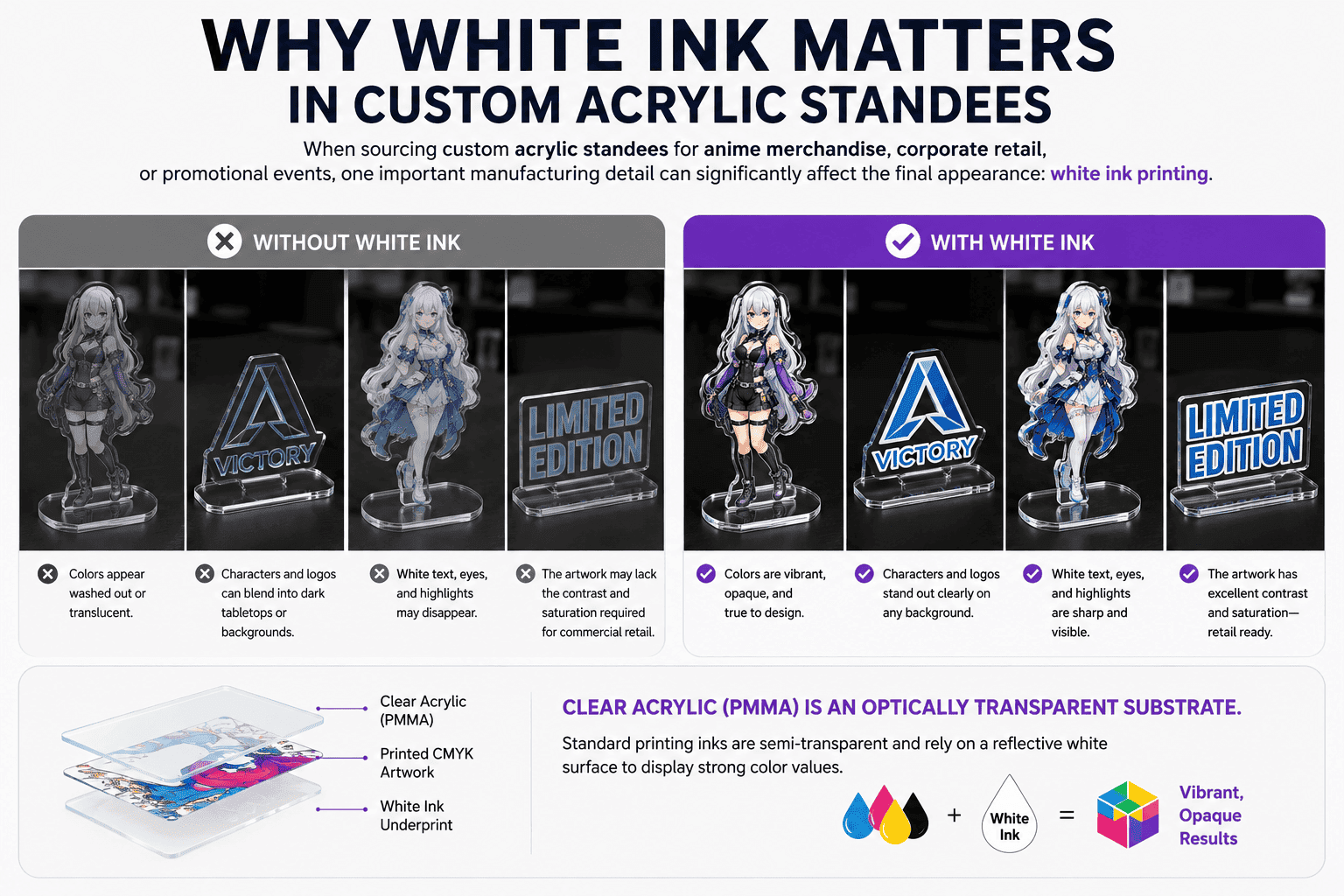
Buyers who print custom artwork onto clear acrylic often notice that the physical sample looks different from the on-screen digital proof:
- Colors appear washed out or translucent.
- Characters and logos can blend into dark tabletops or backgrounds.
- White text, eyes, and highlights may disappear.
- The artwork may lack the contrast and saturation required for commercial retail.
Clear acrylic (PMMA) is an optically transparent substrate. Standard printing inks are semi-transparent and rely on a reflective white surface to display strong color values.
Standard Paper Printing:      CMYK Inks + White Paper Substrate = Opaque, True Color

Clear Acrylic (No White):     CMYK Inks + Clear Acrylic Sheet = Translucent, Washed-Out Color

Clear Acrylic (With White):   CMYK Inks + Solid White Ink Base = Vibrant, Opaque Finish
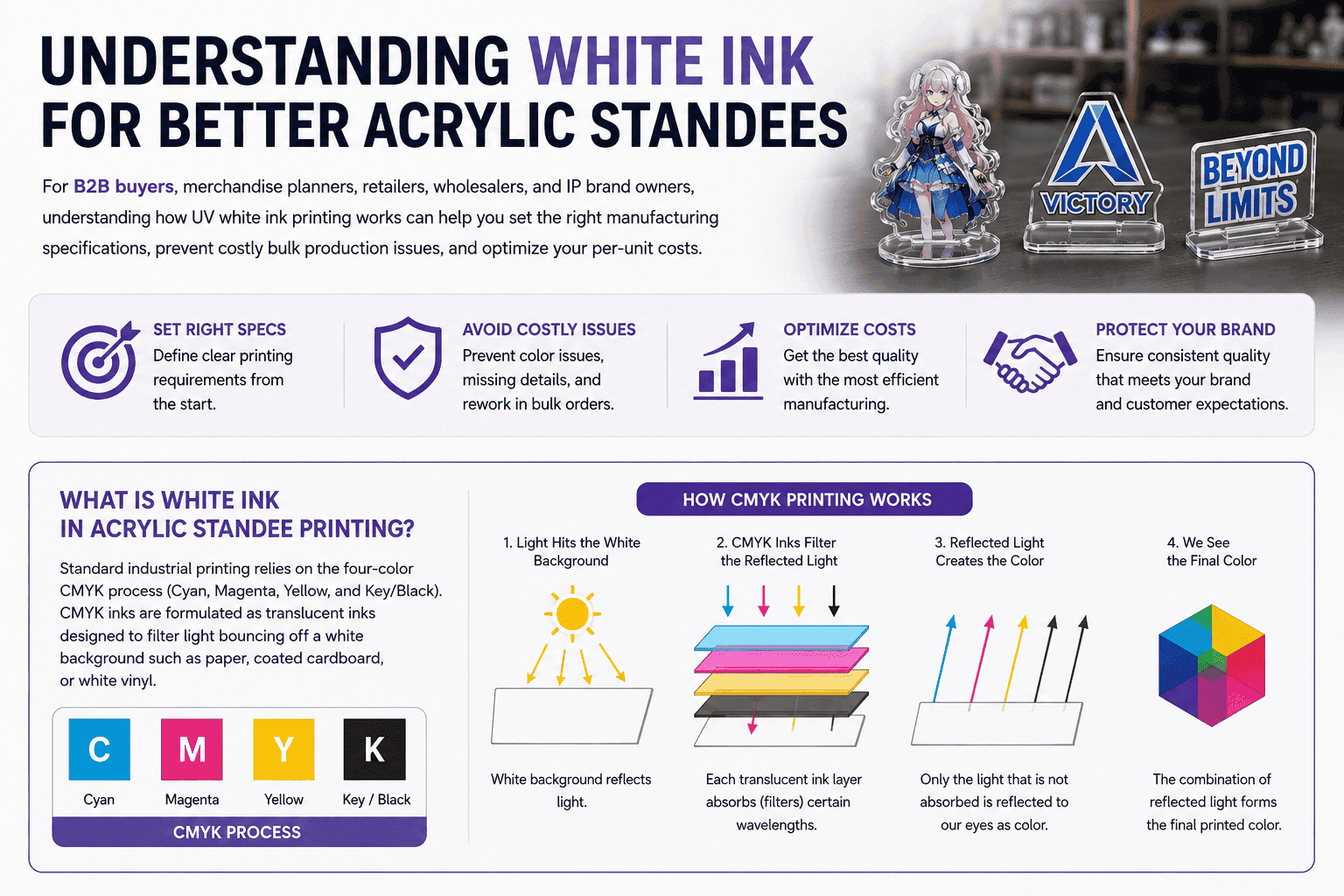
For B2B buyers, merchandise planners, retailers, wholesalers, and IP brand owners, understanding how UV white ink printing works can help you set the right manufacturing specifications, prevent costly bulk production issues, and optimize your per-unit manufacturing costs.
What Is White Ink in Acrylic Standee Printing?
Standard industrial printing relies on the four-color CMYK process (Cyan, Magenta, Yellow, and Key/Black). CMYK inks are formulated as translucent inks designed to filter light bouncing off a white background such as paper, coated cardboard, or white vinyl.
+-------------------------------------------------------------------------+
| CMYK Inks Cannot Create Opaque White Areas on Their Own.                |
| In conventional printing, any "white" area in your digital design file |
| represents the absence of ink, exposing the white paper beneath.       |
+-------------------------------------------------------------------------+
Because acrylic sheets are transparent, leaving an area unprinted does not create a white graphic. Instead, it leaves a clear, see-through area.
UV white ink is a highly pigmented ink formulation designed for industrial UV flatbed printers. When printed onto clear PMMA sheets, it creates an opaque base that helps CMYK colors appear stronger and more consistent.
Why Does Clear Acrylic Need White Ink?
Acrylic offers high optical clarity. Without an opaque white layer, light can pass through the printed CMYK layer and the acrylic sheet, which can change the appearance of the artwork.
Incident Light
      │
      ▼
┌──────────────┐
│  CMYK Ink    │ ── Translucent Color Layer
├──────────────┤
│  White Ink   │ ── Opaque Reflective Base
├──────────────┤
│  Clear PMMA  │ ── Transparent Acrylic Sheet
└──────────────┘
1. Reducing Unwanted Background Show-Through
Without a white base layer, ambient light can pass through the printed CMYK layer. If the finished standee sits on a dark wooden desk, black shelf, or near an indoor light source, the background can show through the graphics and affect the visual result.
2. Improving Color Saturation
CMYK inks rely on reflected light to display strong colors. A dense white ink undercoat helps reduce light transmission through the acrylic and improves the visual saturation of reds, yellows, deep blues, pastels, and other colors.
3. Creating Visible White Details
Anime characters, corporate logos, and promotional designs often include white elements such as eye highlights, clothing details, teeth, text, and brand graphics.
Without white ink, these areas can remain transparent.
UV white ink deposits an opaque white layer onto the acrylic, making these details clearly visible.
What Happens to Standees Printed Without White Ink?
Printing directly onto clear acrylic with CMYK inks alone can create several visual issues:
- Washed-Out Colors: Deep colors may look lighter or more translucent.
- Lower Contrast: Character linework, shading, and fine graphic details may lose visual impact.
- Missing White Elements: White areas in the artwork can appear transparent instead of solid white.
- Background Sensitivity: The appearance can change depending on the color and lighting of the surface behind the standee.
For this reason, many custom acrylic standees for retail and wholesale merchandise use a white ink base.
How Does White Ink Layering Work on Acrylic?
Industrial UV flatbed printing machines apply ink in precise passes. Depending on the artwork, visual effect, and single- or double-sided printing requirements, manufacturers can use different white ink configurations.
Option 1: CMYK Only           Option 2: CMYK + White Base       Option 3: Double-Sided Sandwich
   (Translucent)                  (Standard Standee)                (Opaque Both Sides)

┌──────────────────┐           ┌──────────────────┐              ┌──────────────────┐
│     CMYK Ink     │           │     CMYK Ink     │              │    CMYK (Front)  │
├──────────────────┤           ├──────────────────┤              ├──────────────────┤
│  Clear Acrylic   │           │    White Base    │              │    White Barrier │
└──────────────────┘           ├──────────────────┤              ├──────────────────┤
                               │  Clear Acrylic   │              │    CMYK (Back)   │
                               └──────────────────┘              ├──────────────────┤
                                                                 │  Clear Acrylic   │
                                                                 └──────────────────┘
Option 1: CMYK Only (Translucent Effect)
- Structure: Single layer of CMYK printed directly onto clear PMMA.
- Characteristics: High light transmission, glass-like appearance, and softer color impact.
- Best For: Special-effect overlays, suncatcher merchandise, and transparent flame or aura effects.
Option 2: CMYK + White Ink Base
- Structure: A solid or selective white ink layer sits beneath the CMYK graphic layer.
- Characteristics: Higher color density, stronger contrast, visible white details, and a more opaque graphic presentation.
- Best For: Anime merchandise, pop-up store products, corporate promotional products, and retail collectibles.
Option 3: CMYK + White Barrier + CMYK
- Structure: A color layer on the front, a white barrier in the center, and a second color layer on the reverse.
- Characteristics: Helps prevent the artwork from the opposite side from showing through and supports different artwork on each side.
- Best For: Premium reversible standees, dual-character displays, and high-end retail merchandise.
White Ink vs. CMYK-Only Printing
| Feature / Metric | CMYK + White Ink Base | CMYK-Only Direct Printing |
|---|---|---|
| Visual Opacity | More opaque and blocks background | Semi-translucent to transparent |
| Color Fidelity | Stronger and closer to the approved artwork | Lighter and more translucent |
| White Rendering | Crisp, solid white elements | White areas remain transparent |
| Fine Detail Legibility | Higher contrast | Details can blend into the background |
| Background Sensitivity | More consistent across different surfaces | Appearance changes with the background |
| Standard B2B Use Case | Anime merchandise, retail collectibles, logos | Stained glass, suncatchers, special effects |
When Should You Use White Ink?
The right ink configuration depends on your artwork and the visual effect you want to achieve.
| Design / Product Type | White Ink Requirement | Recommended Print Configuration |
|---|---|---|
| Full-Color Anime Characters | Recommended | Spot white ink under the character artwork |
| Text, Badges & Corporate Logos | Recommended | White ink underbase behind key graphic areas |
| Designs with Pure White Areas | Recommended | Dedicated spot white channel for white areas |
| High-Contrast Dark Artwork | Recommended | White layer to improve color density |
| Stained-Glass / Suncatcher Merch | Optional | CMYK-only for stronger light transmission |
| Selective Aura / Magic Effects | Hybrid / Selective | White ink under the character and CMYK-only for selected effects |
| Double-Sided Standees | Typically Recommended | CMYK + White Barrier + CMYK |
When Can You Skip White Ink?
While white ink is common for retail merchandise, you can skip it when you want a deliberate translucent visual effect.
Stained-Glass and Suncatcher Effects
Without a white layer, natural light can pass through colorful graphics and create a stained-glass appearance.
Translucent Magic, Fire, and Water Auras
For anime acrylic standees, you can combine different printing techniques. You can apply a solid white base behind the character while keeping selected magical effects translucent.
Tinted / Smoked Acrylic Accents
Printing translucent CMYK on tinted or neon acrylic can create subtle floating color effects for cyber-themed or special-effect designs.
Tip for Product Designers: You do not have to choose 100% white ink or 0% white ink. By creating a Spot White vector mask channel in your design file, you can apply white ink selectively to the areas that need stronger opacity.
White Ink and UV Printing on Acrylic: The Manufacturing Process
Producing high-quality custom acrylic standees requires coordination between artwork preparation, acrylic material, UV printing, and cutting.
┌────────────────────────────────────────────────────────┐
│ 1. Prepress File Audit (Spot White Channel Extraction) │
└──────────────────────────┬─────────────────────────────┘
                           ▼
┌────────────────────────────────────────────────────────┐
│ 2. PMMA Substrate Prep (De-dusting & Anti-Static Care) │
└──────────────────────────┬─────────────────────────────┘
                           ▼
┌────────────────────────────────────────────────────────┐
│ 3. Industrial UV Printing (White Ink + CMYK Inks)      │
└──────────────────────────┬─────────────────────────────┘
                           ▼
┌────────────────────────────────────────────────────────┐
│ 4. Instant LED UV Curing                               │
└──────────────────────────┬─────────────────────────────┘
                           ▼
┌────────────────────────────────────────────────────────┐
│ 5. CNC / Laser Cutting                                 │
└──────────────────────────┬─────────────────────────────┘
                           ▼
┌────────────────────────────────────────────────────────┐
│ 6. QC & Base Assembly Testing                          │
└────────────────────────────────────────────────────────┘- Prepress File Audit & Spot Channel Creation: Engineers check customer artwork and create the required white ink channel to define the exact printing areas.
- Substrate Preparation: The acrylic sheet is cleaned and prepared before printing to reduce dust and surface contamination.
- Multi-Head UV Printing: Industrial UV printers apply white ink and CMYK pigments in controlled printing passes.
- Instant UV Curing: LED UV light cures the ink and creates a durable print layer bonded to the acrylic surface.
- High-Precision CNC / Laser Cutting: Laser or CNC equipment cuts the standee outline and base slots according to the approved design.
- Quality Assurance & Fit Check: QC technicians inspect white ink coverage, print quality, cutting edges, surface condition, and base-slot fit.