How to Turn One Anime Character Into a Complete Merchandise Collection

Table of Contents

1. Character Analysis & Product Roles

When you have a strong anime character, you do not need to create a completely different concept for every product. The goal is not to put the exact same artwork on as many items as possible, but rather to build a cohesive product system around a single character.

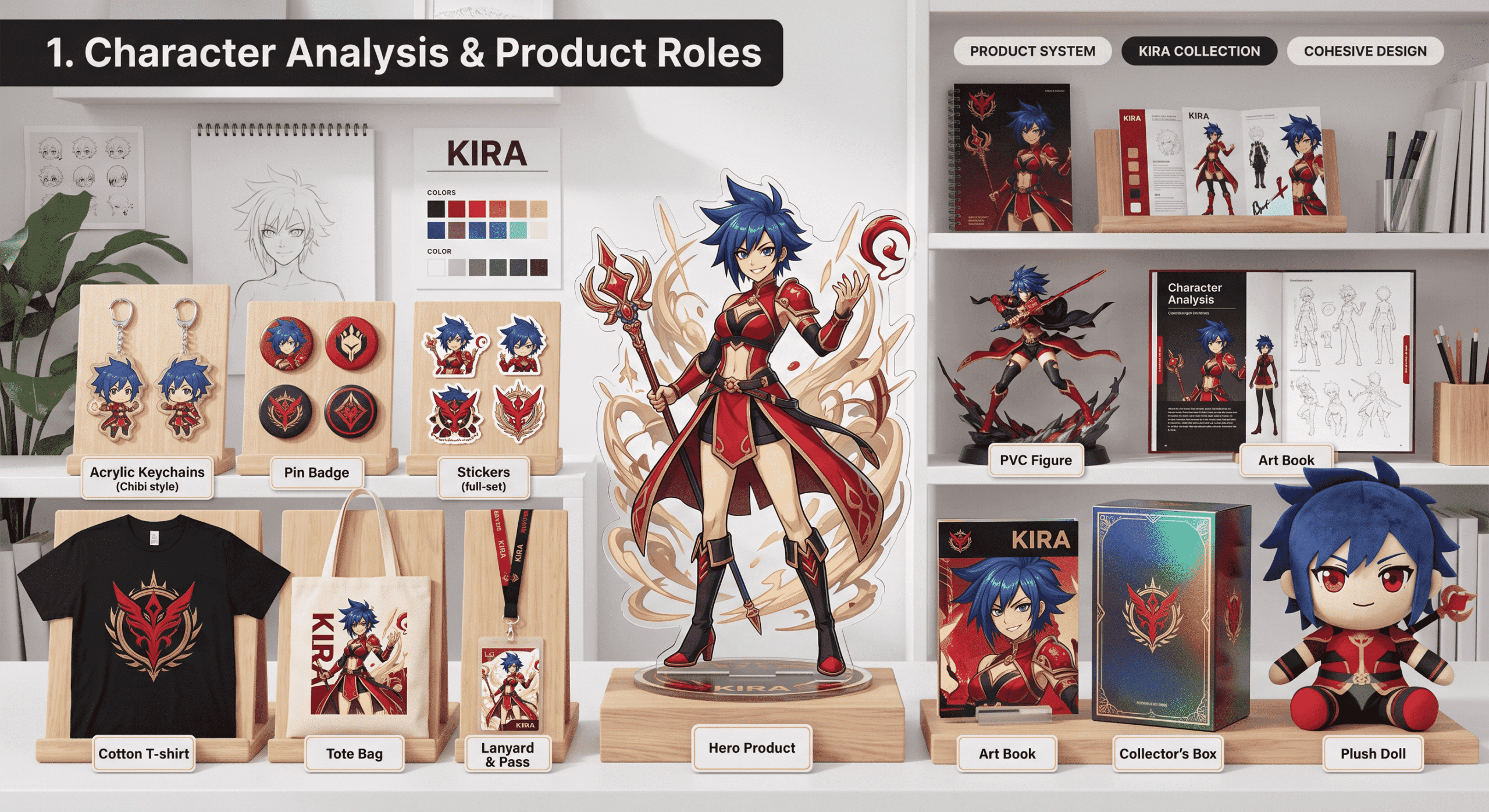
Before choosing your products, analyze the character’s visual recognition, available poses, and design details. A character with several strong artwork variations gives you room for strategic SKU expansion. To avoid a repetitive collection, assign every SKU a specific commercial role:

  • Hero Product: The core item that visually represents the character, such as a premium acrylic standee that gives the artwork a strong physical presence.

  • Entry Product: Lower-priced items (e.g., acrylic keychains, stickers, pin badges) that lower the barrier to purchase.

  • Supporting Product: Lifestyle items like tote bags, photocard holders, or T-shirts that give fans more ways to engage with the character daily.

  • Premium Product: High-value items for collectors, such as large-scale standees, multi-character sets, or limited-edition packaging.
 

2. Building Your Product & Price Ladder

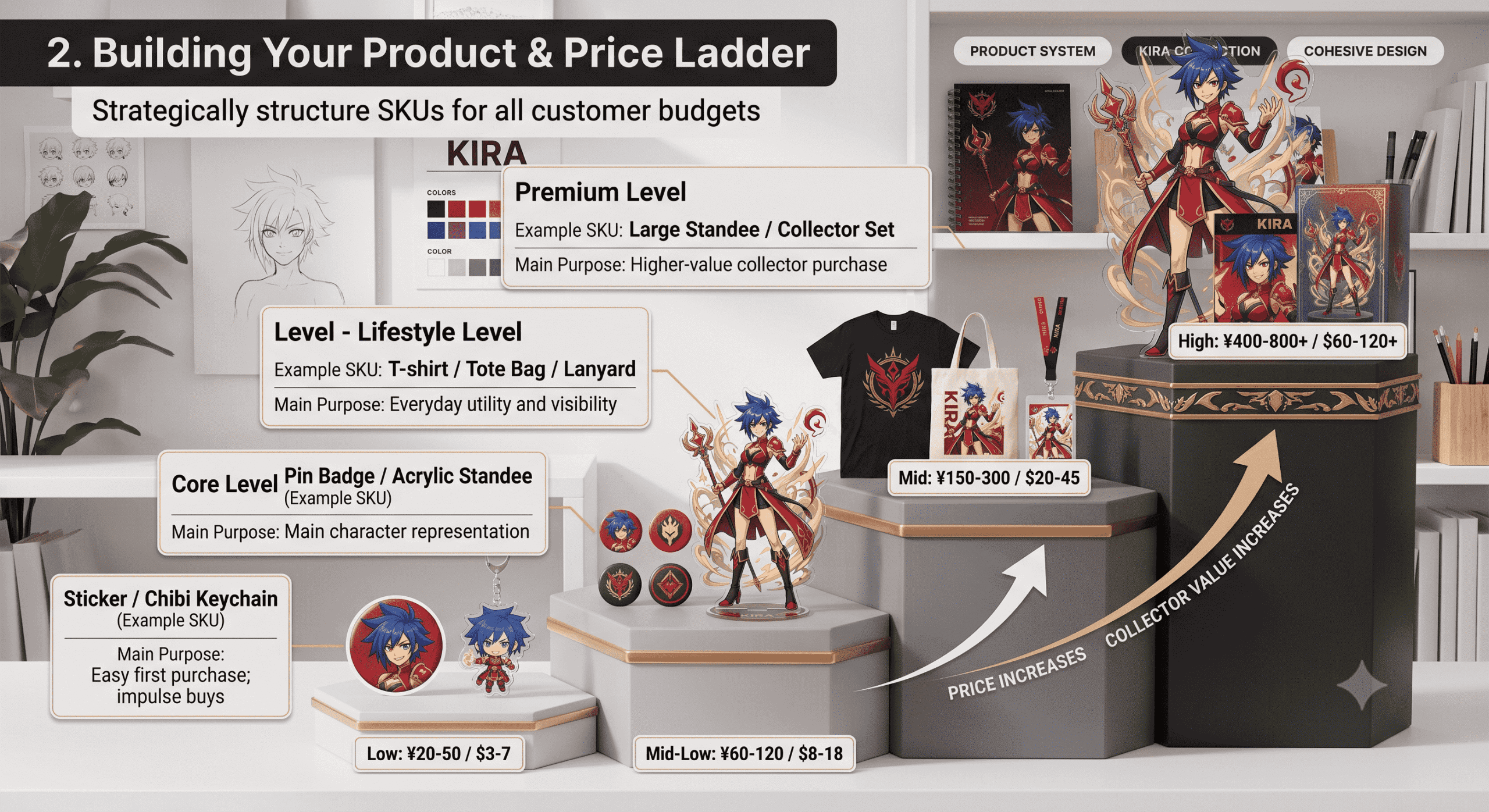
A successful merchandise line should not rely on a single selling price. By structuring your SKUs into a product ladder, you empower retailers to serve customers with varying budgets. A casual fan can start with a low-cost item, while a dedicated collector can purchase a comprehensive set.

Product Level Example SKU Main Purpose
Entry Level Sticker / Chibi Keychain Easy first purchase; impulse buys
Core Level Pin Badge / Acrylic Standee Main character representation
Lifestyle Level T-shirt / Tote Bag / Lanyard Everyday utility and visibility
Premium Level Large Standee / Collector Set Higher-value collector purchase

For example, you might use a chibi design for the entry-level keychain, a full-body illustration for the core acrylic standee, and a simplified character symbol for the pin badge. This ensures the character supports multiple purchasing behaviors without forcing every product into the same category.
3. Artwork Strategy & SKU Lifecycle

One of the biggest mistakes in character merchandise development is simply printing identical artwork across every format. Different products require different visual treatments. A large standee needs a strong visual presence—perhaps enhanced with double-sided sandwich printing or diamond edge polishing for a premium feel—while a small keychain requires clear shapes that remain recognizable at a scaled-down size.

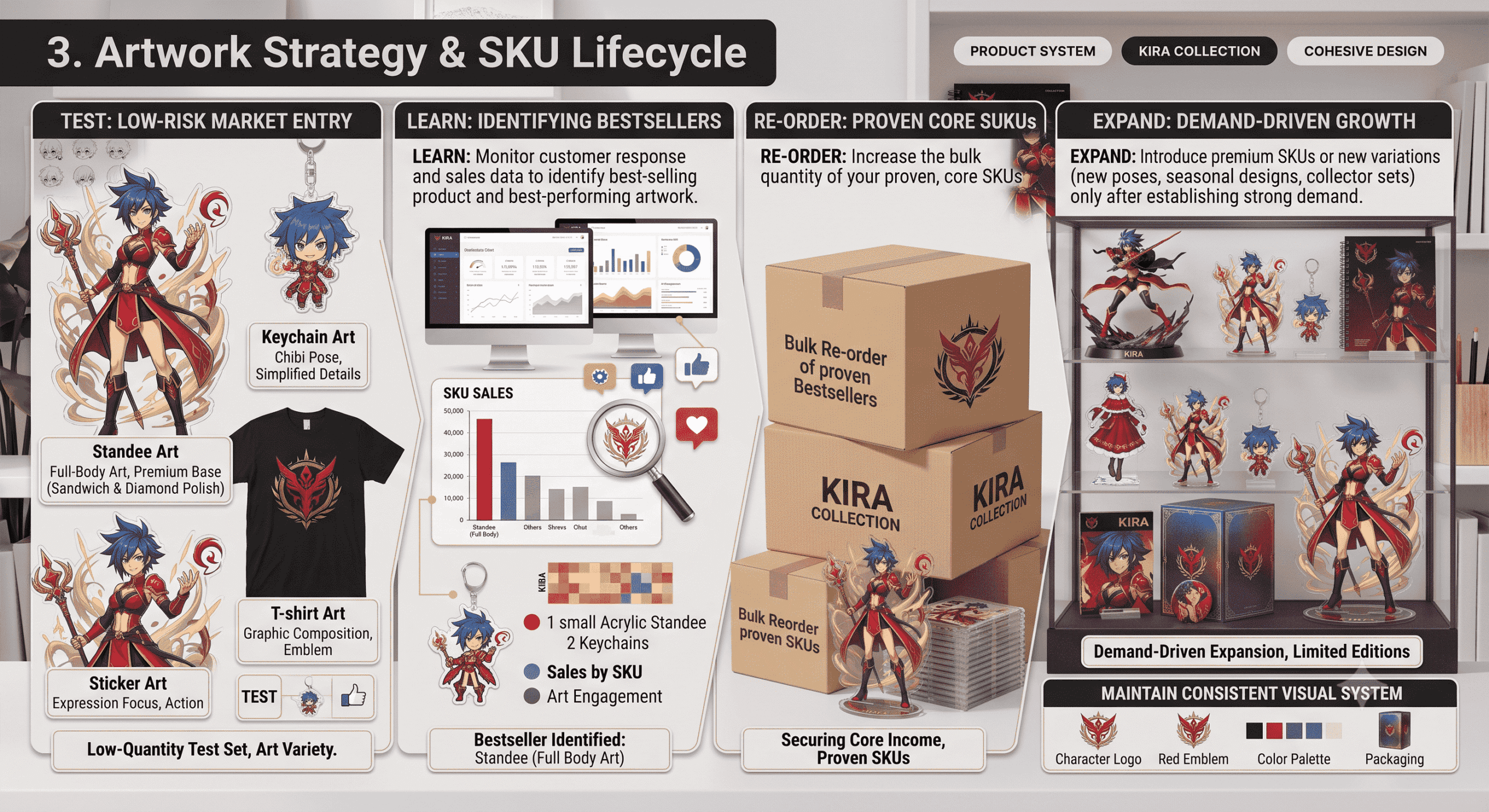
To manage inventory risk when launching a new character, avoid creating too many SKUs at once. Instead, utilize a Core + Test + Premium development cycle:

  • Test: Launch 1 hero product and 2–3 supporting products (e.g., one standee, one keychain, one sticker). Keep these experimental SKUs at a controlled quantity.

  • Learn: Monitor customer response and sales data to identify the best-selling product and best-performing artwork.

  • Re-order: Increase the bulk quantity of your proven, core SKUs.

  • Expand: Introduce premium SKUs or new variations (new poses, seasonal designs, collector sets) only after establishing strong demand.

Maintain a consistent visual system throughout this lifecycle. Ensure your character logo, color direction, packaging style, and backing cards share the same identity, making it easier for retailers to create high-impact displays.
4. Manufacturing & Bulk Order Strategy

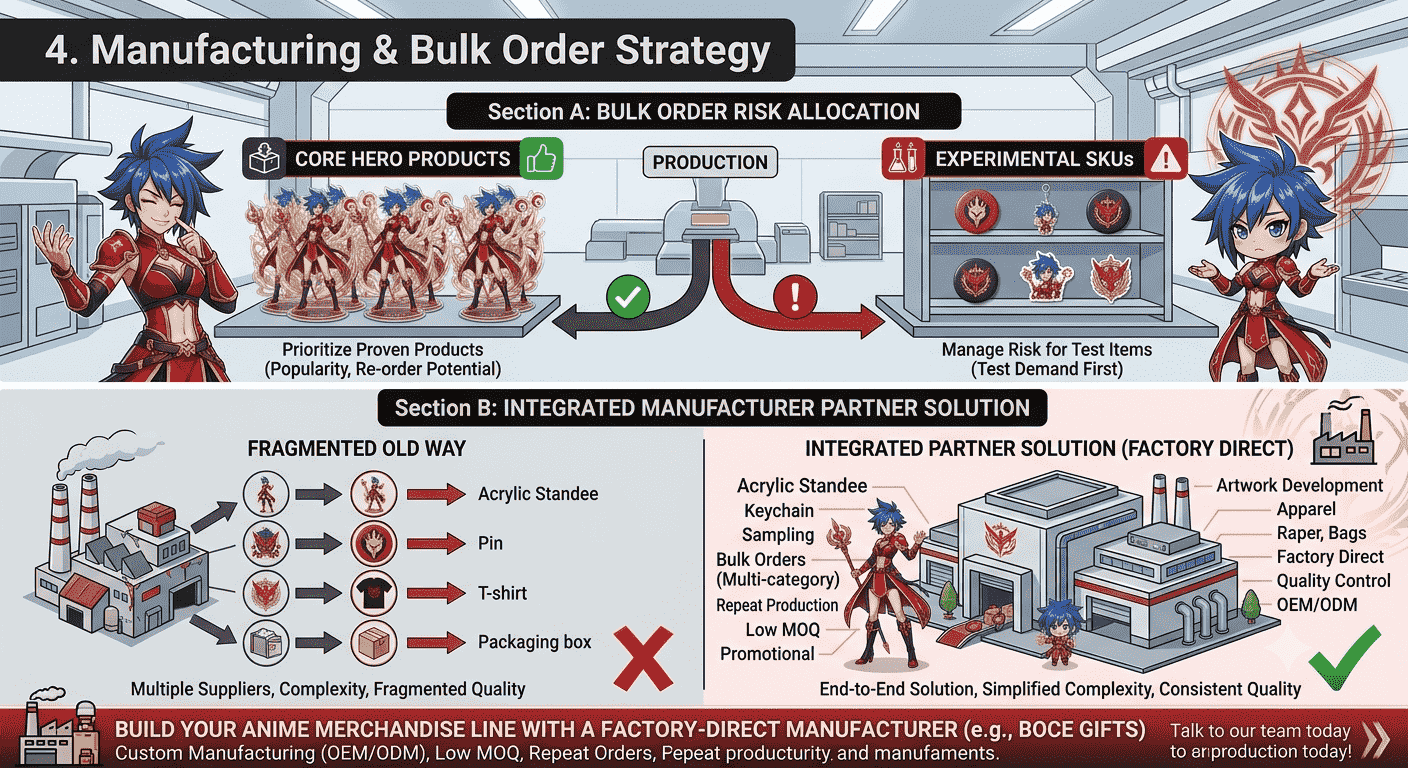
When planning your first bulk order, the primary focus should not just be finding the lowest wholesale price, but deciding which SKUs deserve the largest initial investment. Allocate more inventory to your core hero products based on character popularity and expected re-order potential, while keeping experimental SKUs minimal.

As your character collection grows, working with multiple suppliers for acrylics, pins, apparel, and packaging creates unnecessary complexity. Choose a custom manufacturing partner that can support your entire product line from the first sample to large-scale repeat production.

Build Your Anime Merchandise Line With a Factory-Direct Manufacturer At BOCE GIFTS, we support B2B buyers and retailers with custom anime merchandise manufacturing, from artwork development and sampling to bulk orders and repeat production. Our product range includes premium acrylic standees, keychains, pins, apparel, bags, and custom promotional merchandise.

OEM / ODM | Custom Manufacturing | Low MOQ | Factory Direct | Quality Control | Repeat Orders

Talk to our team today about manufacturing your next character merchandise collection.

Are there any specific internal links to your other WordPress guides that you’d like me to seamlessly embed into this text?
Submit Your Sourcing Request
RELATED POSTS
How to Choose a Custom Acrylic Standee Manufacturer: 7 Questions to Ask Before You Order

How to Choose a Custom Acrylic Standee Manufacturer: 7 Questions to Ask Before You Order Not all acrylic standee manufacturers are the same. Some are real factories with printers, cutting tables and QC staff under one roof; others are trading companies that take your order and hand it to whichever workshop is cheapest that week. On a small order the difference is barely visible. On a wholesale run — where colour consistency, a real lead time and artwork confidentiality start to matter — it is everything. The good news is you do not need to be an expert in acrylic to tell them apart. You just need to ask seven questions. A genuine custom standee supplier will answer all seven clearly and back the answers with evidence; a middleman will get vague on the ones that require owning production. Use this as your checklist before you send a deposit. The 7 questions Ask these before you pay a deposit 1 · Are you the factory? 2 · Can I get a sample? 3 · Is design really free? 4 · What is your QC process? 5 · Which materials & certificates? 6 · How do you protect my IP? 7

Read More >>
Custom Acrylic Standees Wholesale: MOQ, Price Tiers & Lead Time Explained

Custom Acrylic Standees Wholesale: MOQ, Price Tiers & Lead Time Explained If you are sourcing custom acrylic standees wholesale, three numbers decide whether a supplier fits your project: the minimum order quantity, the price per piece at your volume, and the production lead time. Finishes, packaging and artwork can all be adjusted later — but those three have to be clear before you commit a budget or a launch date. At BOCE we manufacture acrylic standees in our own facility and sell wholesale only. So the rules are published rather than negotiated one email at a time: MOQ 50 pieces, four volume price tiers starting at $1.12 per piece, and a 10–15 day production window after artwork approval. Here is exactly how each number works, what is included, and how to get a formal quote. The short answer 50 pcs minimum per order, wholesale only $0.85 from, per piece at 1,000 pcs, stock size 10–15 days production after proof approval Free samples & proof you cover shipping Why the MOQ is 50 pieces An MOQ is not an arbitrary gate. It comes from how acrylic standees are actually made. Every design needs a print setup — colour calibration, cutting paths,

Read More >>
Magnetic Acrylic Display Frames: A Buyer’s Guide for Retail & Events

Magnetic Acrylic Display Frames: A Buyer’s Guide for Retail & Events If you run a retail store, a brand booth, or a pop-up at a convention, you already know that display space is expensive real estate. You want a fixture that looks clean and premium, protects the print, and — most importantly — lets you swap the image when a new campaign drops without paying for the whole unit again. That is the job a magnetic acrylic display frame was built to do. This guide covers what they are, where they earn their place, the four specs to lock before you order, and what to check on a wholesale run. What Is a Magnetic Acrylic Display Frame (and How Is It Different from a Standee?) A magnetic display frame is two clear acrylic plates held together by small embedded magnets. Your printed artwork is sandwiched between the plates: no adhesive, no groove, no glue residue. Press the plates together and the magnets clamp the print flat and visible; pull them apart and you can replace the artwork in seconds. A standard acrylic standee, by contrast, is a single printed piece with a fixed design — when the campaign changes, the

Read More >>

Leave a Reply

Your email address will not be published. Required fields are marked *

Get Started with Boce Today!

Contact us today, and our team will respond promptly. We are always dedicated to meeting your expectations and exceeding them. Fill out the form now!

Get free samples