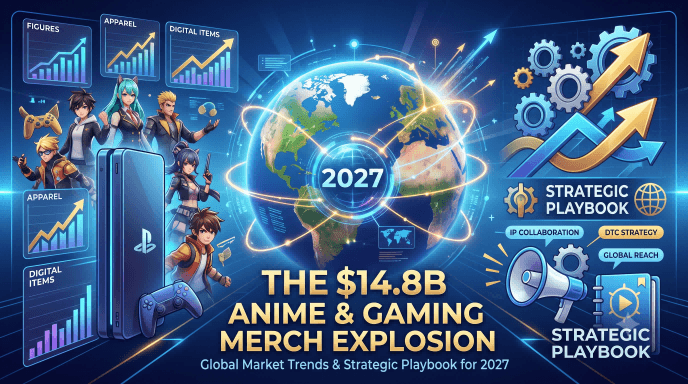
Anime, Comic, and Games (ACG) merchandising has officially left the subcultural fringe behind. Once confined to niche hobby shops in Akihabara, anime merch—often fondly called “Guzi” (谷子) or designer pop-toys—has transformed into one of the most dynamic, high-growth engines driving the global entertainment industry.
Fueled by the worldwide explosion of anime streaming platforms, mature cross-border IP licensing, and Gen Z and Gen Alpha’s appetite for “emotion-driven” consumption, the global market is on a steep upward trajectory.
Let’s dive into the market numbers, consumer psychology, and strategic roadmap shaping the future of ACG merchandising toward 2027.
1. Global Market Size & Regional Breakdown (2025–2027)
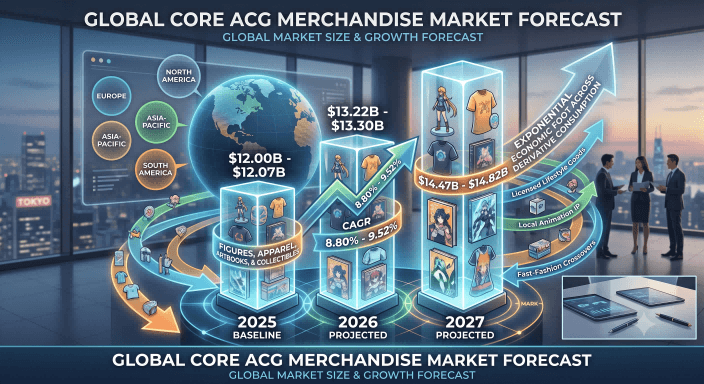
In 2025, the core global (anime/gaming) merchandise market—encompassing figurines, scale models, apparel, badges, acrylic stands, and artbooks—reached a baseline valuation of $12.00B to $12.07B.
Projecting forward at a compound annual growth rate (CAGR of 8.80%–9.52%), the core market is set to hit $13.22B–$13.30B in 2026 and cross the $14.47B–$14.82B mark by 2027.
When factoring in broader, non-core derivative consumption (such as licensed lifestyle goods, local animation IP products, and fast-fashion crossovers), the economic footprint expands exponentially.
Global Market Valuation & Growth Forecasts
| Market Segment / Indicator | 2025 (Base) | 2026 (Est.) | 2027 (Projected) | Long-Term (2033–2034) | CAGR |
| Global Core ACG Merch | $12.00B – $12.07B | $13.22B – $13.30B | $14.47B – $14.82B | $23.90B – $27.35B | 8.80% – 9.52% |
| Global ACG Anime Industry | $35.61B – $37.70B | $39.17B – $41.70B | $43.22B – $45.54B | $70.90B – $77.20B | 9.20% – 10.33% |
| China “Guzi Economy” Market | ¥240.6B RMB | ¥276.69B RMB | ¥309.89B RMB | > ¥400.0B RMB | 12.50% – 15.20% |
| China Broad ACG Merch | ¥652.1B RMB | ¥698.0B RMB | ¥743.25B RMB | ¥834.4B RMB (2029) | 6.30% – 8.10% |
| Japan Character & Licensing | ¥2.8767T JPY | ¥2.9635T JPY | ¥3.0524T JPY | > ¥3.2000T JPY | 3.00% – 3.20% |
Key Regional Dynamics
-
Asia-Pacific (Manufacturing & Consumption Hub): Holds over 65% of the global market share. Japan remains the largest single-nation revenue driver (59% of core market revenue in 2025), evolving toward “experience + social” brand strategies. China is seeing explosive growth; its lightweight, high-frequency “Guzi economy” (badges, acrylic stands) will top ¥300 Billion RMB by 2027.
-
North America (Fastest-Growing High-Value Market): Driven by platforms like Crunchyroll and Netflix, anime has entered mainstream pop culture. Expected to post a regional CAGR exceeding 15%, hitting $3.5B–$3.8B by 2027.
-
Europe & Emerging Markets: Localized dubbing and e-commerce expansion are driving an 11%+ annual growth rate for figurines in Europe. Meanwhile, Southeast Asia, India, and Latin America represent high-potential, volume-driven blue ocean markets.
2. Category Evolution & Consumer Demographics
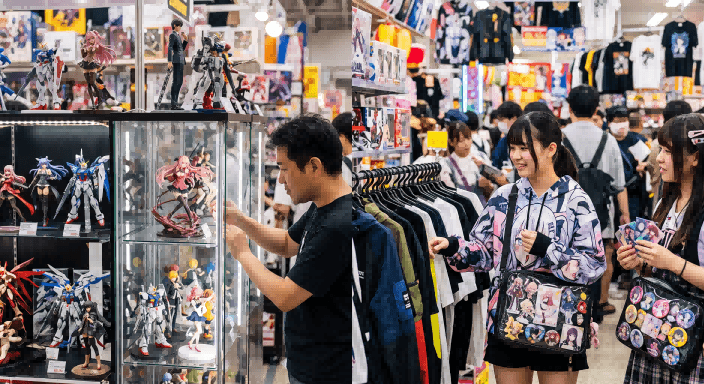
ACG merchandise has split into a dual-track ecosystem: heavyweight collectible items and high-frequency social/display items.
-
Figurines & Scale Models (37% market share in 2025): The largest overall category, projected to reach $5.4B globally by 2027, dominated by high-precision, limited-edition PVC figures.
-
Apparel & Accessories (Fastest Growth, 13.9% CAGR): Anime fashion is moving away from full cosplay and into daily streetwear, tech wear, and fast-fashion collaborations.
-
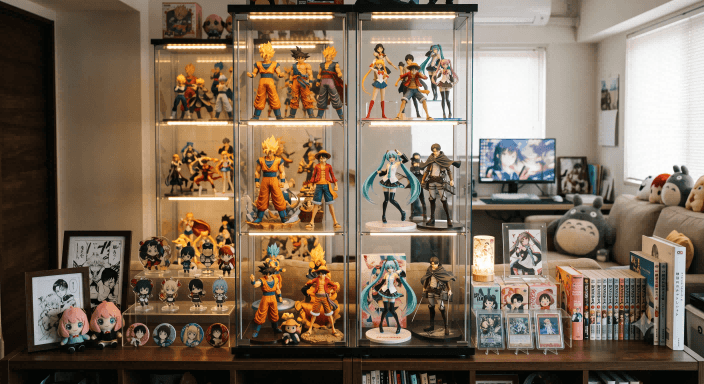
“Guzi” / Micro-Merchandise (High Velocity): Tin badges, acrylic stands, art cards, and “Ita bags” (decorated transparent bags) carry low price tags (<$50) but yield insanely high repeat purchase rates and social viral coefficient.
Target Audience Segmentation Matrix
| Consumer Segment | Age / Demographic | Core Psychology & Buying Behavior | Top Product Categories | Annual Spend Profile |
| Core Collectors | 22–38 yrs; stable income; hard-core gamers/anime fans. | Seeks supreme craftmanship, scarcity, and long-term emotional value. | High-end scale figures, limited statues ($500+ USD). | Extremely High ($5,000+ USD/yr in Japan). |
| Social / Oshi Fans | 14–25 yrs (Gen Z / Gen Alpha); heavy female ratio. | Passion for “Oshi” (fave characters); seeks community identity & social flexing. | “Guzi” (badges, acrylic stands, Ita bags, blind boxes). | High Frequency (Modest per-item, high total repeat spend). |
| Casual / Fashion | 18–32 yrs; mainstream viewers, streetwear enthusiasts. | Impulsive, trend-driven buys; views anime as a cool aesthetic label. | Collab apparel, accessories, desk decor, blind boxes. | Low to Moderate (Occasional seasonal purchases). |
3. The 3 Psychological Drivers Behind the Craze
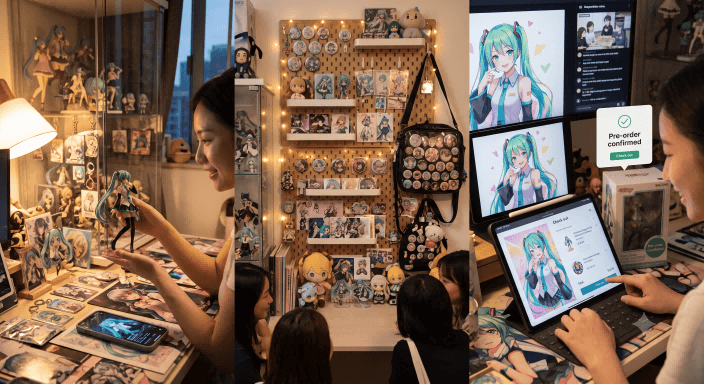
Why are consumers spending thousands on plastic, acrylic, and tin badges? It comes down to three deeply rooted psychological factors:
-
Physical Proof of Emotional Attachment: In a hyper-digitized world, physical merchandise acts as a tangible anchor for virtual relationships formed with characters in games or shows.
-
Emotional Shelter & Social Currency: Merch serves as daily comfort in high-stress environments. Furthermore, displaying rare items via “Ita bags” or desk setups functions as visual social currency within peer communities.
-
The “Oshi-katsu” Revolution: Fans no longer see themselves as passive viewers. Buying merch is viewed as a form of “patronage” or direct support that helps keep their favorite IP and characters alive.
4. The 3 Engines Shaping the Supply Chain
“Success in 2027 requires moving away from traditional shelf-retailing and upgrading to a strategy rooted in emotional connection, flexible manufacturing, and community resonance.”
-
Engine 1: Simultaneous Global Streaming Release: Gone are the days when overseas fans had to wait a year for merch imports. Today, streaming platforms allow IP owners to launch physical merch globally the exact minute an episode airs.
-
Engine 2: DTC & Experiential Retail: While online DTC platforms account for over 53% of sales (growing at 14.6% CAGR), offline channels are transforming into immersive pop-up stores, character cafes, and convention hubs.
-
Engine 3: AI & 3D Printing Production: Modern flexible supply chains, AI-assisted visual design, and high-precision 3D printing have cut sample prototype cycles from months down to days, enabling ultra-fast responses to viral trends.
5. Strategic Playbook for Brands & Retailers
To capture a slice of this $14.8 Billion pie by 2027, businesses should execute across three clear tiers:
                      / \
                     /   \     TOP TIER: High-End Collectibles ($500+)
                    /  *  \    - Craftsmanship, Scarcity, Pre-order model
                   /-------\
                  /         \  MID TIER: Lifestyle & Fashion ($50 - $500)
                 /    *      \ - Streetwear collabs, poseable figures, desk aesthetics
                /-------------\
               /               \ BASE TIER: Mass Social "Guzi" (<$50)
              /       *         \- Badges, acrylic stands, blind boxes, high velocity
             /-------------------\
1. Product & Pricing Tiering
-
Top Tier (Collectibles, >$500): Focus on 1/4 and 1/6 scale statues, numbered limited editions, and high-end craftsmanship. Operate on a strict pre-order model to eliminate inventory risk.
-
Mid Tier (Lifestyle/Fashion, $50–$500): Focus on poseable figures (Nendoroid/Figma), tech accessories, and streetwear collabs that integrate anime seamlessly into daily life.
-
Base Tier (Social “Guzi”, <$50): Fast-moving, collectible badges, blind boxes, and acrylic stands. Leverage blind-box mechanics and frequent product drops to maximize repeat purchases.
2. Regional Expansion Blueprint
-
North America: Heavy emphasis on streetwear/apparel collabs, premium scale figures, DTC online stores, and major convention presences (e.g., Anime Expo).
-
East Asia (China & Japan): Rapid-response local supply chains, ultra-frequent “Guzi” drops, pop-up cafes, and dense brick-and-mortar retail in key shopping districts.
-
Emerging Markets (SEA, LatAm, India): High-volume, entry-level priced merchandise (keychains, stationery) paired with official regional e-commerce stores (Shopee, Lazada) to combat piracy.
2027 Execution Roadmap
-
Short-Term (0–12 Months): Build a rapid-response supply chain using 3D prototyping. Secure fast-turnaround licensing deals with hot seasonal streaming anime.
-
Mid-Term (12–24 Months): Establish a global DTC platform and rollout a three-tiered pricing matrix. Launch experiential pop-up shops in top metro hubs across Asia and North America.
-
Long-Term (24–36 Months): Integrate DTC consumer data upstream to co-create IP derivatives early in production. Partner with global fast-fashion and lifestyle brands to elevate the merchandise from subculture goods to global lifestyle icons.